After my wife’s funeral, I never told my son about the cabin in Tobermory or the $340,000 she left me. Six weeks later, he calmly said, “We’re going to sell your house.” I just smiled, because I’d already moved out. But what he doesn’t know is that I arranged everything through the proper legal process, so it won’t play out the way he thinks.
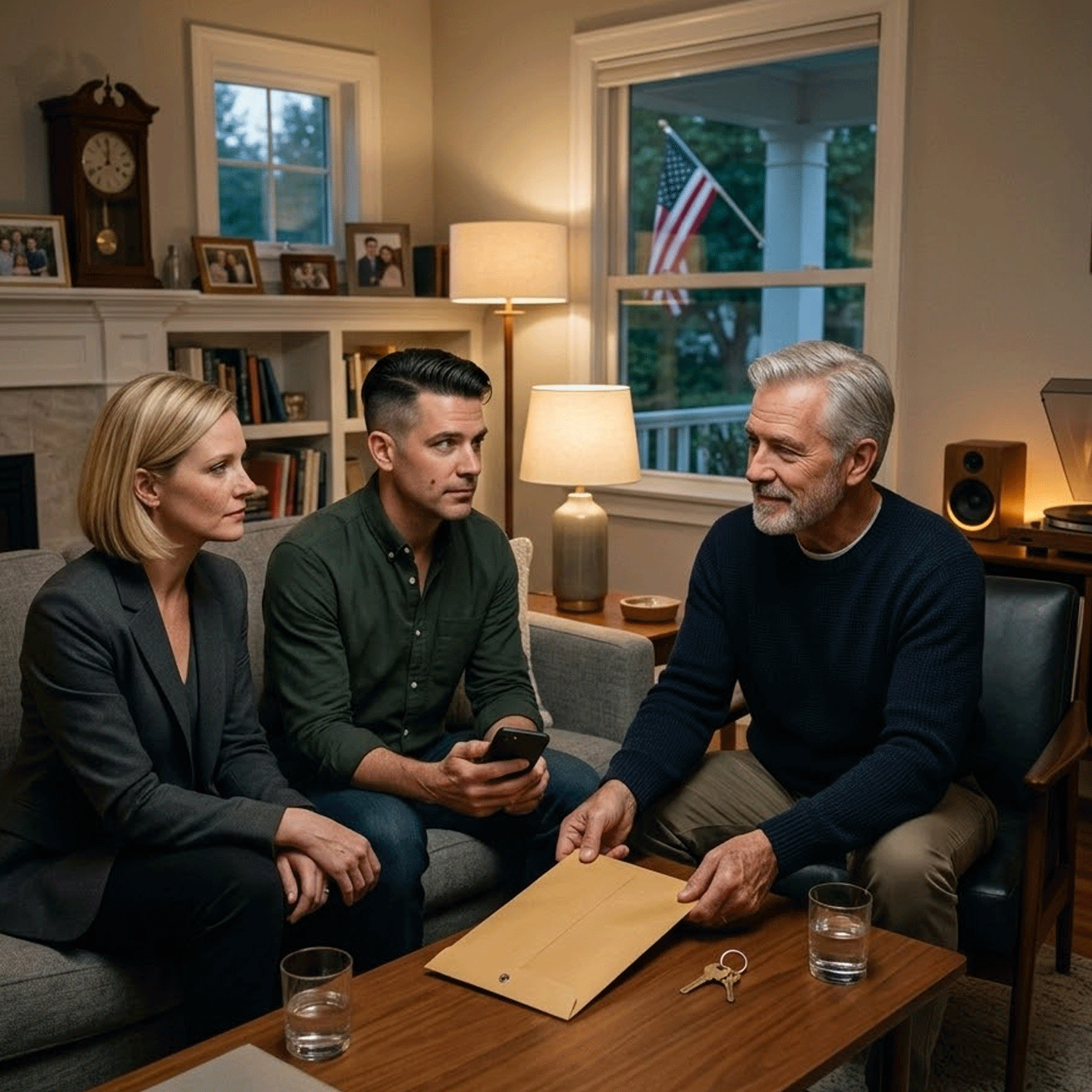
After my wife’s funeral, I never told my son about the cabin in Tobermory or the three hundred and forty thousand dollars she left me. Six weeks later, he said, calm as if he were reading weather off an app, “We’re going to sell your house.” I smiled because I’d already moved out. What he didn’t know, what he couldn’t imagine, was that I had arranged everything through the proper legal process, the slow, boring machinery of signatures and filings, so it wouldn’t play out the way he thought.
The day we buried her, the sky was the color of tin and the wind came in off the lake like it had something personal to say. The church was full in the way small-town churches get full when a good woman is gone, every pew a familiar face, coats damp from sleet, hands clasped too tightly. Someone from the American Legion post down the road, where Margaret volunteered with their holiday food drive every December, stood near the back with a folded flag under his arm. It wasn’t a military funeral. Margaret never would have wanted a fuss. But the gesture mattered to him, and to me. I took that folded triangle at the end, held it against my chest, and I remember thinking, absurdly, that it was lighter than I expected. Grief is never light. Cloth is.
She told me once, about three years before she got sick, that she’d found a place up near “Tobber” where she could finally breathe. I didn’t think much of it at the time. Margaret was always talking about getting away from the city, away from the noise, away from all of it. Forty-one years of marriage and I knew her patterns, or at least I believed I did. She said things like that the way some people talk about winning the lottery, a pleasant thought, not a plan. I was wrong about that, and as it turned out I was wrong about a lot of things.
Four days after the funeral I was standing in my own kitchen holding a mug of coffee that had gone cold, listening to my son talk about square footage. The mug was one of mine, chipped at the rim, with a faded Chicago Bears logo on it from the years when I still drove down across the border for games with my brother Frank and came back hoarse and happy, wearing the same navy sweatshirt until Margaret threatened to throw it out. It felt ridiculous, that little detail in my hand, the kind of detail that stays when something bigger is gone.
Derek had his phone out and he was showing his wife something on the screen, and neither of them was looking at me. The funeral was four days ago. My wife of forty-one years. Four days.
Between the funeral and that morning in the kitchen, the house had become a revolving door of casseroles, condolence cards, and people asking if I was “holding up.” I nodded until my neck ached. I thanked people until the words stopped meaning anything. At night, when the last visitor left and the dishes were rinsed and stacked, I walked from room to room the way you do in a house after the power goes out, touching the back of a chair, the edge of a counter, as if I could locate her by feel. Her coat was still on the hook by the garage door because I couldn’t bring myself to move it. The pocket still held a crumpled receipt from the grocery store and a lip balm she never finished. Ordinary things, stubbornly ordinary, while my whole life was not.
“The detached garage alone adds significant value,” Derek was saying, as if he were giving a presentation at work. “And the lot is oversized for this neighborhood. If we list in spring, we’re looking at strong numbers.”
He said “we” like the word belonged to him.
Pamela leaned in toward the phone, her manicured finger scrolling. She made a small sound of approval, the kind you make when you see a sale tag. I watched the two of them in the kitchen Margaret had remodeled with her own hands twelve years earlier, watched Pamela’s coat sleeve brush the cabinet door that still had a faint scratch from the time Derek was eight and tried to ride his skateboard inside. The room smelled like flowers that were already dying in a vase by the sink. Sympathy bouquets. You don’t know what to do with them after.
I set the mug down very carefully, like if I put it down too hard something in me would break. Derek finally looked up, not quite meeting my eyes.
“Dad, we’ve been over this. The house is too big for one person. It’s a lot of upkeep.”
I let him talk. The words were familiar already, as if he’d been rehearsing them on the drive over. Derek has always been a rehearsed person. Even as a boy, when he’d come to me to ask for something, he’d do it like he was making a case.
“I’ve been managing this house for twenty-seven years,” he added. “You were managing it with Mom.”
He said it like that settled the matter. Like Margaret’s absence had automatically transferred some authority over to him, like grief came with paperwork that made him the new decision-maker.
Derek has always had a talent for stepping into the empty space and calling it responsibility. When he was twelve and Margaret went back to work after a summer break, he started “organizing” the pantry, stacking cans by expiration date and then announcing that we were out of peanut butter because the jar wasn’t where he thought it belonged. He meant it as help. He also meant it as control. Margaret used to smooth it over, laugh softly, redirect him. “He likes order,” she’d say, as if order were a harmless hobby and not a way of pushing other people out of their own lives.
Pamela was already walking through to the living room, her heels clicking on the hardwood floors Margaret had refinished herself. I could still see Margaret there, sleeves rolled up, hair tied back, paint on her wrist, humming under her breath. Pamela had a notepad now. She was writing things down. I couldn’t see what, but I didn’t have to guess.
I didn’t say anything else that evening. I let them finish their coffee. I walked them to the door. I stood on the porch in the November cold long after their car disappeared around the corner, my hands shoved into the pockets of my coat because I didn’t know what else to do with them.
The maple in the front yard had already dropped its leaves. Margaret planted that maple twenty-three years ago when it was barely a sapling. Back then we were still young enough to believe time moved slowly. I used to tease her that we’d never live to see it reach the eaves. It was well past the eaves now, thick trunk, strong branches, the kind of tree that looks like it’s always been there. The street was quiet in that suburban way that used to feel like safety. Someone had put a small American flag in our flower bed after the funeral, a neighbor who knew I’d been born in Michigan and never quite stopped sounding like it, even after decades in Ontario. The flag leaned a little to one side. I couldn’t bring myself to straighten it.
Being American in Canada is mostly a matter of paperwork and nostalgia, until it isn’t. I kept my U.S. passport in the same drawer as my Canadian health card. I paid taxes in both places some years when contracts took me back over the line. Margaret used to joke that our marriage license should have come with a customs stamp. We watched the Super Bowl every February and still called it “down home” when we drove to visit my cousins in Michigan. Margaret was the one who made sure Derek knew the words to both anthems, not because she cared about politics, but because she believed in knowing where you come from.
I went inside and washed the mugs and went to bed in a room that still held her scent in the closet, a soft detergent smell and the faintest trace of the lavender hand cream she’d used at night. I lay there staring at the ceiling fan, watching it move air it didn’t need to move, and I tried to understand how four days could feel like a lifetime and also like nothing at all.
Her name was Margaret Anne Kowalski. She was sixty-three years old when she died. She was the most quietly capable person I have ever known.
We met in 1982 at a mutual friend’s dinner party in Kitchener, in the kind of beige-carpeted apartment where everyone brought a dish and the host apologized for the lack of seating. I was working as a site supervisor for a construction company then, the kind of job that put you in steel-toe boots at sunrise and made you smell like sawdust even after you showered. Margaret was teaching fourth grade at the local public school. She had dark hair and a way of listening that made you feel like what you were saying actually mattered, even if you were just talking about nothing.
There wasn’t really dancing happening at that party, not the way you think of dancing, but someone put on a record and the room shifted, that old soft edge people get when they’ve had two drinks and it’s late enough to be honest. I asked her to dance anyway. She said yes anyway. Later I would realize that “anyway” was one of her great strengths, a willingness to step forward even when the moment wasn’t perfect.
We built everything together. The house in Oakville. The savings. The life. We built it the way you build anything solid: one payment at a time, one decision at a time, a long series of ordinary days. We had Derek in 1986. My brother Frank’s boy, Owen, was born in 1989 and grew up in and out of our house after Frank passed. Frank died young, one of those heart attacks that comes out of nowhere and changes the shape of a family overnight. Margaret treated Owen like he was hers. She packed his lunches when his mother worked nights. She drove him to hockey practice. She sat in cold arenas with a thermos and a blanket and cheered like it mattered because to him it did.
Derek, our own son, moved to Calgary in 2014 with Pamela, chasing a job and a bigger salary and a life he thought was waiting for him out west. They came back for holidays. They called on birthdays. I know they loved their mother in the way people love things from a distance, warmly and sincerely but without the daily weight of it.
When Margaret got her diagnosis in 2021, they started calling more. When she declined faster than any of us expected, they started visiting more. When she could still walk, Pamela would take her to get her nails done and come back talking about “making memories,” as if memories were something you could buy if you got there in time. When Margaret started sleeping most of the day, Derek would sit at the edge of the bed and talk about work while she listened with her eyes closed. He meant well, I think. Or he meant something like well.
After she passed, they stayed.
They took over the guest room and made it theirs within a day. Pamela hung her clothes in Margaret’s spare closet without asking. Derek moved my mail into a neat pile on the counter like he was sorting evidence. They spoke in low voices in the evenings, the kind of voices people use when they’re talking about you and don’t want you to join in. I told myself it was grief. I told myself I was being paranoid. Paranoia is what men call it when their instincts are trying to keep up.
That last part is where it started to go wrong.
In the week after the funeral, Pamela asked me if I had spoken to a financial adviser lately. It was a sunny morning, cold but bright, and she said it in the same tone she might have used to ask if I’d tried a new restaurant.
“I haven’t seen the need,” I told her.
She nodded slowly, the way you nod at someone who has just said something you find concerning, someone who doesn’t know they’re behind the times. Margaret used to make that face at Derek when he was fifteen and insisted he didn’t need to study for a test.
That same week, Derek asked me if I had considered simplifying, his word, my arrangements.
“Simplifying,” he said, sitting at my kitchen table like he owned the chair.
I was sixty-seven years old, retired from construction management for four years, perfectly healthy, living in a paid-off four-bedroom house in Oakville. I didn’t know what there was to simplify. I learned quickly enough.
Ten days after the funeral Derek sat me down and explained, with charts on his phone, that the house represented an underperforming asset. He said that for a man my age living alone, maintaining a property that size was a liability. He said there were beautiful communities. He said communities for active seniors where I would have everything I needed in one place and people my own age to spend time with. He mentioned one called Lake View Pines, which he had apparently already researched, and he showed me photos of the lobby like a lobby was supposed to replace a life.
I looked at the photos. I looked at my son.
“I’m not moving to a retirement community,” I said.
“Dad,” he replied, and he sounded tired already, like he’d been dealing with me for months instead of days. “It’s not like that. I just want you safe. You just lost Mom.”
“I’m sixty-seven,” I said. “I just lost your mother. I’m not moving anywhere.”
He let it go for about a week, which is how Derek has always negotiated. He backs off long enough that you think the conversation is over, and then he comes back in from a different angle.
Pamela came by on a Thursday when Derek was at a work meeting. She brought a casserole, which I appreciated, and then she asked if she could look at the upstairs bathroom because she’d noticed the grout looked like it might be going.
“Sure,” I said. “Go ahead.”
It seemed normal, even kind. I sat at the table with my coffee, still drinking it out of habit, though habit had no mercy those days. I heard her moving upstairs, opening drawers, closing them, the faint tap of her heels on the landing.
I found out later from Owen, who had a habit of being around without anyone noticing, a useful quality Pamela never accounted for, that she took photographs. Not just of the bathroom. Of the master bedroom closet. Of the furnace room. Of the backyard.
Owen had seen her on the back deck with her phone, turning slowly, like she was doing a virtual tour.
When I asked Pamela about it, she smiled like I was being silly.
“I’m just trying to help you understand what deferred maintenance might look like to a future buyer,” she said.
She used the phrase “future buyer” so naturally that I understood it had been in her vocabulary for some time, maybe longer than Margaret’s illness, maybe longer than Margaret herself. I didn’t say that part out loud. I just nodded and started paying closer attention.
Margaret and I had a joint account, which made sense for forty-one years and made me vulnerable now. Derek’s name was also on the account as a secondary holder. We’d added him years ago after Margaret’s first health scare, when the doctors thought it might be her heart and we wanted to make sure Derek could help manage bills if anything happened. We were practical people. We believed in contingencies. We didn’t believe our contingency would become the threat.
The something happened, but not what we’d expected and not then. The access remained.
I noticed the first transfer in December, a month of gray skies and early darkness. Three thousand dollars moved from our joint account to an account I didn’t recognize. At first I thought it was a billing mistake, something set up by accident, a paperless autopay I’d forgotten about in the fog of everything. Grief does that. It makes you doubt your own memory, your own competence. It makes you apologize to people for asking questions that should be obvious.
I called the bank. The woman on the line had a warm voice and a script and she kept saying “I’m sorry for your loss,” like she was pressing a button.
The transaction, she told me, had been authorized online from an IP address registered in Calgary. Derek’s address.
I started checking the account the way I used to check a job site at the end of the day, walking it, looking for what didn’t belong. I printed statements and laid them on the table. I circled amounts with a pen. My hands shook the first time, then steadied. That steadiness frightened me more than the shaking. It meant a part of me had moved from mourning into assessment.
When the bank representative told me the transfer was authorized from Calgary, she offered to open an investigation. Her voice softened, like she was speaking to a child.
“Sometimes family members help with finances during a difficult time,” she said.
“Sometimes,” I agreed. “And sometimes they help themselves.”
There was a pause, and then the script returned. “Would you like me to put a note on the account that you’re requesting additional verification for future online transfers?”
“Yes,” I said. “And I’d like a printed record of every online login for the last ninety days.”
She hesitated. “We can provide access logs, sir, but it may take some time.”
“Take whatever it takes,” I said, and for the first time since Margaret died I heard my own voice with a hard edge in it. The woman went quiet, then said she’d file the request.
I sat very still at my kitchen table for a long time. Outside, the streetlight came on, casting a pale glow across the snowbanks. The house felt too big, not because of the square footage, but because of the silence.
Then I called Owen. Owen was twenty-nine years old, working as a paralegal in Hamilton, a solid and steady young man who would have made Frank proud. Frank would have loved the way Owen handled himself, the way he asked a question and listened to the answer all the way through. Frank would have hated what Derek was doing, and that thought, that imagined anger, was like a small flame in me.
I told Owen what I’d found.
Owen went quiet in the way he does when he’s thinking hard. I could hear his breathing on the line, the faint hum of traffic, the kind of sound that tells you someone is pulled over somewhere, taking you seriously.
Then he said, “How long do you want to wait before you do something?”
“Long enough to know how much,” I said.
Over the next six weeks I tracked it carefully. Small amounts at irregular intervals, always from the joint account, always moved out in a way that felt practiced. Two thousand here. Fifteen hundred there. A five-thousand-dollar transfer on a Friday afternoon, timed like someone hoped I wouldn’t notice until Monday.
By mid-January, it had reached sixty-seven thousand.
He was methodical about it, which told me he’d thought it through. Derek wasn’t panicking. Derek was planning.
There was also a conversation I overheard. I wasn’t hiding. I was in the hallway, coming back in from the porch with the mail. They simply didn’t hear me, the way you don’t hear furniture.
Pamela was on the phone, her voice low and confident.
“Once the house lists,” she said, “the timeline takes care of itself.”
She didn’t specify a timeline for what, and that was the point. She didn’t have to. The words landed in me like a weight.
I called my lawyer on a Tuesday morning.
Her name is Barbara Finch. I have worked with her since 2003, back when I was still running jobs and needed someone who could read contracts the way I read blueprints. Barbara is not a warm woman, but she is exceptionally thorough. Warmth can be comforting. Thoroughness keeps you alive.
I told her everything. I didn’t dramatize it. I didn’t have the energy for drama. I gave dates, amounts, the names on the accounts, what I’d overheard, what Pamela had been photographing. Barbara listened without interrupting, which is one of the things I value about her. When I finished, there was a brief pause on the line, the sound of her turning a page.
Then she said, “Harold, I think it’s time you told me about the property your wife registered in her name in 2019.”
I was quiet for a moment.
“Margaret told you about that?” I asked.
“Margaret updated her estate planning with me in March of last year,” Barbara said. “She was quite clear about what she wanted. I assumed you knew the specifics.”
I did and I didn’t.
Margaret had mentioned the property to me, the place near Tobermory, up on the Bruce Peninsula, the kind of rugged shoreline she loved, all rock and pine and cold, clear water. She said she found it on her own using money from a small inheritance she received when her aunt passed in 2018.
That inheritance had been small by the standards of real estate, but it was the kind of money Margaret treated with reverence because it carried a person’s name inside it. Her Aunt Lillian had been the one who taught her to sew a button properly, the one who slipped her twenty-dollar bills in birthday cards even when she was grown. When Lillian died, Margaret sat at the table with the check in her hand and said, very quietly, “I want to do something that lasts.”
I thought she meant new windows for the house, or paying off the last of the mortgage early. Practical things. I kissed her forehead and said, “Whatever you want, honey.” Then I went back to whatever I was doing, confident that “whatever” would include me in the details. Margaret didn’t fight for attention. She simply used the space people didn’t notice and built something in it.
She’d mentioned it the way she mentioned many things she’d done quietly and competently while I was looking elsewhere.
“I found something,” she’d said one evening, almost offhand, folding laundry. “Something for later.”
I hadn’t asked enough questions. I thought “later” meant something vague, a someday that belonged to both of us. I didn’t understand. She meant specifically this.
Barbara explained it to me the way you explain something to a man who’s been building houses his whole life and still doesn’t realize what’s been built behind his back.
The property was a three-bedroom cedar log house on four acres of forested land, eight minutes from the harbor in Tobermory, with a wood stove and a well and a screened porch facing north toward Georgian Bay. Margaret bought it outright in September 2019 for three hundred and forty thousand dollars cash, money from her inheritance plus savings she accumulated quietly in an account I didn’t know the full details of. She registered it solely in her name. In her estate, it passed solely to me.
Derek was not mentioned.
Barbara had helped Margaret draft everything. The will was airtight. The beneficiary designations on Margaret’s life insurance, substantial because I insisted on it when we were young and she agreed to maintain it, had been updated in March of the previous year. They named me as primary and Owen as secondary. Derek was not named.
Margaret had known something. Not necessarily everything, not the scale of it, but something about the direction of things. She’d known her son well enough to plan around him.
I sat with that for a long time after I hung up with Barbara. I still sit with it sometimes, even now. It is one of the great acts of love I have ever been on the receiving end of, and I was not even aware it was happening. I thought I knew my wife because we shared a bed and a bank account and a calendar. I didn’t fully understand that a person can love you and still keep a corner of their strength private, the way you keep a spare key hidden for a day you hope never comes.
I did not tell Derek about any of this.
Not then.
What I did was stand at my kitchen window and look out at the bare maple branches against the winter sky and realize, with a clarity that surprised me, that grief was not going to be the thing that finished me. Grief was heavy, yes. Grief was constant. But betrayal had a sharper edge, and it made me pay attention.
The next day I drove to Barbara’s office and sat in her waiting room beneath a framed print of a lighthouse. The receptionist offered me water. I declined. My mouth was too dry for water to help.
Barbara walked me through what the law could do and what it couldn’t, what could be proved and what could be implied, what would make a judge tired and what would make a judge angry. She did it the way she does everything: without sentiment, without cruelty, just the facts laid out like tools.
“We can address the transfers,” she said. “But first we need to secure you.”
“Secure me,” I repeated, and it sounded like something you’d say about a building in a storm.
Barbara looked at me over her glasses. “Harold, you’re not the first widower to discover that grief makes other people bold. Let’s make sure your foundations hold.”
On my way home I stopped at a hardware store, not because I needed anything, but because walking through aisles of familiar things, nails, hinges, levels, lumber, calmed me. It reminded me that most problems had a physical solution. You measure, you cut, you fasten, you check it twice. You don’t leave gaps.
At the end of one aisle was a display of small American flags, the kind people stick in planters for Memorial Day. I picked one up and set it back down. I wasn’t in the mood for symbols. I needed something more solid than cloth.
That night Derek and Pamela ate dinner at my table, talking about “timing” and “market conditions” like they were discussing the weather. I nodded in the right places. I let them believe I was tired and overwhelmed, because that is what they expected from me, and there is a strange power in letting someone underestimate you. When Pamela asked if I was thinking about Lake View Pines again, I said, “I’m thinking about everything,” and I meant it.
Later, in the quiet of the house, I opened Margaret’s old desk drawer where she kept documents. She had always been the organized one, the one who filed and labeled and tucked away what mattered. In the back, behind the insurance papers and the warranty for the dishwasher, I found a manila envelope with her handwriting on it.
HAROLD.
Inside were copies of deeds and a letter from Barbara and a set of keys on a plain metal ring.
The paper in that envelope had Margaret’s particular neatness, corners squared, staples aligned. Even dying, she had been a woman who believed in clean lines. I could see her at the dining room table in the months before she went downhill, glasses on the bridge of her nose, pen in hand, pausing to rest when the fatigue hit, then continuing anyway. She never told me she was doing it. She never needed applause. She needed certainty. She needed me protected in a way my own pride might have argued with if she’d asked permission.
There was also a small folded map, the kind you used to get at gas stations, with a circle drawn in pen around a spot on the Bruce Peninsula.
I sat there with the keys in my palm and felt something in my chest loosen, just a fraction. It wasn’t relief exactly. It was recognition. My wife had been planning for me to survive this, not just her death, but whatever came after.
In the early hours of the morning, when sleep wouldn’t come, I stood in the hallway and listened to Derek and Pamela breathing in the guest room and I thought about all the years I had worked with crews, watching who showed up when the job got hard, watching who disappeared, watching who cut corners when no one was looking. I had spent my life building things that had to stand. I could not pretend I didn’t know what a cut corner looked like when I saw it in my own family.
By the end of that week I knew two things.
First: I was going to Tobermory.
Second: I was not going to ask permission.
I went to Tobermory on a Tuesday in early January, a day when the highway looked like it had been sketched in graphite and then erased halfway through. The sky hung low. Snow had fallen the night before, not enough to make the roads impassable, just enough to blur the edges of everything and make the world feel muffled, like it was holding its breath. I packed the car the way I used to pack for long job sites, quietly and in stages, as if routine could keep my hands steady.
I didn’t take much that first trip. A duffel bag with clothes. My toiletry kit. A binder of documents Barbara told me not to let out of my sight. Margaret’s cedar box of letters, the one she kept on her dresser like it was an heirloom, because in a way it was. I tucked it into a tote bag and set it on the passenger seat like a person. In the cup holder I placed a travel mug of coffee I didn’t taste.
Before I pulled out of the driveway I stood for a minute and looked back at the house, the dark windows, the familiar outline of the roofline, the maple tree bare against the winter. I thought of all the years we’d lived there, the birthdays and arguments, the nights we stayed up talking in the kitchen, the mornings Margaret made pancakes because Derek had a tournament and she didn’t want him to leave the house hungry. I thought of how quickly a place can turn from home into territory.
Then I drove.
By the time I reached the Bruce Peninsula, the landscape changed in a way you can feel in your bones. Fewer streetlights. More rock. Trees that looked tougher, leaning into the wind like they’d been shaped by it. I passed signs for small towns, names painted on weathered boards, and I felt the strange sensation of moving into a life that had been waiting for me without my knowledge.
The property was down a narrow road that curved through forest. The driveway was unplowed, but I had a shovel in the trunk and I didn’t mind the work. Work, at least, made sense. I shoveled for nearly an hour, the kind of steady, physical effort that clears your head even when nothing else can. When I finally pulled up to the house, it looked exactly like Margaret would have chosen: sturdy cedar logs, the roofline simple, a screened porch facing the water as if the house itself had decided the view mattered.
It was empty, naturally, and cold. When I unlocked the door and stepped inside, the air smelled like wood and winter. The silence was different from the silence back in Oakville. This silence felt honest.
Margaret had left a note tucked into the kitchen window frame, as if she had expected I might arrive alone.
It was three sentences. I won’t write them here. They are mine.
But I will tell you that I sat on the porch for two hours after reading it, coat still on, boots still damp from the snow, staring out at the gray January sky above the treeline, and for the first time in months I understood something I hadn’t been able to put into words.
I was going to be all right.
Not because I was strong in some heroic way. Not because I had a clever plan. Simply because my wife had built a place where I could breathe, and she had trusted that I would show up and use it.
When I drove back to Oakville, I didn’t announce where I’d been. Derek and Pamela were still in the house, moving through rooms with their quiet sense of entitlement, speaking to each other in shorthand. Pamela had put my mail into neat stacks, as if organizing my paper could organize my life.
I played my part. I nodded. I sighed at the right times. When Derek said, “We should probably start thinking about what you want to take with you when you downsize,” I said, “I’ve been thinking about that,” and let him believe my thoughts were aligned with his.
That week I called a locksmith.
I did it on a Wednesday in January while Derek and Pamela were out at lunch with friends in Mississauga, which Owen told me about casually, the way he delivers useful information without drama. I met the locksmith at the house and walked him around, pointing out the front door, the back door, the side entrance to the garage. He worked quickly, a man who had done this a thousand times, the sound of metal and tools echoing in the hallway where Margaret’s photos still hung.
When it was done, he handed me a set of new keys. The old ones, he asked, did I want them back?
“No,” I said.
I watched him drop them into his pocket like they were nothing, and I felt something sharp and clean inside me, like the moment you finally cut a rotten piece of wood out of a frame.
I also contacted the bank, and with Barbara’s help I formally removed Derek’s access to the joint account. The banker asked me twice if I was sure, because people like to believe families are safer than they are.
“I’m sure,” I said.
The remaining funds, less a reserve I kept for current expenses, were transferred to an account in my name only. Barbara documented everything. Dates. Signatures. Correspondence. The kind of paper trail that doesn’t care how charming someone sounds when they insist they were only trying to help.
Then I started packing.
I didn’t pack everything at once. I was methodical. The things that mattered most went first.
Margaret’s photographs, the ones she kept in albums and the ones she framed on the hallway wall. Her books, especially the ones with notes in the margins, her handwriting small and precise. The cedar box with our letters from before email made letters obsolete, the letters that smelled faintly of time and paper and the life we built before the world went digital.
Then my tools. My files. The practical things. In my career, I learned that practicality is not the opposite of love. Sometimes it’s the purest form of it.
I made arrangements with a moving company Owen recommended, a small outfit that did quiet moves for people who wanted discretion. Three weekends in a row, while Derek and Pamela believed I was “thinking things over,” I moved the better part of my life four hours north.
Each trip felt like a strange double existence. In Oakville, I was the grieving father who needed guidance. In Tobermory, I was a man learning how to boil water on a wood stove and listen to the wind move through birches.
The first night I slept in the log house, I woke at 3:00 a.m. to the sound of nothing. Not traffic. Not a furnace kicking on. Just stillness. For a moment my brain panicked, looking for the familiar hum of suburban life, and then it let go. I lay there under a heavy quilt Margaret must have chosen, because it was exactly her style, plain and sturdy, and I listened to my own breathing until it slowed.
In Oakville, Derek grew more confident as I grew quieter. He mistook my restraint for consent. He started saying “when we list” instead of “if we list.” He talked about timelines the way people talk about seasons. Pamela made a spreadsheet. I saw it once on the laptop in the living room, rows and columns and projected numbers, as if my life could be reduced to cells.
There was a moment, about two weeks into January, when I walked into the kitchen and found Pamela on the phone again. She turned away when she saw me, but not fast enough.
“I’m telling you,” she said, “once it’s on the market, it’s basically done. He’ll go along with it.”
He. Not Harold. Not Dad. Just he, like I was a problem to be managed.
I didn’t confront her. I didn’t have to. I already knew what I needed to know.
The call that changed everything came in late January.
Derek called me as if he were checking in, his voice casual, but I could hear the excitement under it, the sense of movement, of plans becoming real.
“I spoke with a real estate agent,” he said. “We’re thinking April would be the ideal listing window. The spring market up here is strong. We could be looking at really solid numbers.”
“April,” I repeated, keeping my voice level.
“Yeah. Pamela’s cousin,” Derek added. “She has a strong track record in the West End.”
“I see,” I said.
There was a pause, the kind of pause that means the other person expects you to react and you haven’t yet.
“And when were you planning to tell me the house was for sale?” I asked.
“Dad,” he said, and there it was, that tired impatience, like I was being difficult for not stepping aside. “We’ve talked about this. You can’t stay in that house indefinitely. It’s just not practical.”
“You’re right,” I said. “I’m not in that house.”
Another pause. Longer this time.
“What do you mean?” he asked.
“I mean I moved out three weeks ago,” I said. “I’ve been in Tobermory since the second week of January.”
“Tobermory?” The word came out of him like it hurt. “What? Why would you go to Tobermory? Where are you staying?”
“My house,” I said.
For a moment he didn’t speak, and I could almost see him, standing in the guest room at my place in Oakville, phone in his hand, trying to rearrange the story in his head.
“Dad,” he said finally, slower, “what are you talking about?”
“Your mother bought a property on the Bruce Peninsula in 2019,” I said. “She left it to me in her will. Barbara Finch handled the paperwork. The will is clear. The title is clear. It’s mine.”
“You’re telling me Mom bought a house and never told either of us?” he said, and his voice rose a notch, not quite anger yet, but something close.
“She told me,” I said, which was almost entirely true. “She didn’t tell you because it wasn’t yours to know about.”
“Dad, this is…” He stopped, started again, like his mouth couldn’t find the right argument. “This is insane. This is not fair.”
Fair. The word floated in the air between us like a joke.
I didn’t raise my voice. I didn’t have to. I had learned something over the years running crews: the person who stays calm is usually the one who has the leverage.
“There’s also sixty-seven thousand dollars missing from the joint account,” I said.
The line went silent.
I let the silence sit there. Silence can do a lot of work if you let it.
After a beat, Derek’s voice returned, sharper now. “What are you accusing me of?”
“I’m not accusing,” I said. “I’m stating. I have bank records, transaction logs, IP addresses. Barbara has already drafted correspondence regarding unauthorized transfers from a joint account following the death of the primary account holder.”
“You can’t—” he started.
“I can,” I said. “And if it comes to it, I also have Pamela’s voice on a phone call recorded on my own porch discussing the timeline of a sale of a property she had no authority over.”
That part was true in the way a lot of things are true. Pamela had been on my porch with her phone. Owen had heard her. The porch security camera I installed years ago after someone stole a package captured more audio than people realize. I hadn’t listened to every second of it until Owen suggested I might want to. When you’ve been in construction as long as I was, you learn to install cameras the same way you install locks. Not because you’re paranoid. Because sometimes you need proof.
Derek didn’t speak.
“I don’t want to use any of that,” I said, and I meant it. I didn’t want court. I didn’t want police. I didn’t want to spend my remaining years watching my family break into pieces under fluorescent lights.
“I want you to understand that I know everything,” I continued. “I want you to understand what your mother understood about you. And I want you to make a choice about what kind of person you’re going to be going forward.”
His breathing on the line sounded different now, smaller.
“But you also need to understand this,” I said. “The house in Oakville is going to sell on my timeline. The proceeds belong to me. What your mother left behind belongs to me. If I choose to give you anything at all, it will be a gift, not an obligation.”
The line was quiet long enough that I checked to see if the call had dropped.
Then Derek said, almost to himself, “She knew.”
His voice had changed. It wasn’t arrogance anymore. It was something closer to grief, or guilt, or the place where those two things overlap and you can’t tell them apart.
“Mom knew,” he said again. “She knew.”
“Your mother knew you,” I replied. “And she loved you anyway. That was her business.”
I took a breath, looking out at the birches through the window, the thin trunks pale against the snow.
“What happens next is yours,” I said.
Then I hung up.
In the quiet after, I stood at the counter and stared at the kettle, the old metal one Margaret must have picked out because it whistled loud and bright, like it refused to be ignored. I filled it with water from the tap and set it on the stove. The wood stove in this house didn’t care about family drama. It cared about fuel. It cared about heat. It cared about whether you respected what it took to keep something going.
When the kettle began to whistle, I felt the sound in my chest like a reset.
I poured coffee. I sat down. I looked at the note Margaret left in the window frame, folded now, tucked back where it belonged. I didn’t read it again. I didn’t need to. I carried it with me.
Two days later, Owen arrived.
He showed up on a Saturday afternoon in his battered Civic with a bag of groceries and no announcement, which is exactly his way. He walked in like he’d been there before, set the groceries on the counter, and then looked around the cabin with an expression that told me he was seeing Margaret in the details.
“She picked a good one,” he said finally, nodding toward the porch.
“She always did,” I replied.
We took a walk through the property in the late afternoon light, through the white birches at the back of the lot, down toward the creek along the eastern edge. The snow was still thick up there in February, and our boots punched through the crust with every step. We didn’t talk much at first. Owen was comfortable in silence, a quality Margaret had, and walking with him felt like walking with an echo of her steadiness.
“How are you doing?” he asked eventually.
“Better,” I said, and then corrected myself because I’ve never been good at lying to the people who deserve the truth. “Getting better.”
He nodded once, like that mattered.
We walked until the cold settled into our bones and then went back inside. I made dinner. We sat by the wood stove. Owen told me about work, about the kinds of cases he dealt with, the small injustices that stack up in people’s lives. I told him about Frank, about things I hadn’t said out loud in years because I didn’t know who would hold them properly. Owen did. He held them without flinching.
That night, after Owen went to bed in the spare room, I sat on the porch with a blanket around my shoulders and listened to the wind. In Oakville, my son and his wife were in my house, probably pacing, probably recalculating. Here, the trees didn’t care. The bay didn’t care. The only thing that mattered was the next breath, the next cup of coffee, the next morning.
And in that stillness, I realized something else.
Derek thought this story was about property. Pamela thought it was about numbers. They were wrong.
It was about respect, the kind you either build over decades or you don’t. It was about boundaries, the kind you set too late or just in time. It was about a woman who loved her husband enough to prepare a place for him to land, and loved her son enough to be honest about who he might become.
By the time I returned to Oakville for the last time to handle paperwork, Derek had stopped trying to sound in charge. He met me in the kitchen like a boy who’d been caught doing something he knew was wrong but hadn’t expected consequences.
“We need to talk,” he said.
“We already did,” I replied.
Pamela stayed in the living room, pretending to scroll on her phone. I could feel her listening. I could feel the anger in her like heat off asphalt.
Derek swallowed. “Dad, I didn’t mean—”
“I’m not interested in what you meant,” I said quietly. “I’m interested in what you did.”
His shoulders sagged slightly, and for a second he looked like the child he used to be, the one Margaret would pull close and whisper to when he got overwhelmed by his own emotions.
“Barbara will be in touch,” I added. “You can talk to her if you need clarity.”
His eyes flicked up. “Are you going to… are you going to ruin us?”
I looked at my son, really looked at him, and felt the complicated ache of love and disappointment, two things that can exist in the same place without canceling each other out.
“I’m not trying to ruin you,” I said. “I’m trying to keep what’s left of me intact.”
Then I walked through the house, room by room, and for the first time the place didn’t feel like mine. It felt like a chapter that had ended. The walls held memories, yes, but they also held the echo of Derek’s voice saying “we’re going to sell your house” like my life was a group project.
I locked the door behind me, new key in the lock, a small click that sounded final.
And I drove north.
In the weeks that followed, Barbara handled what needed to be handled. The Oakville house sold in April, as Derek predicted, though not with Pamela’s cousin. The numbers were what they were. A paid-off home in Oakville is worth something substantial, and Margaret and I had earned that value the long way.
I didn’t take satisfaction in any of it the way people assume you do when you “win” a conflict. Winning isn’t what it feels like when the opponent is your own child. It feels like limping away from a fire with what you can carry.
Still, there were choices to make.
And I made them.
From the proceeds of the sale, I transferred fifty thousand dollars each to Derek and to Owen.
Owen called me, startled. I told him it was what Margaret would have wanted and I meant it. He was quiet for a moment and then he said thank you in a way that told me he was crying, which is the kind of thing Frank would have done too.
Derek called after he received the transfer. I’ll say this for him: he didn’t try to thank me in any way that suggested he thought he deserved it. He didn’t argue. He didn’t negotiate. He just said he was sorry.
He said it like he meant it, though I recognize that grief and guilt can look similar in the short term, and what they become over time depends on the person. I told him Tobermory was beautiful in July if he ever wanted to come up. I told him his mother would have liked showing it to him.
I left the rest unsaid.
Some things a person has to figure out on their own. There are limits to what a father can do.
Pamela, I did not call. I had nothing to say to Pamela. Anything I said would have become fuel for a story she would tell herself where she was the victim of my stubbornness. I didn’t owe her that narrative.
By mid-summer, the log house didn’t feel like a hiding place. It felt like mine. I repaired a section of fence line on the north side where something had been getting into the compost. I learned which boards swelled in humidity and which ones needed reinforcement before winter. I bought a set of good boots and stopped pretending my old ones were fine. I started waking earlier, not because I had to, but because the light on Georgian Bay in the morning has a quality I haven’t found anywhere else.
Margaret would have wanted to paint it if she’d had more time.
She’d been taking watercolor lessons in her last years, something I teased her about gently, and she’d gotten genuinely good at it. I have four of her small paintings hung in the hallway. I walk past them every morning. Some days I stop and look longer than I mean to. Some days I just touch the frame with my fingertips like a greeting.
In August, I sat on the screened porch with coffee that was actually hot for once because I learned I need to sit down before I pour it, not after. The birches caught the light at the edge of the property, thin and bright, and for a moment the world looked almost tender.
Owen was driving up the next weekend with a friend of his, a young woman from Hamilton who worked in environmental assessment and was interested in the creek’s ecosystem. I told him she was welcome to look at whatever she wanted. The more people who walked through these birches and understood what was here, the better.
There was a town council meeting in September about a proposed development further up the peninsula, and the outfitter next door, a woman who ran kayak rentals and guided hikes for tourists, asked if I wanted to come speak. I was a construction man, which means I understand both what gets built and what gets lost in the building. I told her I’d think about it.
I did think about it, on long walks when the path was soft with pine needles and the air smelled like water and sun-warmed rock. I thought about how Margaret built things for forty-one years. She built a marriage. She built a home. She built a life with me. And then, when she knew she was running out of time, she built one more thing quietly without asking anyone’s permission and left it for me to find.
I found it.
Some people spend their whole lives waiting to inherit something from someone else. The ones who end up with something real are usually the ones who understood somewhere along the way that the building was always theirs to do.
And the strange part is, even after all of this, I still talk to Margaret sometimes, not out loud mostly, though occasionally on the long walks when there’s no one around. I’ll say something about the light, or the deer tracks in the mud, or something I read in the paper that would have made her laugh. I don’t think she can hear me. I’m not a man who holds strong opinions about what happens after, and I’ve always distrusted certainty in both directions.
But the practice helps me organize what I think, and I suspect that was always part of what she was for me. Not that she was a function. She was far more than that. Still, part of love, the daily working part, is that it helps you understand yourself. You get used to having a mirror that knows you well. When it’s gone, you learn to hold still differently.
The kettle is going inside again. Another round of coffee. Another hour of this clear August morning. And then I have that fence line to check.
A good life going forward is not given to you. It’s not inherited. It does not arrive because someone else failed to take it from you, though sometimes that is the beginning of the story. It arrives because you decide to build it, carefully, with attention to what’s already there, with respect for the ground you’re building on.
Margaret knew that.
And now, in the quiet, I’m trying to live in a way that proves she was right to trust me.
Still, there’s one more part of this I haven’t said out loud, the part that sits under everything like the foundation under a house. It’s not about the money or the property. It’s about what it costs to draw a line with your own family, and what you do with yourself after you draw it.
Because the truth is, setting a boundary doesn’t end the story.
It starts a different one.
There’s a particular kind of quiet that settles into a place when you stop waiting for someone to knock. It isn’t loneliness, not exactly. It’s the absence of vigilance. Back in Oakville, even before Margaret got sick, I didn’t realize how often I listened for the garage door, how often I measured my day by other people’s movements. After she died, the house turned into a stage where Derek and Pamela kept rehearsing a future that didn’t include me as a full person, only as a problem to be managed.
Up here, the sounds are simpler. Wind in the birches. A loon calling out across the water like it’s checking to see who’s still alive. The soft click of the wood stove settling as the logs burn down. Sometimes, on clear nights, you can hear a distant boat engine out on Georgian Bay, a low hum that fades and returns, as if the water is breathing.
The first weeks after the Oakville house sold, I expected the quiet to hit me like a wall. People talk about “starting over” like it’s a brave, clean decision you make with a straight back. The truth is messier. I was tired in my bones. I woke up with my jaw clenched. I’d make coffee and forget where I set the mug down. Grief is a kind of fog that doesn’t lift on a schedule, and betrayal doesn’t either. They come in waves, and sometimes the wave you think is grief turns out to be anger, and sometimes the anger turns out to be sadness you didn’t want to admit you still had.
Margaret used to be the one who caught me when I drifted into my own head. Not with lectures. Not with pep talks. Just with presence. She’d walk into a room, set a hand on my shoulder, and say, “You’re gone somewhere. Come back.”
Now, when I drift, I have to bring myself back the hard way.
That’s what the work helped with. Not busywork, not distraction, but the kind of honest maintenance that keeps a place standing. A fence line that needed tightening where the ground dipped toward the creek. A porch screen with a small tear that would become a problem if I ignored it. A set of steps that felt a touch loose under my weight. I had spent my career building things that had to hold people up. It steadied me to do it again, even if now the person being held up was me.
The neighbor with the outfitting business, her name is Carrie, came by one afternoon in late August while I was wrestling with a roll of wire fencing. She stood at the edge of my driveway with her hands on her hips, sunglasses pushed up into her hair like she lived in them, and she watched me struggle for a minute before speaking.
“You’re doing that the hard way,” she called.
I straightened slowly, my back reminding me I wasn’t fifty anymore. “It’s the only way I know.”
Carrie walked over, took the wire from me without asking, and showed me how to anchor it in a way that didn’t require wrestling the whole roll at once. Her movements were efficient, practiced. People who work outdoors for a living have a particular kind of competence that doesn’t need to announce itself.
“You new up here?” she asked.
“Newer than I planned to be,” I said.
She glanced at the house, at the cedar logs, the porch that faced north. “Nice place. Someone had good taste.”
I felt the familiar pinch of emotion and let it pass without grabbing it. “My wife,” I said. “She picked it.”
Carrie’s face softened, just a fraction. Not pity. Recognition. “I’m sorry.”
“Thank you,” I replied.
She nodded once, then said, “There’s a town council meeting in September about that development proposal. You should come.”
“I heard something about it,” I said.
Carrie tilted her head, squinting toward the treeline as if she could see the future through it. “They’re calling it ‘revitalization.’ You ever notice how that word always means someone else’s life gets rearranged?”
I almost laughed, because there it was again, the same kind of language Derek used. Simplifying. Underperforming asset. Practical. Words that sound reasonable until you notice what they’re designed to erase.
“I might come,” I said.
“You should,” she replied, and then she handed the wire back to me like she was returning a tool to its rightful owner. “People assume this peninsula belongs to whoever shows up with the biggest checkbook. They forget there are people already here.”
After she left, I stood for a while looking at the edge of my property, the birches thin and pale, the creek hidden beyond them. I thought about what gets lost when something new gets built without respect for what was already there. I thought about families and houses and how both can be damaged by someone who sees only value and not history.
In early September, Owen drove up for the weekend with his friend from Hamilton, the environmental assessment woman he’d mentioned. Her name was Leila. She was polite, curious, the kind of person who asked thoughtful questions and actually listened to the answers. She walked along the creek with a small notebook and a kind of careful reverence, stopping to point out plant life I didn’t have names for, crouching to examine the water with the seriousness of someone who understood that ecosystems aren’t just scenery.
“You’ve got something special here,” she said at one point, looking up at me. “People underestimate how fragile these creeks are.”
“I’m learning,” I admitted.
Owen smiled slightly, as if that mattered more than I realized. He stayed quiet while Leila talked, the way he does when someone else has earned the floor. Later, when Leila was taking photos of the creek bank, Owen walked with me back toward the house and said, “She’s good.”
“I can tell,” I replied.
Owen hesitated, then added, “She’s… good for me, I think.”
The way he said it reminded me of Derek once, long ago, when Derek was still a boy and he’d bring a school project to the table and wait to see if I was proud. Owen didn’t need approval the way Derek did, but he still wanted a witness.
“I’m glad,” I said, and meant it.
That evening, we ate dinner on the porch. The light on the bay was the color of diluted gold. Leila asked about Margaret. Owen told a story about her showing up to his university graduation even though she was tired in a way she hadn’t fully admitted yet. He said it quietly, no theatrics, and I felt my throat tighten in that old familiar way.
“She never missed anything that mattered,” Owen said.
“No,” I agreed. “She didn’t.”
Later, after Leila went to bed, Owen and I sat with our coffee and listened to the night settle. There’s a point on the peninsula where the air cools noticeably after sunset, as if the water pulls heat out of the land. Owen pulled his hoodie tighter and looked out into the darkness.
“Has Derek called again?” he asked.
“He called once,” I said. “After the transfer.”
“And?”
I stared at the dark line of trees. “He said he was sorry.”
Owen didn’t push, which is one of his gifts.
“What do you think?” he asked eventually.
“I think people can be sorry and still be dangerous,” I said. “Sometimes the apology is real. Sometimes it’s a tool.”
Owen nodded slowly, absorbing that the way he absorbs everything. Then he said, “He didn’t learn that from Margaret.”
“No,” I replied. “He didn’t.”
In the weeks that followed, I fell into a rhythm. Mornings on the porch with coffee. Walks along the property line. Small repairs. Trips into town for groceries and hardware supplies. Tobermory is the kind of place that changes with the season in a way cities don’t. In summer, it fills with tourists and sunburn and rental kayaks stacked like colorful shells. In early fall, it turns quieter, the tourists thinning out, the locals reclaiming the roads. By October, the air smells sharper, and the trees begin to do their slow, deliberate shift into color.
One afternoon in late September, I finally went to the town council meeting.
It was held in a modest municipal building with fluorescent lights that made everyone look tired. The chairs were those hard plastic ones that pinch the back of your legs. The room smelled faintly of coffee and old paper. A few people had brought binders. Carrie was there, sitting near the front with her arms crossed like she was ready for a fight. Leila came too, at Owen’s request, and she had a folder of notes and maps that looked more official than anything the developers brought.
The developers were three men in crisp shirts who kept using words like “opportunity” and “growth” and “enhanced amenities.” One of them said “sustainable” twice without explaining what he meant. I watched their faces as they spoke. I’ve been around enough job sites and enough boardrooms to recognize the look of someone who believes the land is empty simply because they don’t know the people on it.
When it was time for public comment, Carrie stood first. She spoke plainly about water access, about traffic, about what the development would do to the outfitters who depended on the bay being clean and the trails being open. She didn’t embellish. She didn’t beg. She made her case like someone who was used to being dismissed and refused to be.
Leila spoke next. She referenced the creek, the ecosystem, the impact studies that hadn’t been done properly. She did it in a calm voice that didn’t sound angry until you noticed how hard it is to stay calm when you’re watching someone try to bulldoze what you love.
Then, without planning to, I stood.
My knees complained. My hands felt slightly numb, not from cold but from adrenaline. Owen looked up at me, surprised, then gave a small nod as if to say, Go ahead.
I walked to the microphone and felt every eye in the room.
“My name is Harold,” I began, and it struck me how strange it was to say my name in a room like that when for weeks I had felt like a ghost. “I’m new to living here full-time, but I’ve been coming up to this part of the world for years. I worked construction management most of my life. I know what it takes to build things.”
One of the developers smiled politely, as if I’d just declared myself part of their team.
I kept going.
“I also know what it takes to maintain what’s already here,” I said. “And I know what happens when people build fast without understanding the ground. You can put up a structure that looks impressive, sure. But if you don’t respect the land and the water and the people, it doesn’t hold. It cracks. It shifts. And sometimes it collapses in ways that cost everyone more than they planned to pay.”
The room was quiet. Not breathless quiet. Listening quiet.
“I’m not against change,” I added, because I meant it. I’ve never been sentimental about progress. “But I am against the kind of change that treats a place like a blank page. This peninsula isn’t blank. It has stories. It has limits. It has a way of teaching you what you can and can’t force.”
I paused, then said the thing that surprised even me.
“My wife died this year,” I said, and my voice stayed steady even though my chest tightened. “She loved this area. She chose to put part of herself here. I’m trying to honor that. I’m trying to build a life that fits the ground I’m standing on.”
I didn’t mention Derek. I didn’t mention betrayal. That wasn’t for the room. But I felt the line connect inside me anyway. The same instinct that told me to protect my life from my own son was the instinct telling me to protect this place from people who saw only profit.
When I finished, I stepped back, and Owen’s eyes were shiny in that way he tries to hide.
Outside, after the meeting, Carrie clapped me on the shoulder hard enough to sting.
“Good,” she said simply.
Leila smiled at me. “That was… good,” she echoed, and I realized she meant it in the same way Margaret used to mean it when she said I’d handled something well. Not flattery. Respect.
That night, back at the cabin, I slept harder than I had in months.
The next morning, I woke to a phone call I didn’t expect.
It was Derek.
I stared at the name on my screen for a long moment before answering. The bay outside the window was flat and gray. A gull cried once and went quiet.
“Dad,” Derek said, and his voice sounded cautious, like he didn’t know what version of me he was calling.
“What is it?” I asked.
He hesitated. “I’m… I’m in Ontario for work. I’m in Toronto. I wanted to ask if… if I could come up.”
I didn’t respond right away. I looked at the coffee mug in my hand, steam rising, and thought about the difference between letting someone back into your life and letting them back into your home. Those are not always the same thing.
“Why?” I asked.
There was a pause on the line, then Derek exhaled, a sound like he’d been holding his breath for weeks.
“I want to see it,” he said. “The place Mom picked. I want to… I don’t know. I want to understand.”
“And Pamela?” I asked.
“She’s not coming,” he said quickly, and the quickness told me more than the words. “She’s… she’s not coming.”
I waited. Silence is a good test. If someone fills it with excuses, you learn what they’re afraid of.
Derek didn’t rush to defend her this time. He just said, quieter, “She’s angry about… everything.”
“I see,” I replied.
“Dad,” he added, and there was something raw in his voice now. “I know I don’t get to ask for anything. But I’m asking. Can I come up for a day? Just… just talk.”
I could have said no. I could have protected my peace by keeping the door closed entirely. I had every reason to. But Margaret loved Derek. That didn’t erase what he did, but it mattered. It mattered that she would have wanted him to have a chance to become someone better, if he chose it.
“Come Saturday,” I said.
Derek’s breath caught slightly. “Okay,” he said. “Okay. Thank you.”
“Don’t mistake this for forgiveness,” I said, keeping my tone level.
“I won’t,” he replied. “I won’t.”
Saturday came with clear skies and a sharp wind off the bay. The leaves were turning, the birches catching light like pale flames. I spent the morning doing small tasks, not because they needed doing, but because my hands needed something to hold onto. I split kindling. I checked the latch on the shed. I swept the porch, the broom bristles making a soft rasp on the boards.
When Derek’s rental car finally crunched down the driveway, my stomach tightened in a way I didn’t expect. He stepped out and stood for a moment just looking at the house, as if he wasn’t sure it was real.
He looked older than I remembered, though maybe I’d changed too. Grief does that. It ages you quickly in some ways and makes you younger in others, like you’re suddenly more helpless than you want to admit.
Derek walked toward me slowly, hands shoved into his jacket pockets.
“It’s beautiful,” he said, and his voice cracked on the last word.
I nodded once. “It is.”
We stood there for a moment, the two of us on the porch Margaret chose, wind tugging at our coats. Derek’s eyes moved over the rail, toward the trees, toward the faint glint of water through them.
“She really did this,” he said softly.
“She did,” I replied.
He looked down, then up at me. “You knew?”
“I didn’t know the details,” I said honestly. “But I knew enough.”
Derek swallowed. “Why didn’t she tell me?”
I studied my son’s face, looking for defensiveness, for entitlement, for the old reflex of making himself the center. What I saw was something else: confusion, regret, and the ache of being confronted with his mother’s clarity.
“Because she loved you,” I said, and watched his eyes flicker. “And she also knew you. Both things can be true.”
Derek flinched slightly, like the words landed hard.
Inside, the cabin felt warmer than the air outside. The wood stove crackled. I poured coffee and we sat at the table, the same simple wooden table I’d repaired in July when one leg wobbled. Derek wrapped his hands around his mug the way people do when they need warmth for more than just their fingers.
“I don’t know how to talk about this,” he admitted.
“You can start by telling the truth,” I said.
His jaw tightened. He stared at the table, then said, “I thought I was helping.”
I didn’t move. “Try again.”
Derek closed his eyes for a moment, and when he opened them, his gaze was steadier.
“I wanted control,” he said quietly. “I didn’t like feeling… helpless. After Mom got sick, everything felt like it was happening without my permission. And then she died, and the house was just… there. And I kept thinking, if I could get the house sorted, if I could get you moved, if I could handle it, then maybe it would feel like I wasn’t losing everything.”
“You took money,” I said.
Derek’s face flushed. “I know.”
“Why?” I asked, though I already knew. I wanted to hear what he would do with the question.
He swallowed hard. “Pamela kept talking about costs,” he said. “About upkeep. About what you’d need. She said if you stayed in Oakville, you’d burn through savings. She said if we didn’t act quickly, you’d make choices out of grief. And I…” He shook his head, shame in the movement. “I let her steer me.”
“That’s not an answer,” I said.
Derek’s shoulders sagged. “Because I wanted it,” he admitted, and the words came out like he hated them. “Not all of it. But… I thought of it like an advance. Like I’d get it eventually anyway. Like it was… mine, in the future.”
I let the silence sit between us, heavy as the logs in the walls.
Finally, I asked, “Do you understand what that is?”
He looked up at me, eyes wet. “Yes,” he said. “It’s stealing.”
I didn’t soften. “And the house?”
Derek exhaled. “I told myself you couldn’t manage it,” he said. “I told myself you needed me. But really… I needed to feel like I mattered. Like I was the one making decisions. Like I could fix something. And Pamela…” He hesitated, then continued, voice low. “Pamela liked the idea of it. The idea of the money. The idea of being the ones who ‘handled’ everything.”
“Handled me,” I corrected.
Derek nodded, a small, miserable motion. “Yeah.”
I sipped my coffee. It was hot, bitter, grounding.
“You know what your mother was good at?” I asked.
Derek’s eyes flicked up, wary.
“She was good at seeing people clearly without making a show of it,” I said. “She could see your weaknesses and still love you. But she didn’t pretend they weren’t there. She built around them. That cabin is proof.”
Derek pressed his lips together as if he was trying not to cry, and I felt the familiar ache of wanting to reach across the table and comfort him, the father instinct that doesn’t shut off just because your child hurt you. I didn’t reach. Comfort too soon can become permission.
“I don’t expect you to forgive me,” Derek said.
“I’m not ready to,” I replied.
He nodded, accepting it without argument.
“I brought something,” he said after a moment, and he reached into his jacket pocket and pulled out an envelope. He slid it across the table toward me.
I didn’t touch it right away. “What is it?”
“A bank draft,” he said. “It’s… it’s what I can repay right now. Not all of it. But it’s what I can do. And I’ve set up a plan with the bank to repay the rest. I put it in writing. Barbara has it too.”
That caught me off guard, not because I didn’t think it was possible, but because I hadn’t let myself expect it. Expectation is dangerous. It can make you lower your guard before someone earns it.
I picked up the envelope and looked inside. The amount wasn’t everything, but it wasn’t a token either. It was real.
I set it back down carefully.
“Why now?” I asked.
Derek’s throat bobbed. “Because you were right,” he said. “You said I had to choose what kind of person I was going to be going forward. And I… I don’t want to be that person. The one who takes from you. The one who… uses Mom’s death as an opportunity.”
The word opportunity came out like poison, and I knew he’d heard it in his own mouth before and hated himself for it.
“And Pamela?” I asked again.
Derek’s eyes dropped. “She thinks you humiliated us,” he said. “She thinks you… tricked us.”
I felt a flash of anger, sharp and bright. “I protected myself,” I said.
“I know,” Derek replied quickly. “I know. She doesn’t want to hear it.”
“And you?” I asked. “What do you want?”
Derek looked up at me, and there was something in his expression that wasn’t entitlement. It was fear. Fear of losing me completely. Fear of realizing he’d already lost Margaret’s trust.
“I want… a relationship,” he said, and his voice almost broke. “I want you in my life. I want to be able to talk to you without feeling like I’m standing in a courtroom. I want to know who you are now. I want to know who Mom was… in ways I didn’t bother to notice.”
He swallowed, then added, “And I want you to be okay.”
I studied him. The cabin creaked softly as the stove shifted heat through the logs.
“Being okay is my job,” I said. “Not yours.”
Derek nodded, accepting the boundary like a man learning, late, that boundaries are not punishments. They’re structure. Without structure, nothing holds.
We spent the afternoon walking the property. We followed the birches toward the creek. Derek stopped a few times to look around as if trying to absorb the place into memory. At one point he crouched near the creek and watched the water move around stones.
“She would’ve loved this,” he said, voice thick.
“She did,” I replied. “She chose it.”
Derek stood slowly. “I didn’t know her,” he admitted.
The honesty in that hurt, because it was true. People assume they know their parents because they grew up in the same house. But knowing someone requires curiosity, and curiosity is a choice.
“You can know her better now,” I said. “If you’re willing to do the work.”
“What work?” he asked.
I looked at him. “The work of becoming someone your mother would recognize,” I said. “Not someone who says the right things. Someone who does the right things when no one is watching.”
Derek nodded slowly. The wind moved through the birches like a sigh.
Back at the cabin, as the light began to fade, Derek stood in the hallway looking at Margaret’s small watercolor paintings on the wall. He traced the edge of one frame with his fingers, gentle, like he was afraid to disturb her.
“She really was good,” he murmured.
“She was,” I said.
Derek turned to me. “Did she leave anything… for me?” he asked, and then immediately looked ashamed, as if the question itself was proof he hadn’t changed.
I didn’t snap at him. I didn’t soften either.
“She left you a chance,” I said. “That’s what she left you. A chance to be better. Don’t waste it.”
Derek’s eyes filled. He blinked hard. “I won’t,” he whispered.
When he left that evening, he stood on the porch for a moment, hands in his pockets, shoulders hunched against the wind.
“Can I call you?” he asked.
“You can,” I said. “But I’m not promising I’ll always answer right away.”
“I understand,” he replied, and this time he sounded like he actually did.
After his car disappeared down the driveway, I stayed on the porch for a long while, listening to the wind and the fading crunch of tires on gravel until it was gone. The air smelled like pine and cold water. The sky was turning the pale, bruised color it does just before night.
I thought, unexpectedly, about the maple tree in Oakville, the one Margaret planted when it was barely a sapling. I imagined it standing there without us now, leaves changing, seasons passing. Trees don’t care who owns the land. They just grow where they’re planted. But people do care. People carve up what should be shared. People decide what’s theirs even when it isn’t.
I went inside and put the kettle on.
That became my new ritual. Not because it was charming, not because it made everything okay, but because it reminded me that I could still do simple things. Water. Heat. Coffee. Breath. Another day.
In October, the town council decision came back with conditions that slowed the proposed development. It wasn’t a full stop, but it wasn’t a rubber stamp either. Carrie came by and told me with a grin that looked half like relief and half like exhaustion.
“Not over,” she said, “but it’s something.”
“It’s something,” I agreed.
Leila sent Owen a message that he read out loud to me, full of careful language about impact assessments and water studies and procedural requirements. Owen smiled when he read it, proud in a quiet way. I realized then that he wasn’t just building a career. He was building a life with shape and purpose, the way Margaret always did.
Derek called every couple of weeks after that. Sometimes the calls were short. Sometimes they were awkward. Sometimes he’d tell me something mundane about work, and I could hear him trying to behave like a normal son with a normal father, as if normal could be restored by repetition. I didn’t pretend the past didn’t happen. I also didn’t punish him for trying.
When you draw a boundary, you learn something strange: the boundary doesn’t just keep people out. It shows you who will do the work to stay in.
Pamela never called me. I didn’t expect her to. I heard through Derek that she thought I was cold, that I “overreacted,” that I should have “kept it in the family.” The phrase kept it in the family always makes me laugh now, a dry kind of laugh, because what she meant was keep it quiet. Keep it convenient. Keep it so she could continue pretending she hadn’t crossed a line.
There’s a difference between privacy and secrecy. Privacy protects something sacred. Secrecy protects something rotten.
Margaret understood that. She didn’t protect Derek’s choices with secrecy. She protected me with privacy. She built quietly, without drama, without announcement, and she left me a structure strong enough to hold me when the storm hit.
By November, the peninsula was mostly empty again. The last tourists were gone. The bay looked darker, the water a cold slate. The air had that metallic bite that tells you snow is coming. I stacked firewood in neat rows beside the shed. I checked the seals on the windows. I learned how quickly the world up here can turn from mild to harsh, and I respected it the way you respect any force that doesn’t care about your feelings.
One afternoon, while I was hauling a load of wood, I found myself talking to Margaret without meaning to.
“It’s strange,” I said out loud, looking at the sky. “I didn’t know you had this much in you.”
The wind moved through the trees. A crow called once from somewhere deeper in the forest.
“I mean,” I continued, feeling foolish and not caring, “I knew you were strong. I just didn’t realize you were… strategic.”
The word made me smile slightly, because Margaret would have hated it. She wasn’t strategic like a chess player. She was strategic like a woman who has watched life long enough to know where people step wrong.
I carried the wood inside and set it by the stove. The cabin smelled like cedar and smoke and coffee. It smelled like survival.
As the months passed, I started to feel something else besides grief and anger.
Gratitude.
Not the performative kind, not the kind you post online with inspirational quotes. The quiet kind that hits you when you notice your hands are steady again. When you realize you made it through a day without clenching your teeth. When you catch yourself humming while you wash dishes and it doesn’t feel like betrayal to be okay.
I was grateful for Owen, for the way he showed up without demanding anything. I was grateful for Carrie, for the way she treated me like a neighbor and not a story. I was grateful for Leila, for reminding me the creek mattered even when nobody was looking. I was grateful for Barbara Finch, who handled the legal mess with the same ruthless competence Margaret admired. I was grateful for the cabin itself, for the way it held me without asking me to explain myself.
And yes, in a complicated way, I was grateful for Derek’s call, for the fact that he came up, for the fact that he offered repayment and didn’t argue when I didn’t hand him forgiveness on a plate. That doesn’t erase what he did. It doesn’t rewrite the past into something prettier. But it does leave room for a future that isn’t entirely burned down.
Sometimes, late at night, I think about the moment Derek said, “We’re going to sell your house,” as if my life was a committee decision. I think about how close I came to freezing, to letting grief make me passive. I think about how often older men are expected to step aside quietly when their children decide it’s time. I think about how easy it would have been to let Derek take over, to let Pamela’s notepad and spreadsheets become the story of my final years.
And then I think about Margaret, folding laundry, saying, “I found something. Something for later.”
She wasn’t talking about property. Not really. She was talking about air. Space. Dignity. A place where I could breathe without being managed.
When I tell this story, people sometimes focus on the money, on the legal details, on the twist of the cabin and the will and the account access. They want to treat it like a clever victory. But the part that stays with me isn’t the paperwork, even though the paperwork mattered.
The part that stays with me is the moment I realized I had to choose myself, even if choosing myself meant disappointing my son.
That is a strange sentence to write, even now.
I was raised in a family where the word “no” was treated like an insult. Where parents sacrificed quietly and children took without questioning because that’s what families did. Margaret came from a similar world, maybe even stricter. She believed in loyalty. She believed in showing up. But she also believed in accountability, and she understood something a lot of people refuse to face.
Love without boundaries isn’t love. It’s surrender.
I didn’t want to surrender the life Margaret and I built. I didn’t want to surrender my remaining years to someone else’s hunger. I didn’t want to be a widower who got folded into a narrative where the young take over and the old vanish politely.
So I did what I know how to do.
I built structure.
I changed locks. I moved money. I documented what needed documenting. I left quietly. I didn’t scream. I didn’t dramatize. I didn’t plead. I simply stepped out of a story that was being written for me and chose a different one.
And now, months later, with winter coming and the wood stacked and the bay turning darker each day, I can tell you the truth I didn’t want to admit at first.
Setting that boundary hurt.
It hurt like losing something, because it was losing something. It was losing the version of Derek I thought I had. It was losing the illusion that family automatically protects you. It was losing the comfort of pretending my son would never see me as a resource.
But it also saved me.
It saved the part of me that still believes a life can be built carefully, with attention, with respect for the ground you’re standing on. It saved the part of me that Margaret trusted, the part she prepared for.
Sometimes I wonder what would have happened if Margaret had lived longer. Would Derek have done the same things? Would she have confronted him? Would she have tried to fix it in her quiet way, smoothing the edges, holding the family together with her own hands until it cost her everything?
I’ll never know.
What I do know is that Margaret gave me a final gift that wasn’t just land or money. It was clarity. It was permission to protect myself without feeling guilty for it. She didn’t say it out loud. She didn’t have to. She built it into the structure of what she left behind.
I’ve learned, too, that boundaries don’t have to be cruel. They just have to be real.
I didn’t have Derek arrested. I didn’t drag him through public shame. I didn’t try to destroy his marriage, though I suspect his marriage will be tested anyway, not by me, but by the truth he can no longer ignore. I simply made it clear that my life is mine.
And in doing that, I made space for Derek to decide who he wanted to be when he wasn’t allowed to take the easy way.
Maybe he’ll choose well. Maybe he won’t. That part is out of my hands.
What is in my hands is the kettle, the fence line, the creek, the porch, the steady work of building a life that fits.
It’s late afternoon as I write this, and the light is slanting through the birches in a way that makes them glow. The bay is calm today, almost glass. Somewhere out in the trees, something moves, a deer maybe, or a fox. The world is quiet but not empty.
I still miss Margaret every day. I miss her in small, sharp moments, like when I reach for a second mug and remember she isn’t here to tease me about how much coffee I drink. I miss her when I walk into town and see watercolor paints in a shop window. I miss her when I hear a song on the radio she used to hum while folding laundry.
But I also feel her in the structure of my days, in the way I’ve learned to sit down before I pour the coffee, in the way I’ve learned not to apologize for protecting myself.
A good life going forward isn’t given to you. It isn’t inherited. It doesn’t arrive because someone else failed to take it from you.
It arrives because you decide to build it.
And here’s the part I want to ask you, because it’s the part that still makes me stop and stare out at the water as if the answer might be written there.
How many people are walking around right now letting someone else rewrite their life because they’re afraid of being called selfish, or cold, or difficult, when really they’re just trying to stay intact?
If you’re still here, thank you. That means more than you know.
Hit subscribe if you want to hear more stories like this one. Drop a comment and tell me, have you ever had to set a boundary with family.
Until next time, take care of yourself.