On Thanksgiving Day, I came home to an empty house and found my daughter-in-law’s stepfather sitting there waiting in a rocking chair, with a note beside him saying that the whole family had gone off on a cruise and left him in my care. I did not say much and simply stayed by his side in silence for four days. But when they returned, my daughter-in-law was the one who had to soften her voice and plead with me, asking me to give her a chance to explain everything.
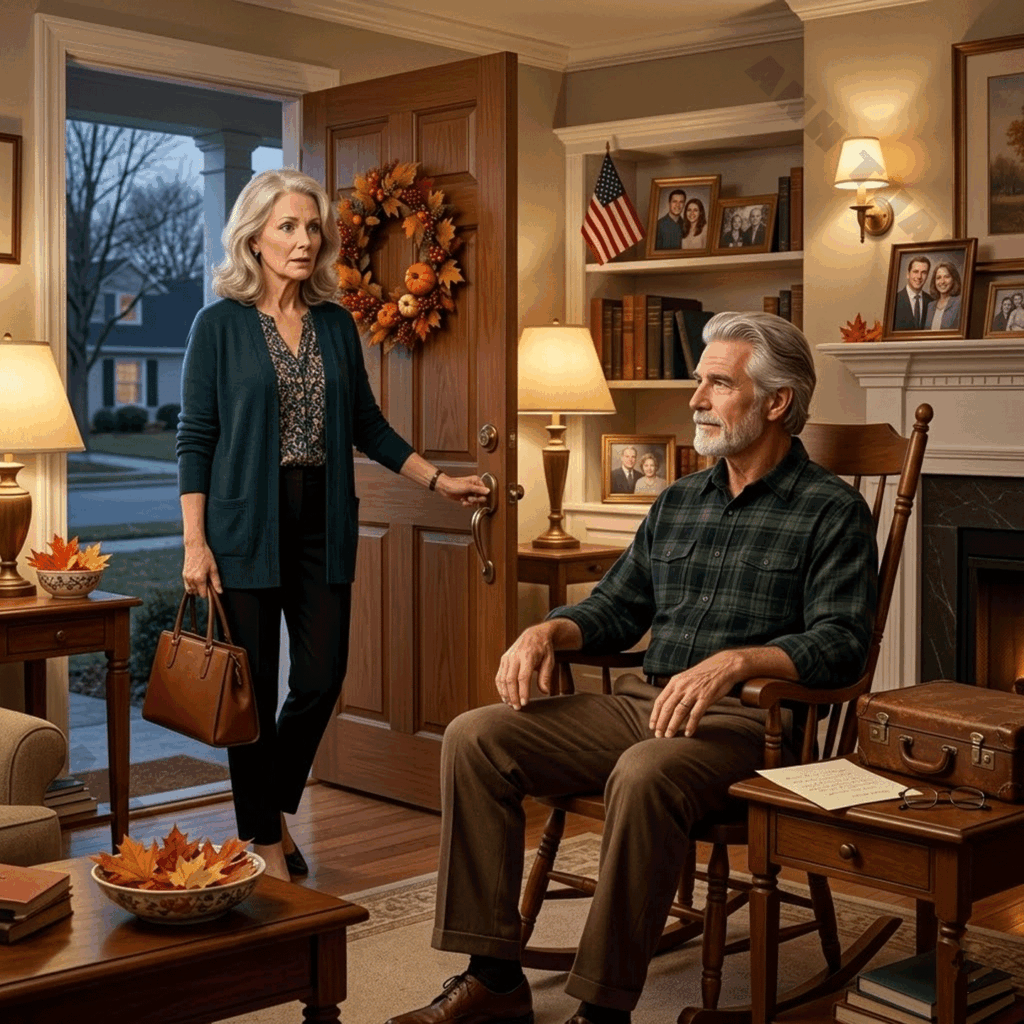
On Thanksgiving Day, I came home to an empty house and found my daughter-in-law’s stepfather sitting there waiting in a rocking chair, with a note beside him saying that the whole family had gone off on a cruise and left him in my care.
If you had told me even a week earlier that this was how my Thanksgiving would begin, I would have laughed in your face, then gone right back to buttering a pie crust and pretending my life was still a thing I could keep in neat little portions. At sixty-eight, I had become very good at rituals. I lived in a white clapboard house on a quiet street where the maples dropped their leaves in thick rust-colored drifts every November and the neighbors still waved from the sidewalk even when they were too tired to stop and talk. My mornings belonged to black coffee, the first pale wash of light coming through the front windows, and the piano in the living room, where Schubert or Chopin felt like a more honest kind of conversation than most of the ones I’d had with living people in the last five years.
Silence and I had made a life together after my husband died. Not the bitter kind of silence, not the kind that hollows out a house until every room feels accusing. Mine was a worn-in, civilized silence, softened by habit. The kettle on the stove. The creak in the hallway near the linen closet. The distant whistle of a freight train from across town on cold nights. The soft thud of the morning paper against the porch. It was the kind of quiet a woman earns after decades of raising a son, hosting holidays, showing up when people call only because they know she will, and swallowing more inconvenience than anyone ever notices.
I was not lonely in the way people like to imagine widows are lonely. I was simply done being needed in careless ways.
That Thursday began with church bells somewhere down by Main Street and the smell of cinnamon in my kitchen. I had gotten up before sunrise to baste the turkey breast I was only making for myself and to finish the apple crumble that David always used to ask for when he was young and all knees and appetite and no sense of how expensive butter had become. The Macy’s parade muttered from the television in the next room, not because I was watching it but because Thanksgiving has its own soundtrack in America, and I have always believed holidays are easier to bear when there is a little noise in the background. Outside, the air had that hard New England edge to it, the kind that turns your breath white and makes the last leaves cling stubbornly to the branches as if winter has to pry them loose one by one.
David had called me two nights before.
“Mom, you’ll do me a huge favor,” he said, and the minute I heard the tone, I knew I would regret answering on the second ring.
There is a certain way grown children speak when they have already decided your answer for you. They start too casually, too sweetly, as if everything is simple and temporary and somehow to your benefit. They do not ask. They arrange the question in such a way that refusal would make you seem petty, lonely, rigid, or unkind.
He told me he and Clara had planned a four-day cruise out of Boston. The tickets were booked months ago. Nonrefundable. The kids needed time away. Everybody was exhausted. Clara’s stepfather, Thomas Caldwell, needed a place to stay for a few days because his retirement residence, according to David, was undergoing some emergency fumigation and “it’d just be easier if he stayed with you.”
“It’s only four days, Mom,” he said. “He’s polite. Quiet. You’ll hardly notice he’s there.”
“That promise alone tells me I absolutely will,” I said.
He laughed the way he always does when he thinks charm can smooth over presumption. “Please? It would help us out.”
I should have said no.
I think about that now more than I like to admit. I think about how many women of my generation were trained to hear inconvenience and translate it as duty. How often we nod before our better judgment has time to sit down at the table. At my age, you would think I had learned to protect the small, hard-won borders of my own life. Sometimes I had. Sometimes I still failed in the old familiar ways.
“All right,” I said. “Four days.”
“Thanks, Mom. I knew I could count on you.”
That sentence irritated me more than it should have. Not because it was untrue, but because it had been true for too long.
I spent Wednesday afternoon preparing my guest room with the sort of sour efficiency reserved for obligations one resents but intends to do properly. Fresh sheets. Extra towels. A wool blanket at the foot of the bed because old men are always cold even when they insist they are not. I moved the stack of library books from the nightstand and set out a glass water carafe I never use unless someone is staying over. The house looked ready in a way I did not feel.
Then Thursday came, and the whole thing turned stranger than I had expected.
I had gone out midmorning to drop off a pie at church and stop by the cemetery with a bundle of white chrysanthemums for James. I do that every Thanksgiving. Some habits are not about grief anymore. They are about continuity. When I came back, the sky had gone that flat silver color that makes the whole world look like it has been exhaled upon, and my porch steps were dusted with the first thin powdering of snow.
The front door was unlocked.
That annoyed me before anything else did.
I stepped into the house, set my gloves on the entry table, and heard the old rocking chair in the living room give one slow, deliberate creak. There, near the front window, sat a tall man in a charcoal wool coat, one hand resting on the curved handle of a cane, the other folded over a leather hat in his lap. His suitcase was placed precisely beside him, upright, as if even luggage ought to know how to behave. On the side table was a folded note in Clara’s handwriting.
Gone a few days. Thank you for watching Thomas. Everything he needs is in his suitcase. We’ll explain when we get back.
Love,
Clara
There are moments in life when indignation arrives so cleanly that it feels almost elegant. I stood there with the cold still in my coat sleeves and read the note twice, not because I had misunderstood it, but because I wanted to give them one fair chance to become less insulting on a second reading. They did not.
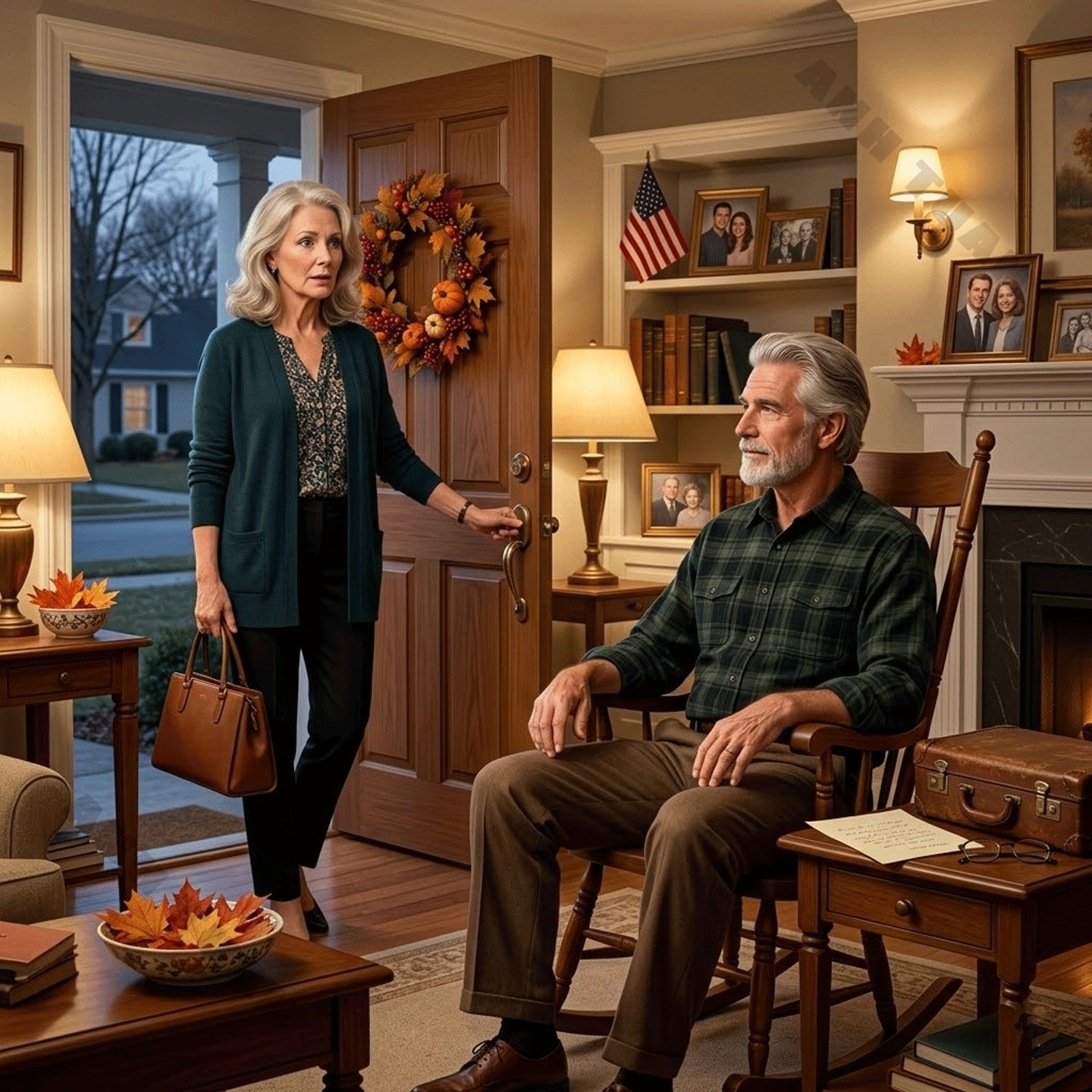
The man in the rocking chair rose slowly, with the kind of care that tells you his body is no longer a thing he takes for granted. He was perhaps a few years older than I was, though he held himself with such formal straightness it made age difficult to estimate. His hair was silver and neatly combed back. His face was fine-boned and severe without being unkind. Even before he spoke, I could see the outline of the life he had lived: order, restraint, polished shoes, books shelved by category, napkins folded into exact squares.
“Mrs. Harris,” he said, inclining his head as though we had met in the lobby of an old hotel. “Thomas Caldwell. I’m afraid we have both been handled with more efficiency than courtesy.”
That caught me off guard.
His voice was low and dry, educated without flaunting it. Not soft exactly, but tempered. I looked at the note again, then at him.
“So it would seem.”
“I was told,” he said, and there was the faintest edge in his expression now, “that I would be spending a quiet holiday in trusted company while Clara and David managed some family logistics. Apparently the logistics involved abandoning us both with minimal consultation.”
I almost smiled.
Not because it was funny yet. It was not. But because in one sentence he had made it clear that he was as unimpressed by this arrangement as I was, and there is a kind of relief in discovering that your unwanted guest may also be an unwilling hostage.
“I suppose they imagined we’d be grateful,” I said.
“I find the older people get, the more often other people confuse usefulness with consent.”
That was the first moment I looked at him properly.
Up close, he did not seem stiff in the way I had feared. Controlled, yes. Precise, certainly. But there was intelligence in his face, and something behind the reserve that did not feel cold so much as well-defended. He set his hat down, and I noticed his hands steady hands, elegant hands, the hands of a man who had spent his life writing notes in the margins of books, correcting drafts, or lifting a teacup without ever clattering it against a saucer.
“I have a turkey in the oven,” I said after a beat. “You may as well stay.”
“I believe that much has already been decided for me,” he replied.
That time I did smile.
Thanksgiving dinner with Thomas Caldwell was one of the stiffest meals of my life. The television in the den carried the murmur of football commentary that neither of us was watching. I served the turkey, dressing, green beans with almonds, cranberry sauce from a dish I had transferred from the can because some standards are worth preserving, and the apple crumble I had made out of habit and pride. He complimented each thing with grave sincerity, the sort of formality that would have seemed absurd if it had not also been genuine.
“This stuffing,” he said after the second bite, “has the texture most people fail to achieve.”
“Most people don’t describe stuffing like a dissertation topic,” I said.
He looked up, and for the first time there was a brief spark of humor in his eyes. “That may be true.”
The afternoon passed under an uncomfortable truce. He read in the living room while I attempted to watch a holiday movie I have seen often enough that it no longer matters whether I follow the plot. The clock on the mantel sounded louder than usual. Every shift in his chair announced itself with a careful creak. There are some people whose very stillness becomes a presence, and Thomas had that quality. He did not fidget. He did not sigh. He occupied space the way a grandfather clock occupies space, quietly but with authority.
Late that evening, I found him in my kitchen rearranging my spice rack.
Alphabetically.
I stood in the doorway with my dish towel in hand and simply stared.
He turned, holding paprika between two fingers like evidence. “You had cumin beside cinnamon. That is not a system. That is surrender.”
“It was a method,” I said.
“It was a cry for structure.”
I ought to have been furious. Instead I heard myself say, “If you touch the vanilla, I’ll put you out in the snow.”
He set it down immediately. “A reasonable boundary.”
That first night, I lay awake longer than usual listening to the unfamiliar sounds of another person under my roof. The guest room floorboards. The low rush of water through the bathroom pipes. The subtle clearing of a throat at half past midnight. I realized, with some annoyance, that I had become too accustomed to being answerable only to my own habits. Another presence in the house altered the temperature of everything. Even when the person is quiet, you feel them in the air.
By Friday morning, it was clear that Thomas Caldwell and I were built from different kinds of discipline.
My mornings begin early whether I want them to or not. James used to say that after fifty, my body simply stopped believing in sleep past dawn. I had coffee going before six and was standing at the sink watching the back fence come into view through the blue light when Thomas entered the kitchen already dressed in slacks, sweater, and pressed shirt as though he had a board meeting rather than nowhere at all to be.
“Good morning,” he said.
“It is too early to mean that,” I answered.
He accepted the mug I offered him and inhaled the coffee with real appreciation. “This is excellent.”
“I buy the expensive beans because nobody else lives here to complain.”
“A philosophy I respect.”
I set a skillet on the stove to make scrambled eggs, and two minutes later he was standing at my elbow with an expression so restrained it was nearly offensive.
“What?” I asked.
“The heat is too high.”
“They’re eggs, not diplomacy.”
“That is precisely why people mistreat them.”
Before I could object, he reached gently past me, lowered the burner, and took up the spatula with infuriating competence. “Low heat,” he said, “and patience. Good eggs should never be bullied.”
I watched, arms folded, while he stirred them slowly until they turned out, I had to admit, soft and perfect.
“You seem very pleased with yourself,” I told him.
“Only with the eggs.”
“Liar.”
He almost laughed then, and the sound of it softened something in the room.
Still, by midday I was ready to be irritated again. He folded the dishtowels differently than I did. He referred to my method of storing sheet music on the piano bench as “geographically ambitious.” He asked whether I had ever considered using labels in my pantry, which made me ask whether he had ever considered minding his own business. He took my good cutting knife and sharpened it without asking. He opened the hall closet, saw the stack of old board games, and suggested I might benefit from “periodic domestic editing.”
I bit my tongue so often that morning I was half surprised it did not bleed.
Yet irritation is a strange thing. It survives poorly when forced to stand too long beside usefulness.
By noon he had fixed the loose hinge on my back screen door, reattached the brass pull on the bottom kitchen drawer, and shown me that the humming noise I had blamed on the refrigerator for six months was actually the vent under the dishwasher. He did each task with the same grave concentration, moving slowly because he clearly had to, but never clumsily. Nothing about him was careless. Even pain, I sensed, had been disciplined into manners.
After lunch, I found him standing in front of the piano, studying the stack of marked-up scores I had left there.
“You play every day?” he asked.
“Most days.”
“That is not the same answer.”
“No,” I said. “It isn’t.”
I sat down and touched the keys without really intending to perform. Some habits are older than self-consciousness. The opening measures of a Schubert impromptu came easily beneath my fingers, and though I was aware of Thomas in the room, I let the music carry me where it always carries me, which is not back into sorrow exactly, but into the quieter country beside it.
When I finished, the house was very still.
“You play beautifully,” he said.
The compliment unsettled me more than criticism would have.
“You’ve been listening?”
“It would have been difficult not to.”
I turned slightly on the bench. “And?”
“And you linger over transitions in a way that suggests you don’t enjoy arriving too quickly anywhere.”
“Is that a musical observation or a personal insult?”
“Both, perhaps.” Then his voice softened. “My late wife adored Schubert. She said he understood yearning without humiliating it.”
There it was, the first true opening in him.
Not much. Just a door left unlatched rather than closed. But enough. Enough to make me see that the formality I had mistaken for hauteur was, at least in part, grief in a tailored coat. Enough to make me say, more gently than I had intended, “My husband liked silence better than music. He would read in that chair while I played and pretend not to be listening.”
Thomas looked at the armchair by the fireplace. “The best listeners often do.”
We spoke very little after that, but the silence had changed shape.
It is a peculiar thing, how quickly two strangers can begin to arrange themselves around each other once pride stops making every movement hard. By Friday evening I had stopped resenting the second cup on the counter. On Saturday morning I set out extra toast without thinking. He began asking before moving things in my kitchen. I began pretending not to notice when he dusted the top shelf of the pantry because, as he claimed, “nobody should own cobwebs intentionally.”
And because life is rarely content to let comfort arrive without friction, that was also the morning I learned that the story we had both been told was a lie.
It happened just after ten. I had gone upstairs to put fresh towels in the guest room because, whatever else can be said of me, I was raised not to let someone reuse damp linens in my house. Thomas had gone out onto the porch with his coat and cane to get a little air. I remember hearing the faint scrape of the rocking chair and then the silence after it, the kind of silence that tells you someone is looking out at the world instead of into a room.
On the bed beside his suitcase lay a tablet I recognized as Clara’s. She must have forgotten it in the rush or sent it with him by mistake. I had no intention of touching it. I am old enough to believe other people’s devices are simply modern diaries with better batteries. But the screen was lit, and before I could look away, I saw my own name.
It was an email thread. One message from Clara to David, one from David back to her, both sent earlier that week.
Let’s hope this works, the subject line read.
That sentence alone was enough to turn my stomach.
I should have left it alone. I know that. I know what rules good people recite about privacy and respect. But there is another rule older than those, and it is this: when your own child has arranged your life behind your back, you do not owe propriety the same loyalty it has not been shown. I read.
Maybe if they get along, Clara had written, they’ll keep each other company. Your mom’s been too isolated since James passed, and Thomas is too stubborn to accept help or consider assisted living. If they connect, it could solve both problems.
David had replied less than ten minutes later.
Exactly. They’re both independent to the point of impossible. If they don’t completely drive each other crazy, maybe they’ll balance each other out. At the very least it gets Thomas out of his place for a few days and Mom around somebody she can talk to. Maybe it’ll lead somewhere. Let’s not tell them too much or they’ll both refuse.
For a long moment, the room seemed to sharpen around me. The blue coverlet on the bed. The folded gray scarf on the chair. The slant of late-morning light through the guest-room blinds. I read the words again, though I had already understood them perfectly.
Not fumigation.
Not convenience.
Not a temporary favor between family members doing what family members sometimes do.
We were an experiment.
Two aging adults, both inconveniently self-governing, both apparently in need of management, had been set down together like mismatched chess pieces by children who mistook concern for entitlement. They had not asked whether I wanted company. They had not asked whether Thomas wanted intervention. They had not trusted either of us with the dignity of our own resistance. They had simply decided, in the bright efficient way of younger people who think themselves practical, that perhaps two solitary older people might cancel each other’s complications out.
I was still staring at the screen when Thomas spoke from the doorway.
“Something wrong?”
I turned so sharply I nearly dropped the tablet. He stood there with one hand against the frame, his coat open, the smell of cold air drifting in with him. He took one look at my face and did not ask again.
Instead he crossed the room, slower now, and I held out the tablet without a word.
He read in silence.
I watched his jaw tighten, not dramatically, not theatrically, but with the contained fury of a man who has spent a lifetime mastering his own reactions and has therefore made each visible one mean something. When he reached the end, he handed the device back to me very carefully, as if it might otherwise suffer for having delivered the message.
“So,” he said at last, “we are a project.”
“Yes.”
He stared out the window for a moment at the bare branches in my backyard. “I knew the story about the renovation was suspicious. The place I’m in has not so much as replaced a hallway lamp in three years, but suddenly I was to believe they were fumigating the entire building over a holiday weekend.”
“And you still came.”
“I was told Clara was worried. Claire was her mother.” He paused, and the name settled between us with its own history. “I thought perhaps she felt guilty about not inviting me along. I did not think I was being… deployed.”
The last word was so dry it almost made me laugh, but I was too angry yet for laughter.
“They think I’m isolated,” I said. “As if living alone is the same thing as being helpless.”
“They think I’m stubborn,” he said.
“You are stubborn.”
“Yes,” he said evenly. “But that does not make them sovereign.”
I sat down on the edge of the guest bed because suddenly standing felt too theatrical for what I was feeling. Anger, certainly. Humiliation in a quieter form. But beneath both of those was something smaller and sharper: hurt. There is no graceful way to discover that the people who love you have discussed your life as a problem set.
“I would have helped if they had simply asked,” I said. “I might have said yes. I might even have welcomed it if they’d trusted me enough to be honest.”
Thomas said nothing.
That, more than any comforting phrase could have, steadied me. He did not rush to excuse them. He did not tell me they meant well. He gave the feeling room.
Finally he drew a slow breath. “There are two ways we can answer this.”
I looked up.
“We can confront them immediately,” he said, “which would satisfy principle and ruin the rest of your holiday. Or we can wait.”
“Wait for what?”
A look came into his face then that I had not yet seen, something almost boyish beneath the severity. Not mischief exactly. Something better developed than mischief. The glint of strategy.
“For them to become uncertain,” he said.
I felt my anger shift, not dissipate but refine itself. “You want to scare them.”
“I want,” he said, “to educate them.”
I stared at him for three full seconds and then, to my own surprise, I laughed. Not because anything was resolved, but because suddenly it was possible to imagine this situation becoming something other than an insult I had to swallow with grace. It was possible to imagine turning it, elegantly, back toward the people who had engineered it.
“What would this education involve?” I asked.
Thomas straightened, the corners of his mouth almost moving. “Restraint. Timing. Ambiguity. The classic tools.”
“And revenge.”
“Mrs. Harris,” he said, “revenge is such an untidy word. I prefer corrective theater.”
I laughed harder then, and the sound startled both of us.
It had been years since anger had made room for delight that quickly.
That was the moment the whole thing changed.
Not into romance. Not yet into friendship, either, if I am being honest. But into alliance. Into a shared refusal. Into the beginning of one of those strange private understandings that can form between two people who realize, all at once, that they have been underestimated by the same family members for remarkably similar reasons.
“Corrective theater,” I said. “Fine. But if we do this, we do it properly.”
His eyes met mine. “I would expect nothing less.”
And just like that, the longest four days of my life became something else entirely.
There is a special energy that comes over a house when two people decide, without saying so in sentimental terms, that they are now on the same side.
The air itself feels altered. Rooms that had held tension begin to hold intention. The smallest domestic acts become charged with private amusement. Even silence acquires a different texture, because it is no longer the silence of strangers enduring one another but the silence of co-conspirators waiting to see what happens next.
Thomas called our plan a social correction. I called it payback. Both names suited.
We began with restraint.
That was Thomas’s rule. He believed panic is best cultivated not by chaos, but by suggestion. Too much drama, he warned me, and younger people dismiss it as overreaction. But uncertainty, delivered in clean measured doses, will make them invent their own nightmare far more effectively than anything we could state outright.
So on Saturday afternoon, after much debate over tone, I sent David a single text.
Everything is under control now. The situation is evolving.
I stared at the screen after hitting send and felt a mean little thrill I had not experienced since I was seventeen and once ignored a boy from Burlington for three days just to remind him that charm is not currency everywhere. Thomas, reading over my shoulder from a tactful distance, gave a small nod.
“Excellent,” he said.
Within two minutes, my phone rang.
I looked at Thomas.
He lifted one eyebrow. “Do not answer.”
It rang again, then stopped, then buzzed with a text.
Mom, what situation?
“Good,” Thomas said. “He’s already hearing danger in his own assumptions.”
“You sound disturbingly experienced at this.”
“I taught theater for thirty-eight years,” he said. “Half my life was spent guiding panicked young people through consequences of their own making.”
That was how I learned what he had done for most of his career. Thomas Caldwell had taught literature and theater at a small liberal arts college outside Plattsburgh, just across the lake, before retiring to a senior residence Clara had helped him choose after her mother, Claire, died. He spoke of his profession the way some men speak of military service: not romantically, but with a sense of formation. It had shaped his eye, his patience, his refusal to waste words. He believed in rehearsal, in intention, in delivery. Suddenly his formality made perfect sense to me. He was a man who had spent decades listening for false notes.
“And you?” he asked later that afternoon as we stood in my living room surveying the faded curtains I had complained about for years without ever changing. “What did you do before you became guardian of the neighborhood pie reputation?”
I smiled in spite of myself. “I taught piano for a while when David was small. After that I did a little of everything. Church bookkeeping. Volunteer committee work. I helped James with the hardware store before we sold it. I spent thirty years making myself useful in ways nobody considered official.”
“That,” he said, adjusting his glasses, “is the history of most competent women in this country.”
There are remarks that flatter you and remarks that see you. The latter are rarer, and more dangerous.
By evening we had staged our first photograph.
The idea came because I was in the hall closet looking for an old tablecloth and Thomas, who had appointed himself the enemy of all domestic neglect, pulled out a box of fabric remnants I had forgotten I still owned. There were curtain panels I had once intended to hem, a length of blue ticking stripe, a stack of old painter’s drop cloths folded beneath Christmas decorations. He looked from the fabric to the living room windows and then to me.
“The room would be better with longer curtains,” he said.
“You are not remodeling my house.”
“I’m not remodeling,” he said. “I’m creating visual evidence.”
An hour later my living room looked like the aftermath of a tasteful cyclone. Fabric draped over the sofa. Measuring tape stretched across the floorboards. Two unopened paint cans dragged out of the basement to serve as suggestive background props. Thomas stood in the center of it holding a carpenter’s pencil and a measuring tape with such solemn concentration that he looked like a man mid-consultation on a major life decision.
I took the photo.
The caption we finally settled on read: Making some changes around here.
“Too much?” I asked.
“Not enough,” Thomas said. “But acceptable.”
I sent it to David.
This time the phone did not merely ring. It began what could only be described as a campaign. First David. Then Clara. Then David again. Then a group text from both of them, attempting at first a casual tone and then abandoning it.
Mom, what changes?
Why is Thomas measuring things?
Did something happen?
Are you both okay?
Thomas sipped his tea and read the messages as I showed him each one.
“They suspect property transfer,” he said.
“You are enjoying this far too much.”
“Revenge, Miss Harris, is most effective when disguised as productivity.”
He had begun calling me Miss Harris whenever he was especially amused, and I had already noticed that I disliked how much I liked it.
Our little performance should have remained nothing more than a way to make David and Clara squirm long enough to appreciate how little they had considered us. That was the original objective. Nothing cruel. Nothing irreparable. Just a measured return of perspective.
But the truth is, somewhere in the middle of our mischief, we stopped acting for the audience and began unexpectedly enjoying one another.
It started with work.
Real work, I mean. Not the kind people pretend to do when they want credit for caring, but the satisfying domestic labor that gives shape to a day. Since the living room had already been turned upside down for the photograph, Thomas insisted we might as well finish at least one actual improvement. We took down the old curtains, washed the windows properly, and spread fabric across my dining table to measure hems. He showed me how to pin without bunching the edges. I showed him where I kept the decent scissors as opposed to the ones I no longer trusted.
We bickered over length.
“You want them pooling on the floor like a neglected opera,” he said.
“I want them elegant.”
“You want them theatrical.”
“That from a theater professor?”
“Exactly from a theater professor.”
We compromised, which is another way of saying I allowed him to be right by half an inch.
The sewing took longer than I expected because Thomas’s hands, though still steady, tired more quickly than he would admit. Once, when he reached for the fabric and his fingers paused just a fraction too long before closing, I understood that he was negotiating pain on nearly every movement. Arthritis, he later told me with typical brevity. Worse in the mornings, worse in the cold, worse when pity was nearby.
“I don’t pity you,” I said.
“Good. I would hate to have to leave.”
So we worked slowly, and because slowness leaves room for talk, we began telling each other things neither of us had expected to say.
I told him how James had owned a hardware store for twenty-six years on the corner of Maple and Second, and how half the town still remembers him as the man who could identify any bolt or bracket by touch alone. I told him how after David moved to Boston and then farther into his own life, the house got quieter in stages, not all at once. First the car in the driveway on holidays. Then the overnight bag in the hall closet. Then the certainty that somebody else would eventually eat the second piece of pie.
Thomas listened with the grave attention of a man who has learned that interruption is often vanity in disguise.
Then he told me about Claire.
She had been a librarian before she became sick. He spoke of her with such control that the grief in it hit harder for being so carefully carried. They had met at a college fundraiser, argued over a misquoted line from Yeats, and been married for thirty-one years. Clara had been in college by then, already mostly grown, wary at first of a stepfather who alphabetized bookshelves and ironed his own shirts. Over time, he said, they had made a kind of truce that eventually became genuine affection. But after Claire died, everything altered. Clara began hovering. Not cruelly. Not even foolishly. Just with that nervous practical concern adult children get when death has recently taught them how fast a life can collapse.
“She meant well,” he said as he threaded a needle with maddening competence. “That is the trouble with people who mean well. They rarely notice the moment they begin trespassing.”
“Yes,” I said quietly. “That is exactly the trouble.”
By Saturday night, we had the new curtains up.
They changed the room more than I expected. The living room, which had gradually grown faded in my eyes because I saw it every day, suddenly looked awake again. The blue-gray fabric caught the lamplight beautifully. The windows seemed taller. The whole space felt younger without becoming foolish. Thomas stood back with one hand on his cane and assessed the room like a curator deciding whether civilization might continue after all.
“It no longer looks as though you are waiting for someone to come home,” he said.
The remark struck so close that for a moment I could not answer.
He realized it at once. “Forgive me.”
“No,” I said. “Don’t. You’re right.”
That was one of the first things about Thomas I came to trust: he did not speak to fill air. When he said something perceptive, it was because he had bothered to look.
That evening, after we ate roast chicken and potatoes and the kind of salad people make when they have both spinach and guilt in the refrigerator, I played the piano again. Not because I meant to perform for him, but because the day had left me full in a way I did not quite know how to settle. Music has always been where I place feelings too layered for ordinary conversation.
This time, when I finished, I heard Thomas humming the last phrase under his breath.
“You know it,” I said.
“I corrected you yesterday for rushing the middle passage,” he replied.
“I did not rush.”
“You anticipated.”
“There is a difference?”
“There is always a difference.”
He moved closer to the piano, one hand resting lightly on its polished edge. “Play it again.”
“Was that a request or an order?”
“A plea, if necessary.”
So I played it again.
When I reached the part he had objected to, I slowed, and from beside me came a quiet satisfied hum. I should have found that insufferable. Instead the room felt strangely intimate, not in any romantic sense yet, but in the way all shared attention becomes intimate when neither person is pretending not to care.
When I stopped, he remained beside the piano a moment longer than needed.
“It has been years,” he said softly, “since music filled a room I was in.”
I looked up at him. “You never listen at your residence?”
“Not like this. Recorded music is company. Live music is presence.”
The sentence stayed with me.
So did the look on his face when he said it, a look not of melancholy exactly, but of recognition. As if something in him had gone quiet for too long and was startled to hear itself answered.
The next morning, Sunday, the sky cleared into one of those bright late-autumn days that belong entirely to the Northeast. Cold enough to make your lungs feel newly washed, but sunny enough that the bare branches cast sharp blue shadows across the yard. I made oatmeal with brown sugar and chopped apples. Thomas insisted on adding a pinch of salt because, according to him, “sweetness without contrast is sentimental.” By then I had learned that nearly all his opinions about food doubled as opinions about life.
After breakfast I sent David another text.
Unexpected connection. We understand each other perfectly.
The effect was immediate.
Clara called three times in under ten minutes. Then David sent a message so carefully casual it might as well have come wearing a fake mustache.
That’s great, Mom. Glad you’re both getting along. What exactly do you mean by “understand each other perfectly”?
Thomas read it and nearly smiled.
“He thinks we’re eloping,” I said.
“He underestimates how much more creative we can be.”
He proposed a drive.
Not a long one, he said, just enough to “produce an outdoor chapter” for our ongoing narrative. Under any other circumstances I might have refused. I am particular about spontaneous excursions, and I had not expected to spend Thanksgiving weekend in the company of a man who corrected my egg technique and weaponized ambiguity. But the weather was too good, the house too newly bright, and I had begun to understand that my first instinct around Thomas to guard my space against him was being replaced by something far less manageable: curiosity.
So I got my keys. He put on his overcoat. We packed a thermos of tea, two sandwiches, and the apple crumble because no scenic overlook in Vermont has ever been made worse by a proper dessert. Then we drove north toward Lake Champlain.
It had been years since I took that road with no practical purpose attached to it. Past the white-steepled church, the shuttered farm stand, the old red barn with the Coca-Cola sign peeling on one side. Past fields gone brown and flattened for winter, past houses with smoke rising from chimneys, past roadside mailboxes leaning at angles like tired men. The mountains stood off in the distance blue and patient, while the lake flashed between stands of leafless trees like strips of cold metal.
Thomas narrated landmarks with the absent-minded authority of a man who had spent a career turning landscape into footnotes.
“That ridge,” he said, pointing with two fingers rather than the cane, “was once used as a signaling point during the War of 1812. And that village small as it looks produced a poet who spent thirty years insisting nobody read him correctly.”
“Perhaps nobody did.”
“Madam, he was unreadable on purpose.”
I laughed more that drive than I had laughed in months, maybe longer. Not the polite social laughter that women learn to produce on command, but the involuntary kind that makes your shoulders loosen before you notice. He had a dry wit, but more than that, he understood cadence. He knew how to let a remark land. He knew not to chase his own humor. There is no quality more attractive in old age than someone who has stopped performing to be liked.
We reached the lake just after noon.
The water lay broad and steel-blue under the pale sun, with a skim of wind lifting silver across the surface. The benches along the shore were mostly empty except for one bundled fisherman and a young couple wrestling a stroller over the gravel path. The maples had nearly finished dropping their leaves, but a few stubborn branches still burned copper against the cold sky. Somewhere far off, a buoy bell clanged. I stood breathing in the smell of water and pine and distant woodsmoke and felt, with sudden clarity, how long it had been since I had gone anywhere simply because the day invited me.
We sat on a weathered bench overlooking the lake. I poured tea into the lid cups from the thermos. Thomas accepted his with both hands, warming them.
“Claire and I used to come here,” he said after a while.
He had never yet spoken her name without a little pause before it. Not hesitation. More like respect for the weight of what followed.
“She’d bring a blanket even when it wasn’t necessary. Said it made sitting still feel intentional.”
“What did you do?” I asked.
“She read. I pretended to read while watching the boats.” He looked out over the water, his profile set against the bright cold day. “We thought silence meant contentment.”
“Didn’t it?”
He considered that. “Sometimes. Sometimes it meant comfort. Sometimes it meant there were things we were too tired to explain because the other person already knew them.”
I wrapped my hands around my own tea. “James used to fish but hated boats.”
Thomas turned to me. “That seems contradictory.”
“He trusted the shore more than the water. He liked a thing to stay where it was supposed to stay.”
“And did it?”
“No.” I smiled faintly. “But it comforted him to believe it might.”
The wind shifted. Somewhere behind us a child shouted, then laughed. Two gulls skimmed low over the water and banked sharply into the light.
“My son thinks I’m isolated,” I said, surprising myself by saying it aloud.
Thomas did not rush to contradict me. “Are you?”
“Sometimes,” I admitted. “But not in the way he means. Solitude and abandonment are not the same thing.”
“No,” he said. “They are often mistaken for each other by people who cannot imagine contentment without witnesses.”
I looked out across the lake. “And Clara thinks you need looking after.”
“She thinks grief made me fragile. In some ways it did. But fragility is not the same as incapacity either.” He took a measured sip of tea. “Children grown children especially panic when they realize their parents can still make choices they would not choose for them.”
“That sounds rehearsed.”
“It is. I have had months to think it.”
We sat in companionable quiet after that, the kind that does not demand interpretation. The air had sharpened with afternoon. The tea steamed less. I could feel the cold beginning to work into my knees, but I was in no hurry to move.
After a while Thomas said, “Would you indulge the next stage of our campaign?”
“What now?”
“A photograph.”
Of course.
He insisted we stand with the lake behind us and our heads closer together than I thought necessary. The first attempt caught too much wind in my hair. The second made him look, in his words, “like a retired undertaker.” The third was unexpectedly lovely. The lake behind us bright as hammered tin, my scarf blown slightly sideways, his expression almost warm.
He dictated the caption.
An unexpectedly beautiful day.
I objected that it sounded sincere.
“It is sincere,” he said.
“That seems outside the spirit of revenge.”
“On the contrary. Nothing unnerves guilty people like witnessing authentic contentment.”
I sent it.
Three missed calls appeared on my phone before we even reached the car.
Driving home, I realized I was no longer pretending for anyone, not really. Whatever had begun between us as corrective theater had acquired a life beyond the performance. I liked his company. There was no strategic advantage in admitting that, so I kept the thought to myself at first. But it moved through me all the way back along the lake road, through the lowering gold light and the long blue shadows of the mountains, through the small towns already smelling of fireplaces and Sunday dinners.
At home, the house did not feel invaded anymore.
That startled me most of all.
For years I had arranged my life to require no adjustment from anyone. That is one of the hidden luxuries of widowhood nobody tells you about. You suffer the terrible loss, yes. You also inherit a kingdom of one. Your routines become law. Your moods can move through rooms without explanation. The faucet drips and no one says they’ll fix it on Saturday and then forgets. The newspaper is where you left it. The pantry stays disordered only to your own standards. There is peace in that sovereignty.
And yet now, with Thomas’s overcoat on the hall hook and his book on the side table and the faint smell of Earl Grey drifting from the kitchen, the house felt not diminished but activated. As if parts of it had remembered their purpose in the presence of witness. The piano for listening. The table for conversation. The living room for something besides waiting out the evening news.
That night we ate leftovers and apple crumble warmed in the oven until the edges went crisp again. Thomas told me a story about a college production of Hamlet derailed by a cat wandering onto the stage during the gravedigger scene. I told him about David at age eleven gluing his hand to a model airplane on Christmas Eve because he was too impatient to wait for the instructions to dry. By the time I washed the last plate, I could not remember what it had felt like, forty-eight hours earlier, to dread sharing space with him.
Monday arrived with a kind of stillness that felt temporary by nature. Even before I checked the time, I knew it was the day David and Clara would return. You can feel an ending coming in a house, just as clearly as you can feel a storm. The morning light was thinner. The rooms seemed watchful. Even the clock in the kitchen sounded more deliberate.
Thomas was already in the living room tightening the last screw on the curtain rod with one of James’s old screwdrivers.
“They’ll expect disaster,” he said.
“Good.”
“No,” he said, glancing toward me. “Better than good. They’ll expect conflict. We should give them calm.”
I leaned against the doorway, arms folded. “Reverse psychology.”
“Exactly. Peace is far more unnerving when one has earned chaos.”
So we prepared.
I made pot roast because nothing steadies a room like something substantial in the oven. He set the table with an elegance that made my everyday plates look suddenly distinguished. Candles appeared from somewhere in the sideboard drawer I had forgotten about. The living room, with its new curtains and reordered furniture, glowed golden by late afternoon. If anyone had walked in without context, they would have assumed the household belonged to two sensible adults who had inhabited it together for years.
By six o’clock, I heard tires on the gravel and a car door slam.
Thomas adjusted his cuffs.
“Well,” he said, “curtain up.”
The doorbell rang, and something in me that had been waiting all day went very still.
I opened the door before David could use his key. The cold rushed in around him first, then the smell of travel car heat, outside air, wool coats carrying the stale hint of ferry terminals and hotel corridors. My son stood on the porch with his overnight bag over one shoulder, wind-reddened and trying hard to look casual. Clara was right behind him, her expression composed the way it always gets when she is nervous and determined not to show it. They both looked over my shoulder immediately, the way guilty people do when they are trying to assess damage before conversation begins.
“Mom,” David said too quickly. “You okay?”
I stepped aside. “I seem to be.”
That answer unsettled him at once. I could see it.
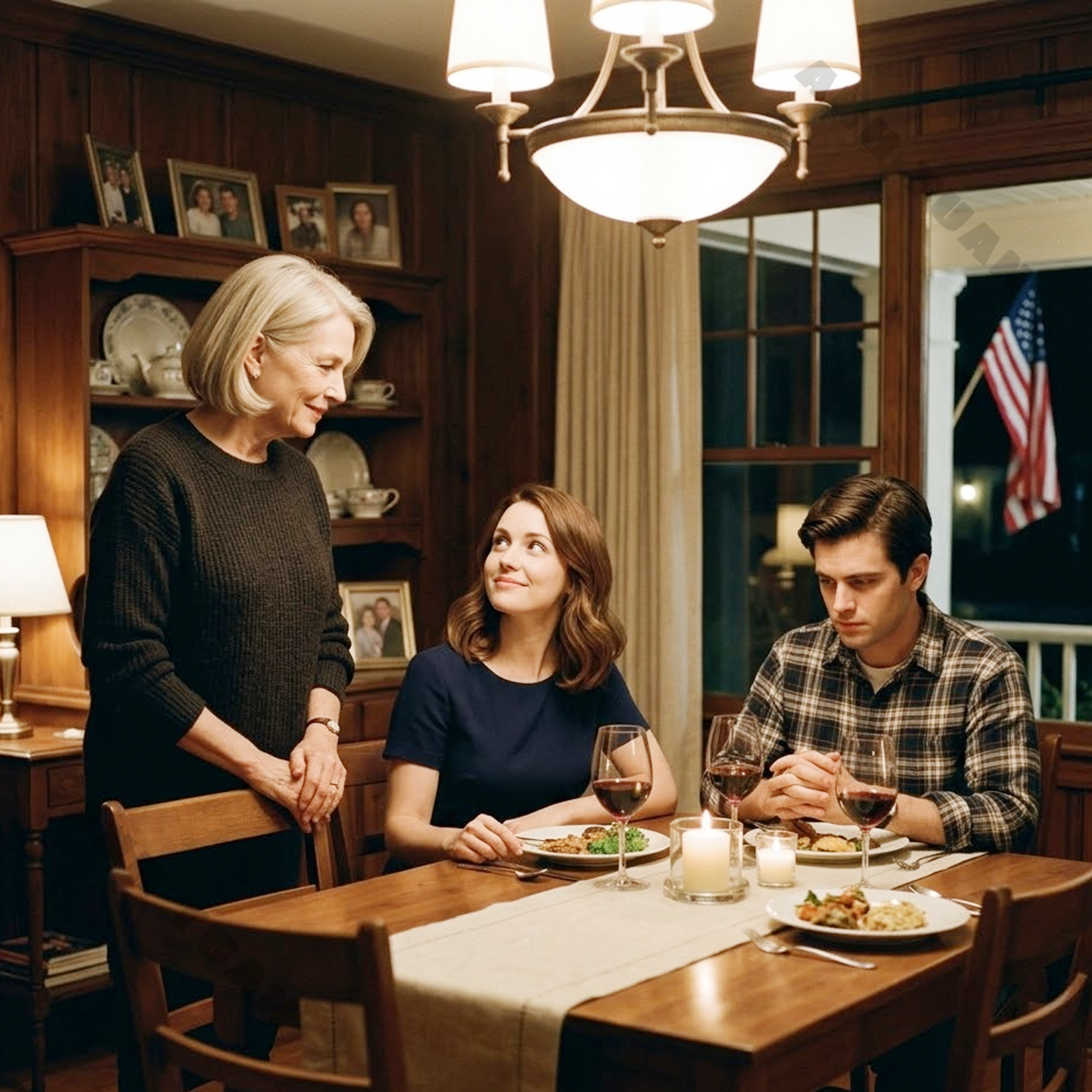
They came in, stamped the cold from their shoes, and stopped dead in the foyer. The living room was visible from there, lamplight pooling on the rug, the new curtains hanging clean and elegant at the windows, the furniture shifted just enough to look deliberate. Thomas stood near the mantel with one hand resting on the back of the armchair, dressed in a dark sweater and pressed slacks like a man receiving guests in his own home. On the dining table beyond, candles were lit. The pot roast had filled the house with rosemary, garlic, onions, and the kind of domestic warmth nobody associates with disaster.
David blinked twice.
Clara’s eyes moved from the curtains to Thomas, then to me, then back again. “You redecorated.”
“We did,” I said.
“All of this?” David asked. “Together?”
Thomas inclined his head. “Joint effort.”
I watched my son trying to rearrange his assumptions in real time. He had prepared himself, I could tell, for tension, tears, perhaps even outrage. He had not prepared for coordinated tranquility. In some ways that was kinder. In other ways it was far more efficient.
Clara set her bag down slowly. “Your messages worried us.”
“I imagine they did,” Thomas said.
David looked at me. “Mom, when you texted that the situation was evolving ”
“It was,” I said.
“And the photo with the tape measure ”
“We made curtains.”
He stared at me. “You know that is not what that looked like.”
“No,” I said evenly. “It isn’t.”
Thomas crossed the room with that careful measured pace of his and gestured toward the dining table. “Perhaps we should sit down before anyone attempts a speech in the foyer. They are rarely improved by luggage.”
The remark was so dry that David gave a startled half-laugh before catching himself. Clara did not laugh. She looked, for the first time since stepping through the door, frightened. Not frightened of us. Frightened of what she suspected we knew.
We took our places at the table. I served the pot roast. Clara offered to help and I told her no, not sharply, but not in the accommodating tone she was likely hoping for. Thomas poured water. Candles moved softly in the draft each time someone shifted. Outside, darkness had come early, and the windows reflected the room back at us like another family sitting perfectly still.
There are meals in which everyone speaks too much because silence feels dangerous. This was not one of those meals. We ate for perhaps three full minutes with only the ordinary sounds of silverware and plates. I let the quiet extend on purpose. So did Thomas. Across from me, David chewed as though he had forgotten how swallowing works when you are anxious. Clara lifted her water glass twice without drinking from it.
Finally, David set down his fork.
“Okay,” he said. “What’s going on?”
Thomas dabbed his mouth with his napkin. “Dinner, at present.”
“Thomas ”
“No,” I said, and the word came out calmer than I felt. “Let him answer.”
Thomas folded his hands beside his plate. “What is going on, David, is that we have had a surprisingly productive four days. Your mother and I discovered that your faith in our capacity to endure one another was not entirely misplaced.”
David looked from him to me. “That’s not what I meant.”
“I know,” I said.
Clara lowered her gaze. There it was, the first tiny fracture in her composure.
I reached for my water and took a sip before speaking again. I did not want anger leading. Anger is satisfying in the moment, but it often lets people retreat into self-defense too quickly. Hurt, delivered cleanly, is harder to wriggle away from.
“You both told us a story,” I said. “Different details, same intention. Temporary stay. Practical inconvenience. A favor. What you did not tell us was that we were being arranged.”
David opened his mouth, then closed it.
Clara looked up then, her face already blanching. “You read the messages.”
“I did,” I said. “Accidentally at first. Deliberately after that.”
Nobody spoke.
I watched the truth land where it needed to. Not dramatically. Not as revelation. More like weight. Like the moment a piece of furniture is set down and the floorboards register its full burden.
Thomas leaned back slightly in his chair. “We are quite aware of your plan. The cruise, the timing, the manufactured explanation about renovations, the hope that two inconvenient older people might, through proximity, solve each other.”
“It wasn’t like that,” David said immediately.
“It was exactly like that,” I answered.
He turned to me with the raw, defensive look sons still wear when they are shocked to discover their mothers can be wounded by them. “Mom, we were trying to help.”
“And that,” I said quietly, “is what people always say when they have done something for someone instead of with them.”
Clara pressed her lips together. Her hands were clasped so tightly in her lap I could see the knuckles whitening. “I didn’t think of it that way.”
“No,” Thomas said. “You thought of it efficiently.”
She flinched.
He did not raise his voice. He never had to. When a person has spent years speaking to classrooms, true disappointment does not need volume to carry.
David scrubbed a hand over his face. “We thought maybe you’d both benefit. Mom, you’ve been alone so much. And Thomas, Clara’s been worried because you keep refusing extra support. We thought maybe if you had company ”
“If I had company I did not choose?” I asked.
“That’s not what I meant.”
“But it is what happened.”
He looked at the table then, and I saw, beneath the defensiveness, the first real crack of shame. That softened me more than I wanted. He was still my son. Even in disappointment, some part of me noticed whether his hands looked tired, whether he had been sleeping enough, whether the gray at his temples had spread. Love does not conveniently leave the room just because anger comes in.
Clara finally spoke, her voice thinner now. “I thought if Thomas got out of the residence for a few days, it might do him good. And I thought if you and he connected, maybe…” She stopped.
“Maybe what?” Thomas asked.
She swallowed. “Maybe it would make things easier.”
There it was again. That word. Easier. So much harm in families is done under the banner of ease. Easier for whom. Easier by whose calculation. Easier measured against whose dignity.
“I’m sure it would,” I said. “A widow less alone. An aging stepfather less resistant. Two lives tidied into a more manageable shape for the people watching from the outside.”
“Mom ”
“No, David. Let me finish.”
He fell silent.
I folded my napkin and set it beside my plate because my hands needed a task. “What hurt was not that you worried. Worry is part of loving people. I understand that. What hurt was that you decided worry gave you permission. You discussed me as if I were a situation. You lied because you assumed honesty would complicate your plan. You took my ability to say no and treated it as an obstacle.”
Clara’s eyes filled before she looked away. David’s shoulders dropped the way they used to when he was twelve and knew perfectly well he had broken something that could not be mended by simple apology.
Thomas spoke more gently then, though not less clearly. “Intent does not erase impact. You may both have meant well. But meaning well is not the same as respecting someone’s agency.”
The room went quiet again, but this time it was not charged in the same way. It was no longer the silence before a truth. It was the silence after one, when everyone is forced to sit in what has already been said.
Clara was the first to break.
“I’m sorry,” she said, and her voice had lost all polish now. “I really am. I thought I was helping. I thought if I told you both ahead of time, you’d refuse on principle, and I told myself that was exactly why I shouldn’t ask.” She gave a short, humorless breath that was almost a laugh and almost not. “I can hear how terrible that sounds now.”
“It sounds controlling,” Thomas said.
“Yes.” She nodded immediately, tears slipping free though she seemed annoyed by them. “Yes. It does.”
David rubbed both hands over his face and let them fall. “I’m sorry too, Mom.”
I waited.
He met my eyes. “I mean it. I was being… practical. At least that’s what I told myself. But really, I was managing. I didn’t even question it because it seemed so reasonable from where I was standing.” He looked toward Thomas. “And that was arrogant.”
Thomas held his gaze a moment, then gave a short nod. “It was.”
The honesty of that answer, simple and unsoftened, nearly made me smile.
David looked back at me. “I should have asked. Even if you said no. I should have asked.”
“Yes,” I said.
There is a point in any apology where the injured person must decide whether the goal is punishment or understanding. I have lived long enough to know that extended humiliation rarely teaches what people think it will. Shame can wake a person up, but too much of it makes them retreat into self-protection, and then nothing useful enters. I did not want David and Clara crushed. I wanted them changed.
So I let some of the tension go.
“Apology accepted,” I said.
Clara exhaled shakily, as if she had been holding breath for hours.
“But,” I added, “that does not mean you get to pretend this was harmless.”
“We won’t,” David said quickly.
“Good.”
Thomas lifted his glass then, not in mockery but in something like conclusion. “There is also the matter of outcome.”
David frowned. “Outcome?”
I looked at Thomas, and there passed between us one of those small private acknowledgments that had become oddly natural in only four days. He was giving me the choice of how to phrase it. I appreciated that.
“Your plan did not fail entirely,” I said at last. “It simply succeeded differently than you intended.”
Clara blinked. David looked confused first, then wary in an altogether different way.
Thomas saved him the trouble of guessing. “We discovered,” he said, with infuriating calm, “that we enjoy each other’s company.”
David stared at him. Then at me. “Wait.”
Clara’s mouth fell open a little. “You mean ”
“I mean,” I said, not hurrying to rescue her from uncertainty, “that we are capable of making our own choices from here.”
Nobody moved.
Then, to his credit, David laughed.
It burst out of him with the startled helplessness of a man who has just realized the universe has a better sense of irony than he does. He laughed once, then covered his mouth, then shook his head. “You’re serious.”
“Oh, we were furious at first,” I said. “Now we’re mostly amused.”
Thomas’s expression barely changed, but I could see the humor there. “You attempted to manage our lives. Instead, you reminded us we still own them.”
Clara looked from one of us to the other. Something in her face softened then, not merely with relief, but with that odd humbled tenderness people get when the story they thought they were controlling turns out to have a wiser ending than they deserved.
“I don’t know whether to apologize again or say congratulations,” she said.
“Perhaps start by passing the potatoes,” Thomas replied.
That finally broke the tension for good.
The second half of the meal was warmer by degrees rather than all at once, but warmth did come. Clara complimented the curtains properly this time, not as evidence but as something beautiful. David admitted the living room looked brighter than he had ever seen it. Thomas, perhaps sensing that the lesson had landed and did not need further emphasis, told stories from his years directing student productions, including the cat during Hamlet and an actor who fainted midway through a soliloquy and later claimed it was an interpretive choice. I told Clara how her forgotten tablet had become the accidental confession of the century, and even she laughed through her embarrassment.
By dessert, the room had become something almost ordinary again, though not the same ordinary it had been before. Truth alters the temperature of future family gatherings, and perhaps that is no bad thing. Better a room slightly wiser than a room politely false.
After the dishes were cleared, David helped me in the kitchen while Clara and Thomas remained in the living room talking quietly. My son stood at the sink drying plates with the dishrag folded too carefully in his hand, the way he used to do when he was little and trying hard to look useful after some misdemeanour.
“You really like him,” he said.
I rinsed a serving spoon and set it in the drainer. “I do.”
He was quiet a moment. “Are you happy?”
The question almost undid me.
Not because it was dramatic. Because it was simple. Honest. Late, perhaps, but honest. I turned off the tap and looked at him. Under the kitchen light, he still had traces of the boy who used to trail sawdust through James’s hardware store and ask questions about every tool in reach. Age layers over childhood, but it does not erase it entirely. Parenthood is partly the long practice of seeing several versions of one person at once.
“I’ve been all right for a long time,” I said. “That isn’t exactly the same thing.”
He nodded. “I think I understand that now.”
“Do you?”
“Yes.” He folded the towel once, then again. “At least more than I did.”
I touched his wrist. “You are allowed to worry about me.”
“I know.”
“You are not allowed to arrange me.”
A small embarrassed smile passed over his face. “Fair.”
When we returned to the living room, Clara was standing near the piano with a look I had not seen on her before: not polished, not defensive, simply open.
“I owe you another apology,” she said.
“You already gave me one.”
“I know. This one’s for something more specific.” She drew a breath. “My mother used to say I have a terrible habit of helping before I’ve actually listened. I always thought she was exaggerating.” Her mouth trembled a little around the edge of a smile. “Apparently she wasn’t.”
Thomas looked at her with an expression gentler than any he had worn all evening. “Claire was rarely wrong about character. It was one of her more exhausting strengths.”
That made Clara laugh through fresh tears.
She crossed the room and hugged me then, tightly, not performatively, not as a gesture to tidy the evening. Just tightly. I felt in her embrace real remorse, and beneath it, fatigue. The fatigue of people in the middle stretch of life who are trying to care for children, careers, marriages, aging parents, bills, anxieties, health, logistics, and all the invisible emotional scaffolding modern adulthood seems to require. I understood that fatigue. I had lived it. Maybe that was why I could forgive her. Not excuse. Forgive.
When she let go, I said, “Help is lovely when it’s offered. Not when it’s imposed.”
She nodded at once. “I know that now.”
David and Clara left around ten. There were hugs at the door, promises to come by the next weekend, and one comically earnest statement from David that from now on he would ask before engaging in “elder strategy,” which caused Thomas to mutter, “A phrase that should never have existed,” and sent all of us into tired laughter again.
Then the headlights vanished down the street. The porch light shone on empty cold air. The house settled around us.
And there we were.
Just the two of us again.
I closed the door and stood for a moment with my hand still on the brass knob. For years, the sound that followed visitors leaving had been the same: the familiar reassertion of my solitary life. The little vacuum after other people’s energy departs. The quiet that is both relief and ache. But that night the quiet was different. It did not feel like the end of company. It felt like the continuation of something.
Thomas had gone back to the living room. When I entered, he was standing by the fire with two small glasses of wine in hand, as if the evening required formal acknowledgment.
“Well,” he said, handing one to me, “our little performance appears to have ended with applause.”
I laughed. “I think we deserve at least a standing ovation.”
We clinked glasses.
The firelight moved over his face, softening the strict lines of it. For the first time, I saw not just the dignity in him, not just the intelligence, not just the dry wit that had steadily worked its way under my guard, but the unmistakable tenderness he kept so carefully sheathed. It was there in the way he had handled Clara’s shame without cruelty. In the way he had let me lead when the confrontation required it. In the way he looked at my home now not as a place he had occupied for convenience, but as a place he had entered.
“Do you regret any of it?” I asked.
“The deception?”
“The revenge.”
He considered. “No. Though I suspect what began as revenge became something less petty and more useful.”
“A lesson?”
“A correction,” he said. Then his gaze warmed. “And perhaps an introduction.”
I looked down into my wineglass. “We’re a little old for being introduced.”
“On the contrary,” he said. “At our age, introductions matter more. One has less patience for waste.”
It was such a Thomas thing to say that I smiled before I could stop myself.
Outside, snow had begun at last. Not much. Just a soft steady falling that silvered the dark garden and caught in the porch light like ash turned holy. The house felt warm clear through. The new curtains moved faintly when the heat kicked on. Somewhere in the kitchen, the refrigerator hummed with honest labor. My piano stood waiting in the corner. My second wineglass sat half-empty on the side table. His cane leaned against the armchair, no longer looking like an intrusion.
Whatever name our connection would eventually take, it did not need to be declared that night. Friendship. Companionship. A late-life tenderness neither of us had expected and neither of us intended to have arranged for us by children with logistical ambitions. Names can come later. Sometimes naming a thing too quickly flattens it. What mattered to me then was not category. It was recognition.
We had found each other by accident, insult, manipulation, Thanksgiving leftovers, curtain hems, and a badly judged family scheme. It was ridiculous. It was improbable. It was real.
The next morning I woke before dawn as usual and lay still for a moment listening.
Somewhere down the hall, a floorboard answered me.
I smiled into the dark.
I got up, wrapped myself in my robe, and went to the kitchen. Coffee first. Always coffee first. By the time the first pale light touched the sink, Thomas had appeared in the doorway, hair still slightly unsettled from sleep, glasses not yet on, looking more human and less ceremonial than I had seen him before.
“You’re up early,” I said.
“I am old,” he replied. “We become vulnerable to sunrise.”
I handed him a mug.
We stood together at the counter without speaking, watching the backyard fence emerge out of the dim winter blue. The snow from the night before lay thin and clean over everything. A cardinal dropped into the bare hydrangea branches. The world looked hushed, not empty.
After a while, Thomas said, “I should probably return tomorrow.”
The sentence settled between us more quietly than I liked.
“Yes,” I said. “Probably.”
Neither of us looked at the other.
There are moments when desire enters a room not as urgency, not as drama, but as reluctance toward an ending you did not know you had begun to fear. That was one of them. Not the desire of youth, all fire and declaration. Something steadier. More dangerous, in a way, because it already knew what absence costs.
He set down his mug. “Would it be unwelcome if I came back for dinner later in the week?”
“No,” I said, perhaps too quickly. Then, more evenly: “It would not.”
“Good.”
That was all. No flourish. No performance. Just an opening, modest and unmistakable.
He returned to his room. I stood at the sink a moment longer, letting the coffee warm my hands.
For years people had spoken around me as though my life had reached its settled shape. Widow. Mother. Woman living quietly in the house she had kept. They did not say the rest, but you can hear it anyway. Past the age of surprise. Past the age of first things. Past the age at which the heart is expected to do anything except endure what remains with dignity.
People are foolish about age.
They think independence is loneliness if it is lived by an older woman. They think caution is bitterness if it is practiced by an older man. They think love belongs primarily to the young because the young are loud about it, because the young turn feeling into spectacle and make the world mistake volume for depth. But the truth is, some of the deepest changes in a life arrive quietly, after everyone else has stopped expecting change at all.
What happened in my house over those four days was not grand in the cinematic sense. No one ran through an airport. Nobody made declarations in the rain. There were no violins swelling while two people flung away their caution for the sake of destiny. There was only a Thanksgiving arrangement gone wrong, an insult disguised as concern, and two people old enough to recognize condescension when it entered wearing good intentions.
And maybe that is exactly why it mattered.
Because underneath the comedy of it, underneath the candlelit confrontation and the anxious text messages and the almost embarrassing neatness of our revenge, there was something harder and truer. There was the question families rarely ask themselves until they are forced to: at what point does care become control? When does worry stop being love’s natural shadow and start becoming an excuse to interfere? When do grown children begin mistaking access for authority?
I do not blame David and Clara for fearing time. Time is frightening. It takes people when you are not ready. It weakens hands, bends backs, makes stairs into negotiations, turns certainty into contingency. Once you have watched one parent disappear into illness or one beloved body fail at ordinary things, you begin looking at everyone older than you through a lens of impending loss. I know that. I know the panic underneath their efficiency.
But fear is a poor architect of other people’s lives.
If you love someone, especially someone older, you must learn the discipline of asking before arranging. Of offering before imposing. Of hearing no without converting it into evidence that you were right to ignore consent in the first place. There is a violence in being managed against your will, even when no one raises a voice. A quiet violence. The kind that can hide under casseroles, concern, calendars, and key copies. The kind that says, We know what is best, and your resistance is merely part of the problem we intend to solve.
Thomas had said something on our second night that returned to me often afterward. The worst kind of control is the one disguised as care.
At the time, I had admired the line because it was clever. By Monday night, I understood it because it was true.
Still, if this story were only about the harm of being managed, it would not have stayed with me as it has. Plenty of families bruise one another through love and fear and assumptions. That is ordinary, if unfortunate. What made those days unforgettable was not merely the lesson our children learned. It was the reminder Thomas and I learned alongside it.
That our lives were not over.
Not in the sentimental nonsense way people talk about “new beginnings” as if every age must mimic youth to count. Not because somebody came in and rescued loneliness with romance, or because a holiday miracle descended and tied everything with ribbon. I do not trust stories that neat. No, what I mean is simpler and, to me, more profound. We remembered that being older did not make us static. That solitude did not make us finished. That grief, properly carried, does not close the door forever. It changes the shape of the room. It does not remove all future weather from the sky.
The week after Thanksgiving, Thomas came back for dinner.
The week after that, we drove to the lake again, this time with thicker coats and less need for invented captions. By Christmas, David had learned to ask before assuming, though he still did it with the tentative tone of a man trying not to touch a bruise twice. Clara started calling not to coordinate me, but to talk. Truly talk. About work. About exhaustion. About how difficult it is to know when help is generous and when it begins to carry ego. Thomas, for his part, continued to criticize my egg technique and reorganize minor corners of my kitchen whenever he thought I was not looking. I let him because he was usually right and because love, whatever age it arrives, often sneaks in wearing annoyance first.
I do not know what readers expect from stories like mine. Perhaps a clear declaration. Perhaps a tidy sentence that says this is the point where friendship became something else, or this is the evening when we held hands by the fire and admitted aloud what had already been growing between us. But life is rarely obliging in that way. Some changes do not announce themselves. They accumulate. A second cup left out without asking. A scarf folded on the hall table because someone will need it when they go. A conversation that runs long enough to forget whose house you’re in. A silence that no longer feels empty because it is shared.
What I know is this: the house no longer feels like a place where I am simply waiting out the remainder of my life. It feels lived in again, even on the days Thomas is elsewhere. The piano sounds different when there is someone who notices whether I rush the middle passage. The view from the porch feels larger when I know another pair of eyes has also measured the winter sky from there. Even my own routines have changed shape, not because I surrendered them, but because they made room.
That matters.
Especially to those of us who have spent years being praised for our independence in tones that secretly meant dismissal. She’s fine on her own. He likes things the way he likes them. They’re set in their ways. Such phrases are often less respectful than they appear. They become excuses not to ask what still stirs inside a person. What they still long for. What they would still risk, if given the dignity of not being prematurely concluded.
So yes, my Thanksgiving began with an empty house, an unwelcome arrangement, and a note that assumed my compliance before I had even entered my own living room. It began with irritation, wounded pride, and the discovery that the people I loved had mistaken their anxiety for wisdom. But it ended with something I could not have predicted and would not have trusted if someone else had told me this story first. It ended with a clearer boundary, a wiser son, a chastened daughter-in-law, and a man in a rocking chair who turned out to understand silence almost as well as I did.
Sometimes good intentions go wrong because people confuse love with the right to direct someone else’s choices. Sometimes family crosses lines not out of cruelty, but out of fear and the old selfishness that hides inside fear. Sometimes the people closest to us need reminding that concern without respect can become its own kind of trespass. And sometimes, if we are very lucky, the thing they tried to orchestrate for their own peace of mind collapses into something far less convenient and far more alive.
So let me ask you this: when the people who love you start deciding what your life should look like, where do care and control stop being the same thing?
If you’re still here, thank you. That means more than you know.
Hit subscribe if you want to hear more stories like this one. Drop a comment and tell me, have you ever had to set a boundary with family.
Until next time, take care of yourself.