They told me I needed to live less comfortably, saying I was “spending too much” and should learn how to tough it out. So I quietly stopped paying the 131 bills I’d been carrying for years, no arguing, no explanations, just letting everything speak for itself. And then, layer by layer, the “stability” they had been bragging about started to crack, revealing who had really been keeping the whole family standing.
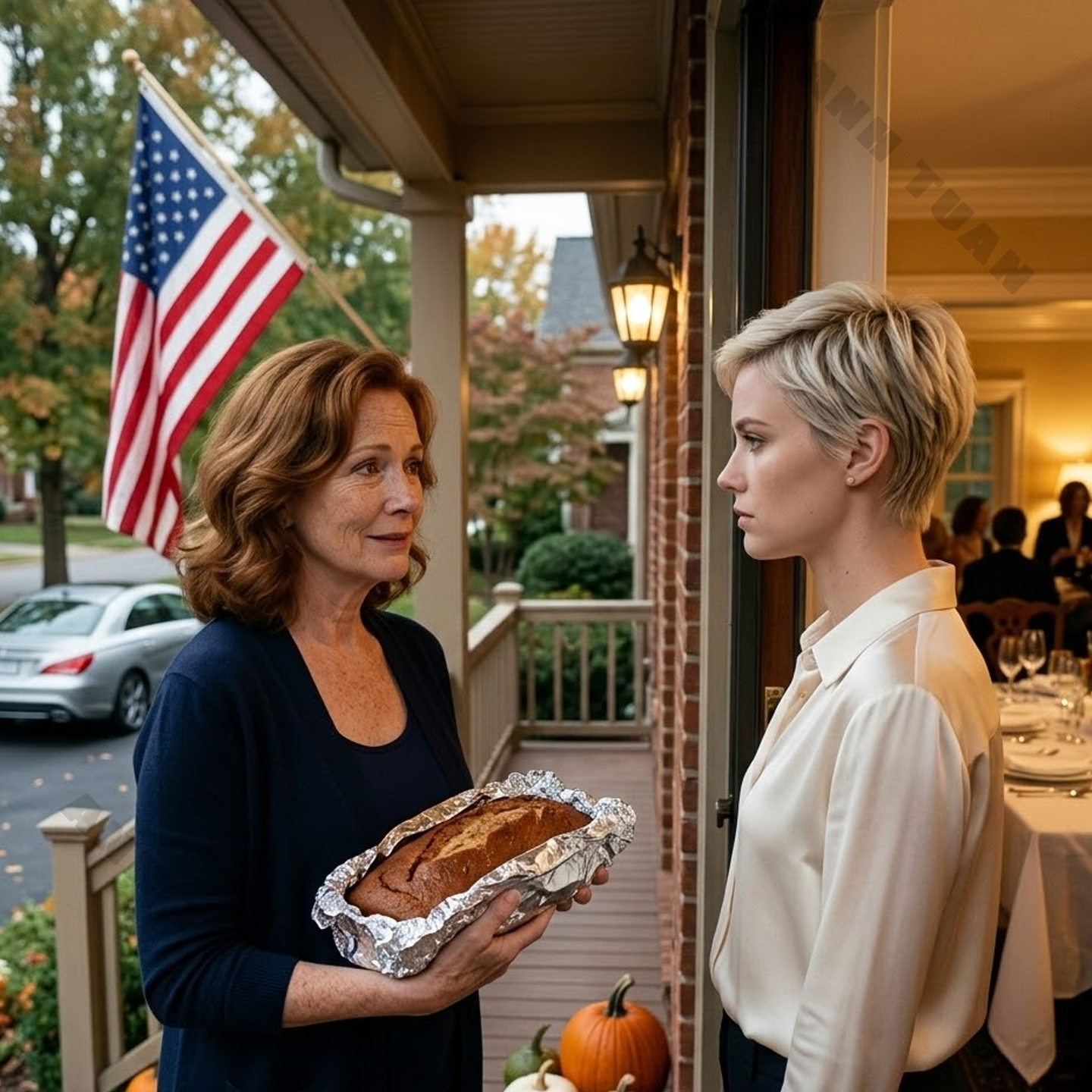
They told me I needed to live less comfortably, like comfort was some bad habit I’d picked up and refused to break. “You’re spending too much,” she said, and she didn’t even bother to soften it with a laugh. She said it like she was giving me good advice, like she was the responsible one and I was the reckless one, and all I could think was how strange it is to be lectured about money in a house you helped someone buy.
The worst part is that I didn’t even go there to talk about money.
I went there with bread.
A warm cinnamon loaf, wrapped in foil, pressed to my chest the way you carry something you made with your own hands. Thirty years of making that same loaf had trained my body to treat it like a promise. Birthdays. Thanksgiving mornings when the coffee pot never cooled. Sunday dinners when my son was still a kid and I could hear him laughing from the living room, the sound of him bouncing from couch to carpet like he had nowhere else in the world to be.
That afternoon in Lexington, the air had that clean bite early fall brings to Kentucky. Not winter, not yet. Just sharp enough to sting the inside of your nose when you breathe in deep, gentle enough to remind you summer hadn’t left quietly, it had just stepped back and let the light soften. The trees along the street were starting to turn at the edges. A hint of copper, a hint of gold. The kind of season that makes people feel generous and nostalgic, like they’re all walking around with memories tucked into their pockets.
I had memories, too.
They were the reason I was standing on that porch in the first place.
I was standing on the porch of a house I helped buy when my daughter-in-law cracked the door open just wide enough to let the insult slip out.
The porch itself looked like something out of a magazine. Fresh stain on the railings, a seasonal wreath, two lanterns flanking the door that gave off a soft, expensive glow. I had watched that porch get built, board by board, mostly from a distance. I had helped pay for the lumber without ever stepping into the contractor’s office. I had signed nothing, asked for no credit, never needed a thank-you. I had done it the way I’d done so many things for Luke. Quietly, efficiently, as if love was supposed to be invisible to count.
I rang the bell and listened to it chime inside. I could hear voices behind the door. Laughter that sounded polished, practiced. Glasses clinking. Music low and clean, the kind of playlist you put on when you want people to believe you’ve got it all together.
The door opened a sliver.
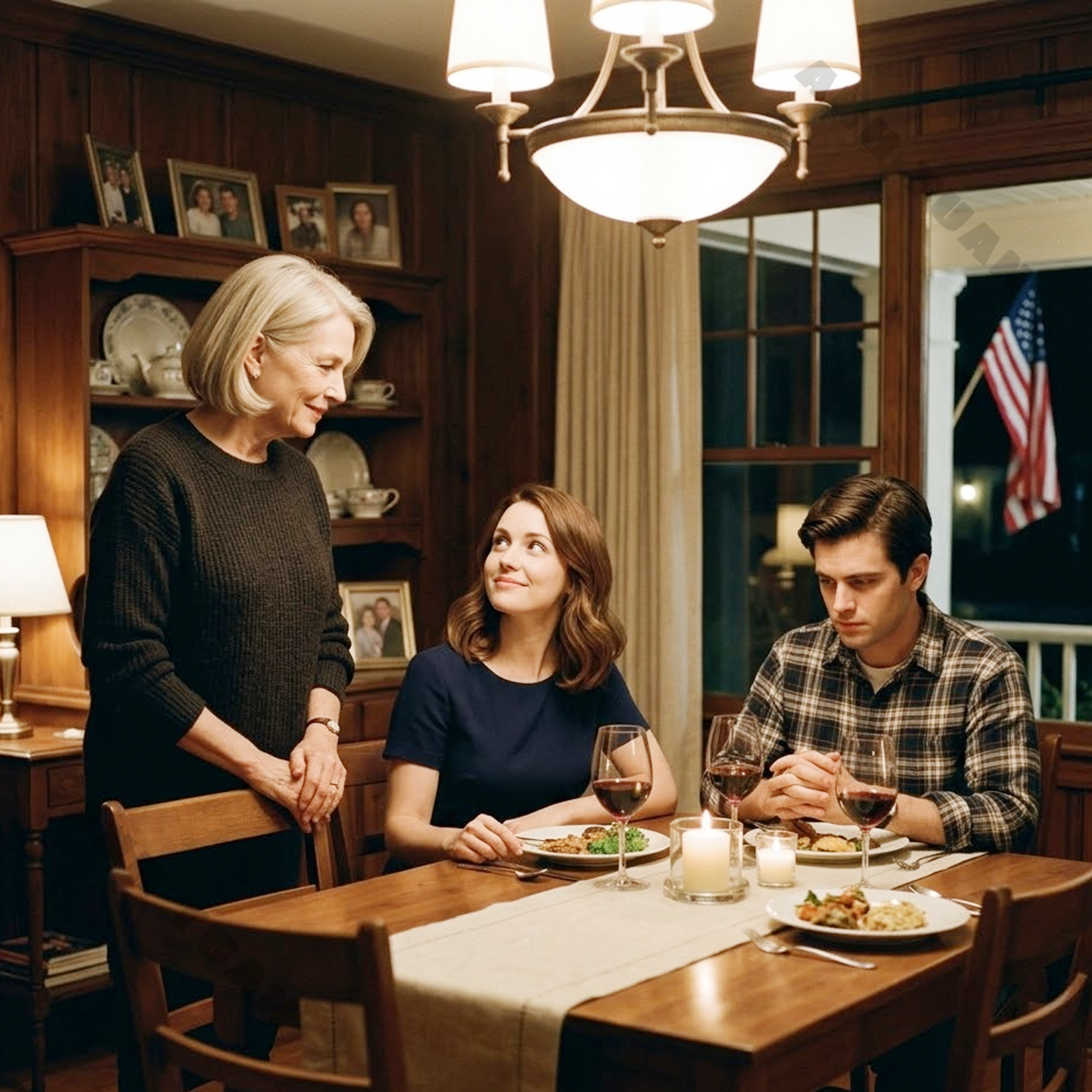
Melissa Whitford’s carefully painted smile appeared in the gap, her lipstick perfect, her teeth bright. Her hair was swept into those effortless curls that don’t happen by accident. Behind her, I caught a slice of their dining room: golden lighting, a long table set with polished silver and crystal glasses, place cards standing upright like little flags. Everything in there was shining.
I had imagined myself sitting at that table next to my son, laughing with my grandchildren, passing dishes, telling Abby to slow down and chew like I used to when she was little.
Instead, I was standing outside, holding bread like some hopeful fool.
“Oh, Evelyn,” Melissa whispered, lowering her voice as if I were an embarrassing secret she needed to keep from spreading. “I think Luke forgot to tell you. Tonight is not ideal for you.”
She paused, and her eyes flicked down, not to the loaf, but to my cardigan, my sensible shoes, my whole presence.
“Not ideal for me.”
The words didn’t land all at once. They came in slow, humiliating pieces, like I had to assemble them myself.
My grip tightened on the loaf. The foil crinkled, loud in the quiet. It betrayed the small tremor in my hands, so I adjusted my hold and forced my fingers to be still.
“But he invited me,” I said. My voice came out softer than I wanted, because part of me still believed there had to be a misunderstanding. “He said seven. He said it would be a small family gathering.”
Before Melissa could respond, Luke appeared at her shoulder.
My son.
The boy I raised on a teacher’s salary in Bardstown. The young man whose first apartment deposit I scraped together for. The grown man whose graduate school loans I subsidized without telling anyone because he was proud and I knew pride could be fragile. The man whose mortgage I had quietly supported for the last three years when their “temporary” tight spot turned into a lifestyle.
He would not look me in the eyes.
His gaze darted past my shoulder, toward the dark street behind me, like he hoped if he didn’t meet my face, he wouldn’t have to fully acknowledge what was happening.
“Mom,” he said, and even that word sounded like it had weight on it, like it cost him something. “We’re keeping tonight… elevated. Some colleagues from the firm are here. It might be uncomfortable for you.”
Uncomfortable.
As if I were a stain on their carpet. As if my presence would rattle the crystal on their table. As if my simple cinnamon loaf was an offense to polished silver.
I swallowed hard. My throat tightened, and I could feel that hot sting behind my eyes that comes when you’re trying not to break in front of people who don’t deserve to see you break.
“I thought I was family,” I whispered.
Melissa smoothed the sleeve of her silk blouse. It was the kind of blouse that probably cost more than my weekly pension check. She didn’t look embarrassed. She looked tidy, satisfied, like this was a boundary she was proud of enforcing.
“We just need some space tonight,” she said. Then she tilted her head, the way people do when they want their cruelty to sound like wisdom. “And honestly, Evelyn, you should learn to live less comfortably. We need to focus on building our future.”
Live less comfortably.
The words hit like a cold slap. Not because of what they meant on the surface, but because of where they were coming from. From a woman standing inside a house I helped pay for. From a couple who drove cars I had a hand in leasing. From people who said “our future” like I wasn’t one of the reasons they had one at all.
My mouth opened. Nothing came out.
So I did what I had been trained to do for decades. I nodded.
My head moved the way an old door hinge moves when it’s rusted. Mechanical. Obedient. I turned and walked down the steps, each one echoing with a humiliation I hadn’t tasted before.
The porch light clicked off before I reached my car.
Darkness swallowed me, and something inside me shifted.
The drive back to Bardstown felt longer than it should have. Kentucky roads can be beautiful, even when your heart is falling apart. Horse farms stretching out behind fences, the last of the light sliding across fields, the kind of landscape that makes you believe in steadiness. But that night, it felt like the road itself had stretched to make room for the ache in my chest.
I kept replaying the moment the porch light clicked off. The sound of it sealing me out like a stranger.
By the time I pulled into my driveway, the cinnamon loaf on the passenger seat had gone cold.
I left it there.
I didn’t have the heart to carry it inside.
My house greeted me with darkness and silence. The porch creaked when I stepped onto it, that familiar groan from old wood that had held up through storms and summers and years of me coming home alone. I didn’t turn on the light. I walked through the living room guided only by the faint streetlight filtering through the curtains.
I set my purse down. I leaned on the kitchen counter.
And I let the humiliation settle into something heavier.
Because it wasn’t just the dinner.
It wasn’t just Melissa’s voice dripping with condescension.
It was everything I had allowed.
Every quiet sacrifice. Every time I told myself generosity was the same as love. Every moment I ignored the little alarm bell inside my chest because I wanted my son to be okay, because I wanted my grandkids to have everything, because I wanted to believe that if I kept giving, they would keep coming back to me with warmth instead of obligation.
I drew a breath and opened the old oak drawer by the refrigerator.
It stuck the way it always did, swollen from decades of humidity and use. I tugged harder, and it slid open with a reluctant scrape. Inside was the folder I kept hidden, labeled in careful handwriting.
Carter household support.
My handwriting.
It hit me then how long ago I had accepted this role without question. How I had named it like it was a normal thing, like I was running some small office out of my modest kitchen.
I carried the folder to the table and sat down.
The chair creaked under me the way it always did, but that night it sounded like a warning.
I opened the folder and began laying out the documents one by one. Mortgage top-ups. Car leases. Melissa’s real estate marketing subscriptions. The children’s tutoring program. Health insurance invoices. The house pest prevention plan. Landscaping contracts. Grocery delivery fees. Memberships to places I had never been invited to, clubs I’d only heard about when Luke mentioned them in passing like they were no big deal. Payments for school trips I didn’t even know the children had taken until I saw the charge.
I counted slowly, my finger tracing the lines of each page as if I were reading a confession.
Ten pages, then twenty, then more.
One hundred and thirty-one active payments.
One hundred and thirty-one ways I had kept their life afloat while letting mine quietly sink.
The total monthly outflow made my breath catch. It was nearly triple what I lived on.
My retirement check, the one I had scraped together through decades in a public school classroom, had not been enough. So I used savings. Then investments. Then little pieces of my future I never expected to part with, the kind of money you tuck away because you assume you’ll need it for your own emergencies someday.
I glanced around my kitchen.
The laminate countertop was peeling at the edges. The stove was over twenty years old and one burner only worked if you twisted the knob just right. My slippers were patched with thread because I told myself buying new ones was unnecessary. The furnace rattled every winter, and every year I postponed replacing it because “the kids need something more,” because “Luke has a lot going on,” because “it’s just for a little while.”
Live less comfortably.
The nausea rose quickly, and it wasn’t only about the money. It was about the contempt. The way they took with one hand while pushing me away with the other. The way entitlement had replaced gratitude so smoothly I almost didn’t notice it happening, like a slow leak in a tire you don’t see until the car is already swerving.
My hands stopped trembling.
They stiffened with clarity.
I closed the folder.
The sound was soft, but in the quiet kitchen it echoed like a gavel. A decision wasn’t always loud. Sometimes it was just a final click in your mind, the moment you realize you’re done.
Tomorrow, everything would change.
Morning arrived gray and heavy, as if the sky itself carried the weight of what I’d uncovered. I dressed slowly, choosing my navy cardigan, the one Luke always said made me look too old-fashioned.
Today, I wanted to feel grounded, not pleasing.
I poured a cup of tea. It went cold untouched while I sat at the table with the folder in front of me, looking at it like it was a living thing. Something I had fed for years. Something that had grown in the dark.
By the time I reached Blue River Savings Bank, the air had sharpened into a brisk wind that pushed against me as though urging me to turn around.
But I didn’t.
I had banked there for over thirty years. It was one of those small-town banks that still smelled faintly like paper and old carpet, with a lobby that had seen generations come in and out holding deposit slips and mortgage documents, families building lives one payment at a time. The bell over the glass door chimed when I walked in, and the warmth inside hit my cheeks.
Michelle, one of the tellers, smiled when she saw me. “Morning, Ms. Carter,” she said, the way she always did, like I was part of the building’s history.
I managed a small nod.
Before I could even ask for her, Ruth Delgado spotted me. Branch manager. Fifty-eight, tidy bun, glasses always perched low on her nose. Ruth had a calm presence that had steadied people through layoffs and medical bills and the kind of financial emergencies that make your hands shake when you sign your name.
She waved me into her office, her expression gentle but questioning.
“Evelyn,” she said, closing the door behind us. “You look troubled. Sit. Tell me what you need.”
I placed the folder on her desk like it weighed more than paper, like it was a brick I’d carried across town. I folded my hands in my lap to keep them steady.
“Ruth,” I said, and my voice came out even, which surprised me. “I need to make some significant changes. I need all automatic transfers to Luke and Melissa’s accounts canceled immediately.”
Ruth blinked, as if she’d misheard.
“All of them?” she asked.
“All one hundred and thirty-one,” I confirmed.
She lowered her eyes to the folder, flipping through the pages I’d highlighted. Her brow tightened as she scanned the list. For a moment she didn’t look like a bank manager. She looked like a woman trying to understand how someone could do this to someone else.
“This will cause immediate disruptions for them,” she said carefully. “Mortgage, utilities, schooling, everything. Is something wrong?”
I stared at a framed photo on her desk of her grandkids at the lake, all smiles and sunburns and innocence, and I thought about my own grandchildren sitting at that crystal table without me.
“Everything is finally becoming right,” I said.
I didn’t smile. I didn’t cry. I let the words sit there like truth.
“I need it to stop today.”
Ruth’s gaze lifted to mine, and something in her expression shifted. She didn’t push. She didn’t lecture me about family. She nodded once, slow and respectful, like she recognized resolve when she saw it.
“Okay,” she said. “We can do that.”
She turned to her computer and began entering cancellations. The clicking of the keyboard sounded sharp in the quiet office. Each click felt like a door closing, not out of spite, but out of necessity.
As she typed, her brow furrowed deeper.
“Evelyn,” she said slowly, and the tone in her voice made my stomach tighten. “I need you to look at something.”
She turned her monitor slightly so I could see.
“There was a recent request to access your investment account,” she continued. “It was flagged because the signature did not match yours.”
My heart thudded, heavy and painful, like it was trying to warn me before my mind caught up.
“A request from who?” I asked.
Ruth hesitated, and in that pause I felt something cold slide up my spine.
“The name listed was Melissa Whitford,” she said.
For a second, the room went too quiet. Not peaceful quiet. The kind of quiet you get right before you realize you’ve been standing on a floorboard that’s rotted through.
Melissa hadn’t just taken my help for granted.
She had been preparing to take control of everything. To step into my accounts. To own what was not hers.
“Did she succeed?” I forced out.
“No,” Ruth said firmly. “The bank froze the attempt due to the inconsistency. But this wasn’t an accident, Evelyn. Someone was testing boundaries.”
Testing boundaries.
That phrase landed hard, because it was exactly what Melissa had been doing in my life for years. Testing how much she could take. Testing how far she could push. Testing whether I would ever say no.
My breath steadied slowly, painfully. I could feel my hands on my lap, my fingers pressing into my own skin as if I needed to anchor myself.
“Then add fraud alerts,” I said. My voice didn’t shake. “Lock down every account. Revoke Luke’s access entirely. Change beneficiaries, change security questions, change everything.”
Ruth met my eyes with quiet understanding. She didn’t look at me like I was dramatic. She looked at me like I was finally awake.
“Very well,” she said. “We will protect you.”
I signed new documents. I initialed lines that used to feel like a formality and now felt like a shield. My hand didn’t shake. The mountain I’d been carrying for years was finally sliding off my shoulders, and it hurt, the way muscles hurt after you’ve held something too heavy for too long.
When I stepped outside, the wind didn’t feel like resistance anymore.
It felt like release.
On the drive home, I kept both hands on the wheel and stared straight ahead, but inside my mind a storm was building. Not the kind that comes out of nowhere. The kind you see on the horizon and realize you’ve been ignoring.
Because it wasn’t just that I’d stopped paying bills.
It was that I’d pulled away the safety net they’d been bragging about, and now they were going to fall.
I pulled into my driveway. I walked inside. I set my purse on the counter.
For the first time in a long time, I poured myself a fresh cup of tea while it was still hot.
I sat down at my kitchen table, the same table where I’d once helped Luke practice spelling words, the same table where Abby used to color pictures and proudly show me her uneven letters. I wrapped my hands around the mug and let the heat seep into my palms.
Then my phone buzzed.
One sharp vibration, then another, then another, so rapid it sounded like a small storm rattling across the wood.
I watched the screen light up, and I didn’t pick it up right away.
Because in that moment, I understood something I hadn’t wanted to admit for years.
I hadn’t just been paying bills.
I had been holding their whole “stability” upright.
And now, without me, it was about to crack wide open.
I let the phone buzz itself tired.
It lit up the kitchen like a nervous heartbeat. Vibration after vibration, the kind that makes you feel hunted even when you’re sitting in your own chair. I stared at the screen as if it belonged to someone else. As if I hadn’t spent years jumping every time Luke called, rearranging my day around his needs because that’s what mothers do, that’s what good mothers do, right?
The tea steamed in front of me. I could smell cinnamon on my hands from the loaf I never brought inside. I could smell lemon from the dish soap on the sponge by the sink. Ordinary smells. Safe smells. And yet my stomach was tight, like my body could sense what was coming before my mind wanted to accept it.
I picked up the phone.
The first message was from Melissa.
Evelyn, Netflix is saying payment declined. Did you forget to update a card?
A minute later, another.
Also the kid’s tutoring portal is locked. Fix this.
Then, just two minutes after that, the tone shifted into something closer to a command wearing a thin mask.
Please fix this.
Not a single line asking if I was okay. Not a question about why the system suddenly changed. No curiosity. Just the assumption that their inconvenience was my emergency.
I set the phone down again, face up, and watched the next bubble appear like it was popping out of the screen.
Luke.
Mom. The electric bill shows unpaid. What is going on?
Mom, call me now.
Mom, seriously, I need you to take care of this. We have people coming this week.
People coming.
Guests. Colleagues. Appearances to maintain. Their world was built on being seen as polished, stable, elevated. And now the polish was cracking, and the first thing they thought to do was grab my sleeve and pull me back into place.
I turned the phone over and slid it across the table like it was a glass about to spill.
Then I did something that would have been unthinkable a year ago.
I stood up and went outside.
The roses along my fence had gotten leggy. I’d meant to prune them weeks ago, but it always felt like there was something else more urgent. Someone else. Some payment. Some “quick” favor. I pulled on my gardening gloves and began clipping away brittle stems, letting the small, steady motions calm the storm in my chest.
The phone buzzed in my apron pocket.
I let it.
Buzz.
Buzz.
Buzz.
Each vibration felt like a hand trying to reach through fabric and grab me. But my shears kept snipping. Dead stem, clean cut. Another. Another. There was something deeply satisfying about making a clear ending, about removing what no longer served the plant so something healthier could grow.
By late afternoon, the messages changed.
Confident demands turned into strained confusion.
Then panic.
Then anger.
Mom, why are the cars flagged as overdue? We got a notice from the water company.
Mom, this is serious.
Mom, stop ignoring us.
This is humiliating.
Humiliating.
That word again.
The same one Luke had used the night he left me standing on a porch like an unwanted guest. The same word Melissa’s tone had carried without saying it outright. Humiliation mattered to them the way oxygen matters to people who’ve never been without it.
I didn’t answer.
I went inside, washed my hands, and made myself a simple dinner. Soup from the freezer. Crackers. The kind of meal I’d lived on for years while I funded club memberships and shiny cars I wasn’t allowed to sit in.
I ate slowly, at my own pace, in my own quiet kitchen.
At dusk, Melissa’s number popped up with another message, and this time there was less polish and more edge.
Evelyn, if you’re doing this out of spite, just know you’re creating unnecessary drama. People will talk. You’re making us look irresponsible.
Making them look irresponsible.
As if responsibility were a costume they wore when it suited them and tossed at my feet when it got inconvenient.
Seconds later another message followed.
If you don’t resolve this tonight, I will reach out to some people who can help mediate this in a formal way.
A threat.
Not loud, not explicit, but sharp enough for me to feel it under my ribs. The kind of threat that assumes you’ll flinch, that you’ll rush to make it go away because you’ve spent your whole life smoothing things over so other people can keep their image intact.
I deleted the messages.
Then I powered off the phone completely.
Silence poured into the house like water. Not empty silence. Not lonely silence. A thick, steady quiet that felt like permission.
I locked the back door. I slid the bolt into place. The metal clicked, and that sound felt like a boundary being set in the real world, not just in my mind.
Across the street, my neighbor, Mr. Talbott, waved as he carried trash to the curb.
“Evening, Evelyn,” he called. Then he hesitated, like he wasn’t sure if he should say the next part. “Saw your son driving around late last night. Seemed like he was looking for something. Or someone.”
My skin prickled.
“Thank you,” I said, keeping my voice even.
I went inside and turned on the porch light, the one I paid for, the one no one could switch off on me.
That night I slept deeper than I had in years, not because I wasn’t afraid, but because I was finally done pretending.
The next morning, the confrontation arrived not with a polite knock, but with the hard slam of my front door hitting the wall.
I was slicing an apple at the kitchen counter when Luke stormed in like he owned the place.
His face was flushed, breath ragged, eyes wild. It was the look of a man whose world had tilted overnight, the look of someone used to having a cushion under every fall.
“Mom!” he shouted. “What on earth did you do?”
I placed the knife down slowly. Deliberately. My hands were steady, and I noticed it. I noticed how different it felt to be calm while someone else was unraveling.
“You shouldn’t enter a home without being invited, Luke,” I said.
He ignored the warning, pacing like a trapped animal.
“The bank froze our mortgage account. The car payments bounced. Utilities are overdue. Melissa is furious. Do you have any idea how embarrassing this is?”
Embarrassing.
Always that word, as if the greatest tragedy in their lives was the opinion of strangers.
I gestured toward the kitchen table.
“Sit down, Luke.”
He didn’t. He kept pacing, running a hand through his hair until it stuck up in places.
“Why would you stop everything?” he demanded. “You know we rely on these things being handled. You know how busy I am.”
Busy.
That was his favorite shield. He wore it like armor. Too busy to notice who was paying. Too busy to question why his mother’s car was old while his wife’s was new. Too busy to ask if I was warm in the winter, too busy to care if I’d eaten, too busy to see me until I became inconvenient.
I looked at him steadily.
“I stopped them because you told me to live less comfortably,” I said. “I’m simply granting your request. I’m living within my means and allowing you to live within yours.”
His mouth opened, then closed.
“Mom, that’s not what I meant,” he said quickly. “Melissa… she meant… it was a misunderstanding.”
A misunderstanding.
I reached for the folder I’d brought back from the bank. It was on the counter, thick and heavy, like the truth itself had weight.
I placed it on the table between us with a soft thud.
“One hundred and thirty-one payments, Luke,” I said. “One hundred and thirty-one ways I’ve been supporting your life.”
His eyes dropped to the papers as if they were written in a language he couldn’t read. His shoulders stiffened. For the first time, he looked less like a polished man from a firm and more like the boy who used to get nervous before spelling tests.
“I didn’t realize it was that much,” he muttered.
“That,” I said, “is the problem. You didn’t realize because you never asked.”
He lifted his gaze, and I could see anger trying to replace embarrassment, because anger was easier for him.
“You’re twisting this,” he said.
“No,” I replied, calm enough to scare him. “I’m finally untwisting myself from years of being your safety net.”
Luke stopped pacing. His eyes sharpened, and his voice dropped into something quieter, colder.
“If you keep this up,” he said, “Melissa wants to pursue legal action. She says we can prove you’re not capable of managing finances on your own.”
For a second, the room felt like it did in Ruth Delgado’s office when she told me Melissa’s name. Too quiet. Too clear.
I didn’t laugh, but something inside me almost did. Not because it was funny, but because it was so predictable. When people can’t control you with guilt, they reach for fear.
“She already tried to access my investment account,” I said. “The bank notified me.”
His face changed.
Not anger now. Not embarrassment.
Fear.
“She… what?” he whispered.
“She did,” I said. “And if she continues, there will be consequences far beyond humiliation.”
He took a step back like the air between us had turned sharp.
“Mom, I didn’t know,” he said, and his voice cracked on the last word.
I nodded once.
“That, Luke,” I said quietly, “is exactly why everything has to change.”
He backed away toward the door, slower now, like he wasn’t sure how to move in a world where I no longer bent to hold him up.
When he left, the house didn’t feel relieved.
It felt hollow, like something had been ripped out of it and the echo was still circling.
I stood by the window and watched his sedan disappear down the street. I tried to imagine what he would do next. Would he come back with Melissa? Would they try to pressure me through family? Would they try to paint me as unstable the way Melissa had already hinted?
I tried to knit. I tried to read. Nothing held.
Then, late afternoon, there was a soft knock on my door.
Not frantic. Not aggressive.
Gentle. Hesitant. Almost musical.
When I opened it, Abby stood there.
My granddaughter.
A plastic container of soup in her hands. Red eyes that told a story before she spoke. Her hair was twisted into a messy bun, and she looked younger than her twenty-one years, like someone had taken the security out of her bones.
“Grandma,” she said, voice thin. “Can I come in?”
“Of course,” I told her, stepping aside.
She moved into my kitchen like she was walking into shelter. She set the soup on the counter. Her hands trembled when she tried to take off her jacket.
I poured tea and slid a mug toward her, but she didn’t drink. She stared into the steam like she was searching for answers in it.
“It’s bad at home,” she whispered finally. “Really bad. Dad is yelling. Mom is crying and breaking things. They keep saying you ruined everything.”
I didn’t interrupt. I let her talk. I let her words fall where they needed to fall.
“They keep saying you did it out of spite,” Abby continued, then she swallowed. “But… I don’t think that’s true.”
I waited.
Her fingers tightened around the mug.
“I saw the folder,” she said. “Dad threw it on the counter when he got home. I saw all the payments. Grandma, I had no idea. None of us did.”
Relief hit me so hard it almost hurt. Not because I wanted Abby to see my burden, but because someone finally understood it was real.
Then Abby reached into her backpack and pulled out her phone.
“And I found something else,” she said, voice dropping. “Something Mom didn’t want anyone to see.”
She tapped through photos, then turned the screen toward me.
My name stared back at me from the documents on her phone.
Refinancing applications. Preliminary loan forms. Authorization drafts. Pages partially filled out in Melissa’s handwriting.
My stomach dropped as if the floor tilted.
“Where did you get these?” I asked.
Abby’s throat bobbed when she swallowed.
“Mom left them on her desk,” she said. “I heard her on the phone… she said she needed to speed it up before you changed anything.”
The room went cold even though the sun was still out.
“Grandma,” Abby whispered, “I think she was planning to put the house in your name on a loan. A big one. One you’d be responsible for.”
The air felt thin.
This wasn’t entitlement anymore.
This was intention.
Calculation.
A plan to use me as collateral, to bind me legally so I could never fully escape, even if I stopped paying.
I stared at the screen until my eyes blurred.
Under the dread, something steadier surfaced.
Resolve.
Because this time I didn’t just have instincts.
I had proof.
Abby reached across the table and took my hand.
“I don’t want to be like them,” she said fiercely. “I got a job at the bookstore on campus. I’m paying for my gas, my books, my insurance. I want to stand on my own two feet.”
Her eyes glistened with conviction, and it felt like a small light turned on in a room I’d been sitting in for years.
I squeezed her hand.
“I’m proud of you,” I said. “More than you know.”
She nodded, wiping at her face with her sleeve like she was embarrassed by her own tears.
“And Grandma,” she added, “they might be planning to move away. Mom said she can’t stay in Kentucky if people start asking questions.”
I leaned back in my chair, absorbing it all.
The facade was cracking.
And through the cracks, the real story was starting to show.
I didn’t know yet what Melissa would try next.
I didn’t know how far Luke would let her go.
But I knew one thing with a certainty that settled into my bones.
If they were already drawing up papers with my name on them, then stopping the 131 payments was only the beginning.
That night, after Abby left, I stood at my sink with the faucet running too long, letting the water rush over my hands like it could rinse away what I’d just learned. Outside, the last light slipped down behind the trees, turning my little backyard the color of old pennies. The house felt the same as it always had, quiet, worn in at the edges, reliable. But I didn’t feel the same inside it. I felt like someone had reached into my life and moved the furniture while I wasn’t looking, and now I had to learn the shape of the room all over again.
I dried my hands and walked back to the table where Abby had been sitting, where her phone had glowed with my name on paperwork I’d never signed. The tea mugs were still there, two circles of warmth on the wood. I touched one with my fingertip, absentminded, like I needed proof the afternoon had been real.
I hadn’t raised Luke to become this.
That was the thought that kept coming, sharp and stubborn. Not because Luke was a child anymore. He was a grown man with a suit and a firm and a mortgage. But because somewhere along the way, the part of him that recognized right from wrong had gotten quiet, and I wasn’t sure if he had silenced it or if someone had done it for him.
I opened my laptop and pulled up my bank’s number, then stopped. I didn’t want to be the woman who spiraled, who called everyone in a panic and handed over control just because she was scared. Ruth Delgado had already protected me once, and she’d told me the truth. Tonight, I needed to protect myself in a different way. I needed to think.
So I did what I used to do when I was teaching and a student came to me with a story that didn’t add up. I sat down. I breathed. I wrote things out on paper.
What I knew.
What I didn’t know.
What I had proof of.
And what I needed next.
By the time I turned off the kitchen light, the list had grown longer than I wanted it to be. My hand cramped, but my mind was clearer.
I slept, but not the way I usually slept. I slept like a person with one ear open, like the house itself might warn me if someone came too close. Still, morning came, and it came ordinary, and I hated that for a moment. I hated that the sun could shine on a world where my daughter-in-law could fill out loan forms in my name like it was a casual errand.
I made coffee anyway. I sat at my table anyway. I watched the steam rise anyway.
Then I drove back to Blue River Savings.
The parking lot was nearly full, which made sense. It was the first week of the month, when people came in to pay bills and ask questions and shuffle money around like life could be managed with the right forms and the right signatures. I walked through the doors with my shoulders back and my folder tucked under my arm. I had never been the kind of woman who walked into a place looking for a fight.
But I was becoming the kind of woman who didn’t avoid one when it was necessary.
Michelle at the teller counter saw me and softened her expression, as if she could tell the air around me was different today.
“Ms. Carter,” she said quietly. “Ruth is expecting you.”
Ruth met me at her office door. She looked steadier than I felt, which I appreciated more than I could say. Some people meet your fear with their own, and it becomes a room full of panic. Ruth met my fear with calm, and it turned into something manageable.
She closed the door behind us and gestured toward the chair.
“Tell me,” she said.
I didn’t waste time.
“My granddaughter showed me documents last night,” I said. “Loan forms. Refinancing paperwork. My name. My address. Pages partially filled out in Melissa’s handwriting.”
Ruth’s face tightened, and for the first time I saw anger flicker through her composure. Not loud anger. Not emotional anger. The kind of anger that comes from watching someone try to take advantage of an older person who has been too generous for too long.
“Do you have copies?” she asked.
“Photos,” I said. “On Abby’s phone. She sent them to me.”
Ruth nodded once, decisive. She pulled a notepad toward her and began writing as she spoke, like she was building a bridge out of procedure.
“We’re going to do a few things today,” she said. “First, we’ll document everything you have. Second, we’ll flag your profile at a higher security level. Third, I’m going to connect you with our fraud department so there’s an official record of this pattern.”
That word again, pattern, and it landed differently this time. It meant I wasn’t imagining it. It meant it wasn’t just one odd request and one rude comment. It meant there was a line connecting every small disrespect, every entitlement, every assumption that my resources were theirs to manage.
Ruth slid her monitor toward me and pointed to a screen with account permissions and access logs. I recognized Luke’s name on a few of them, the access I’d given him years ago when he told me it would “make things easier.”
I could still hear him saying it in my head, the tone he used when he was being persuasive. Mom, it’s just easier this way. Mom, you don’t need to worry about it.
Ruth looked at me.
“Are you ready to revoke everything?” she asked.
I took a breath. I thought of the porch light clicking off. I thought of Melissa’s voice saying live less comfortably. I thought of Abby’s trembling hands when she showed me my name on those forms.
“Yes,” I said.
Ruth clicked, typed, printed. She explained every step without talking down to me, which mattered. I signed papers. I chose new security questions. I set up alerts that would notify me if anyone tried to shift a dollar without my permission. It was tedious. It was thorough. It was exactly what I should have done years ago, but I wasn’t going to punish myself for not knowing what I didn’t know.
When we finished, Ruth leaned back slightly and folded her hands.
“Evelyn,” she said carefully, “I’m going to be honest. The attempted signature mismatch last week and these documents you’re describing, that’s not a misunderstanding. That’s someone preparing.”
I nodded, my mouth tight.
“I also want you to consider speaking with an attorney,” she continued. “Not because you need to escalate for the sake of it, but because you need protection. The moment someone starts drafting obligations in your name, you need professional boundaries, not just personal ones.”
An attorney.
The word made my stomach clench in an old instinctive way. In my family, in my generation, you didn’t talk about attorneys unless something had gone truly off the rails. You didn’t bring outsiders into family mess. You cleaned it up quietly, behind closed doors, so the neighbors wouldn’t talk.
Then I remembered Melissa’s message, the one about mediating things “in a formal way,” like she’d already been preparing the language to paint me as unstable.
“Okay,” I said.
Ruth wrote down a local name, someone she trusted, and slid the paper across the desk. Her pen scratched the last line, and then she met my gaze.
“You’re doing the right thing,” she said.
The drive home felt different than the drive after the porch incident. I still felt the ache, but it didn’t own me. The sky was brighter. The air smelled like cut grass and distant smoke, like someone in the county was burning leaves too early, impatient for fall to arrive fully. I rolled down my window and let the wind hit my face, and for a moment I allowed myself to feel something that wasn’t dread.
Relief.
I pulled into my driveway and noticed something small that almost made me laugh, a laugh that startled me because it had been so long since anything had felt funny. My mailbox flag was up. A piece of junk mail, probably, or a flyer for a fall festival. Ordinary life insisting on continuing.
I went inside, set my keys down, and turned my phone back on.
It was like turning on a radio to a station that had been screaming for hours.
Messages flooded in.
Luke, again and again. Melissa, curt and sharp. A voicemail from a number I didn’t recognize that turned out to be someone from a service company calling about overdue payment. My name, my phone number, my responsibility attached to things I hadn’t been thinking about because for years the payments had been so automatic they’d become background noise.
I listened to none of it right away. I didn’t respond. I let the notifications stack up like a pile of mail I didn’t have to open until I was ready.
Instead, I walked to my pantry and took out flour, sugar, cinnamon. I didn’t do it because I wanted to comfort myself with baking, though maybe some part of me did. I did it because I wanted to prove to myself that my hands could still make something warm and steady even when the world around me was unstable.
I made another loaf.
The cinnamon smell filled my kitchen, soft and familiar. It wrapped around me like a memory I could trust. While the dough rose, I sat at my table and wrote another list.
What would I do if Melissa tried to pressure me?
What would I do if Luke begged?
What would I do if they showed up again?
It wasn’t just planning. It was rehearsing a new version of myself, one who didn’t fold under the weight of other people’s reactions.
The days that followed felt like the uneasy calm after a tornado warning passes without the storm touching down, when the sky looks deceptively blue but everyone knows the air is still charged. I went about my routines quietly. I watered my plants. I swept the porch. I did my laundry and folded it neatly, because neatness has always been one of my ways of telling myself I’m okay.
But beneath the surface, life around me was shifting.
Word travels fast in Kentucky, especially in towns where family names carry more weight than street signs. People here don’t need proof to start talking. They just need a few details and a reason.
I heard the first sign during my morning walk with Ruth Anne, my neighbor who had lived on this street longer than I had. She walked her little terrier like it was her job and she knew everyone’s business the way some people know the weather.
We passed each other by the maple tree that leaned over the sidewalk like it was listening.
“Morning, Evelyn,” she said.
“Morning,” I replied, and tried to keep my voice casual.
She lowered her voice anyway, because gossip requires a certain tone.
“I saw a tow truck hauling away that big SUV from Luke’s place,” she said, eyes wide with the kind of fascination that comes when someone else’s life turns into a show. “You know the one Melissa always bragged about.”
I didn’t react, at least not on the outside. I just nodded as if it was a fact about traffic.
“Oh,” I said. “Did you.”
Ruth Anne watched my face, looking for a crack, for confirmation. I gave her none.
The next day, Mr. Talbott mentioned in the most casual way possible that the Whitfords had canceled their annual fall trip to Asheville.
“They’re always posting pictures from that place,” he said, leaning on his rake. “You know, hiking, little fancy coffee shops. Guess not this year.”
I nodded again. Kept my expression neutral. Inside, I felt something settle. Not satisfaction. Not revenge. Just the quiet certainty that actions have consequences, even when people are used to avoiding them.
Two days later, I ran into Marjorie at the grocery store. Marjorie had been in my book club years ago before she got too busy with her grandkids and her church committee. She pushed her cart closer than necessary and tilted her head toward me, as if we were sharing secrets in a place with bright fluorescent lights and strangers reaching for cereal boxes.
“I heard Melissa’s losing clients,” she whispered. “She’s been distracted, disheveled, and… well. Desperate.”
Desperate.
That word made me think of Melissa’s perfect curls and her silk blouse and the way she’d smoothed her sleeve while telling me to live less comfortably. It made me think of how quickly polish slides off when the foundation underneath is borrowed.
I didn’t ask questions. I didn’t encourage the gossip. I simply said, “I see,” and kept walking, my cart squeaking down the aisle like it always did.
At home, I avoided the temptation to check social media, to look for clues and confirmation. I didn’t want to live inside their chaos. I wanted to live inside my own choices. So I kept my world small and steady. Tea in the afternoon. A little knitting in the evening. The radio low, tuned to the local station that played older country music and read school closings in winter.
Still, I didn’t expect to see Luke again so soon.
It was a Thursday evening, quiet and cool, the kind of dusk that turns the sky a soft lavender. I was sitting on my porch with a mug of chamomile tea, watching the light fade in the way I always had, when I heard tires crunch slowly on gravel.
A modest gray sedan pulled into my driveway.
Not the gleaming SUV. Not Luke’s usual polished car. Something smaller, older, practical.
Luke stepped out and stood beside it for a moment as if he wasn’t sure he had the right house. He wasn’t wearing his tailored blazer or polished shoes. He wore jeans and a faded sweatshirt. The kind of clothes he used to wear when he came home from college for the weekend, when he’d raid my fridge and fall asleep in the living room like the world couldn’t touch him as long as he was under my roof.
He walked toward me slowly, each step heavy and deliberate.
When he reached the bottom of the porch steps, he paused. His hands were in his pockets like a boy waiting for permission.
“Hi, Mom,” he said quietly.
“Hello, Luke,” I replied.
I didn’t invite him up right away. Not to be cruel. To remind both of us that the rules had changed. That he couldn’t just storm into my kitchen anymore like I was an extension of his life.
He looked down, then reached into his pocket and pulled out a small box.
The worn velvet edges told me exactly what it was before he even opened it.
“I brought this back,” he said, voice rough. “I couldn’t… I didn’t want to sell it. It didn’t feel right.”
He opened the box, and there it was.
The vintage watch I’d gifted him on his thirty-fifth birthday. His father’s watch. A piece of family history, the kind of object you don’t replace. The kind of thing that isn’t worth much to strangers but is priceless to people who know what it has seen.
I stared at it and felt a tightness in my chest that surprised me. Not pain. Not anger. Something more complicated. Like grief mixed with recognition.
“I don’t want the watch back,” I said softly. “It was a gift.”
Luke shook his head, eyes wet in a way I hadn’t seen since he was a teenager and I caught him crying in his room after a breakup he pretended didn’t matter.
“I don’t deserve it,” he whispered.
The word hung between us, heavy.
I watched him, really watched him, and saw how stripped down he looked without his usual armor. The firm, the money, the image, all of it was gone in that moment. He was just my son, standing at the edge of my porch with something precious in his hands like he didn’t know what else to do with it.
“Luke,” I said, careful, “what’s going on?”
He swallowed, and his throat moved like it hurt.
“It’s hard,” he admitted. “Really hard. We’re trying, but everything feels impossible now. Without your help, without… without the things we got used to, we’re struggling.”
I nodded.
“Yes,” I said simply. “You are.”
He flinched slightly, like he expected me to deny it for him, to soften the truth so he wouldn’t have to feel it. But I didn’t.
He stared past me, toward my front door, toward the warmth inside my house, and I could tell he wanted to ask for comfort without asking for money. He wanted to come home without admitting he’d been the one to lock me out.
“Melissa is still angry,” he said, voice low. “But I… I understand now. Or I’m starting to.”
A long silence stretched. Crickets started up in the grass. Somewhere down the street, a dog barked once and then stopped, like even the neighborhood was listening.
Finally, Luke lifted his eyes to mine.
“Can I come for dinner sometime?” he asked. “Just me and the kids. No guests. No business. Just dinner.”
Something opened in me then. Not the old reflex to rescue. Not the old panic that if I didn’t fix it all, everything would fall apart. Something gentler and more honest, like a door being opened slowly, cautiously, with both people aware of what could happen if it slammed shut again.
“I would like that very much,” I said.
He let out a shaky breath.
“How about next Tuesday?” I added. “I’ll make roast chicken.”
Luke’s shoulders dropped, and for the first time in weeks, he looked like he could breathe.
“Thank you, Mom,” he whispered.
He didn’t come up onto the porch. He didn’t try to hug me. He simply closed the watch box and held it tighter, like he needed to keep it safe from whatever had been happening in his life.
When he turned to walk back to his car, his steps looked different. Heavier, yes.
But steadier.
After Luke’s sedan rolled out of my driveway, I remained on the porch long enough for the tea in my mug to cool. The sky deepened into shades of violet and rose, the kind of sunset that settles into your bones and reminds you the world still holds beauty even after you’ve been bruised.
For the first time in a long while, I felt no guilt waiting to ambush me.
Inside, the house seemed warmer than usual.
I walked to the drawer beside my refrigerator. The old folder lay exactly where I had left it, thick with documents and years of unspoken expectations. I lifted it and felt the weight of it in my hands. Not just paper weight. Life weight. The weight of being the one who always made sure everything stayed upright, even if it meant bending until I nearly broke.
I carried it to the trash bin.
No ceremony. No hesitation.
I opened the lid and let it drop.
Paper hit plastic with a sound far quieter than what it symbolized.
It was done.
I made myself a cup of cocoa and sat in my living room with my knitting basket. The yarn slid through my fingers, soft and obedient, and I worked on a sweater for Abby. Each stitch felt like a small promise for her future, a future I wanted to be built on strength, not dependence.
I considered starting a sweater for Luke too.
But not yet.
Growth takes time. And this time, the next step had to come from him.
Not from me.
In the days that followed, the house filled with a gentle rhythm. Not the frantic rhythm of managing other people’s crises. A slower, steadier rhythm that belonged to me.
I bought myself a new coat, the color of winter wheat, softer and warmer than anything I had allowed myself in years. I tried it on in the dressing room and looked at my reflection under harsh department store lights, and I realized how long it had been since I’d bought something just because it felt good, not because it was necessary.
I purchased a cashmere scarf too.
I didn’t tell anyone about it. I didn’t post it. I didn’t justify it.
I wore it around the house simply because it felt like kindness.
One evening, Abby stopped by after her shift at the campus bookstore. She came in smelling like paper and rain, her cheeks pink from the cold. She curled up on the couch beside me and pulled her hair down from its clip with a tired sigh that made her look exactly her age.
“I got my paycheck,” she said, and there was pride in her voice like a light.
“That’s wonderful,” I told her.
She grinned and pulled out her phone to show me the deposit, as if it was a trophy.
“I’m saving for a small used car,” she said. “Nothing fancy. Just something that’s mine. And I paid my insurance on my own this month.”
Her independence glowed from her. Not loud, not performative. Just real.
I saw in her the resilience Luke had forgotten he owned.
As the weeks passed, Luke kept his word.
Every Tuesday, he came with the children.
The first time, I watched through my front window as his car pulled in, my heart doing strange things in my chest like it didn’t know whether to brace or soften. The kids ran ahead of him up my walkway, their feet thudding on the porch boards, their voices bright and impatient.
“Grandma!” they called like nothing had changed.
And maybe, for them, not everything had. Children have a gift for living in the moment, for loving without taking inventory.
I opened the door and the house filled with their energy. Their jackets flung over chairs. Their school stories tumbling out in bursts. Their questions about what was for dinner and whether I had any dessert.
Luke followed more slowly. He stood in my doorway for a beat longer than necessary, as if he was waiting for the old version of me to show up, the one who would immediately ask how he was doing, immediately offer to help, immediately smooth everything.
Instead, I simply said, “Come in,” and stepped aside.
Dinner was simple. Roast chicken. Mashed potatoes. Green beans. Ordinary food.
Ordinary conversation.
But something about the ordinariness stitched us back together in ways money never could.
Luke helped wash dishes. He didn’t hover on his phone. He listened when I spoke. He asked Abby about school when she stopped by one Tuesday and stayed for a plate. He laughed at something his son said, a real laugh, not the polite kind he used at his firm events.
He never once asked for financial help.
That, more than anything, told me he understood the boundary.
It wasn’t always smooth. Some Tuesdays, he looked tired in a way that had nothing to do with work. Some Tuesdays, he stared at my kitchen table like he was seeing it for the first time, like he was remembering who he used to be before his life became a performance.
Once, his daughter asked about a vacation they used to take every fall, and Luke’s jaw tightened for half a second before he forced a smile and redirected the conversation.
I didn’t step in. I didn’t offer to cover anything. I let him sit in the discomfort and handle it, because that’s what adults do.
And slowly, week by week, I saw something shift.
Not overnight. Not like a dramatic movie moment where someone suddenly understands everything and becomes a new person.
Real change doesn’t work that way.
Real change is quieter. It happens in choices. In small acts of humility. In someone showing up even when it’s uncomfortable.
One chilly night, after the children had hugged me goodbye and run to Luke’s car, Luke lingered on the porch. The wind tugged at the edges of my scarf. The porch light cast a soft circle around us, warm against the dark.
He looked at me with something I hadn’t seen in a long time.
Respect.
“Mom,” he said, and his voice was careful, like he didn’t want to ruin the moment by saying the wrong thing. “Thank you for not rescuing us.”
I didn’t answer right away. I let the words settle. Part of me wanted to respond with all the pain I’d swallowed over the years, all the nights I’d been alone with my worry while he lived elevated under lights I paid for.
But this wasn’t about punishing him.
It was about reality.
“I love you, Luke,” I said quietly. “But love isn’t meant to carry grown adults. Love is meant to teach them to walk.”
Luke nodded slowly. His breath came out in a visible puff in the cold.
“I know,” he whispered.
He didn’t say Melissa’s name. He didn’t bring her into it. He just stood there, my son, learning how to hold the weight of his own life.
When he drove away, I stepped back inside, lit the fireplace, and cut myself a slice of cinnamon loaf.
The crust was crisp. The inside was warm and soft. The smell filled the room like a memory that had come back home.
I sat close to the flame and let the warmth sink into my skin. For years, I had stood at the edges of my own life, giving and giving until I nearly disappeared. I had convinced myself that sacrifice was the same thing as being needed, that if people relied on me, that meant they loved me.
Now, in my own house, in my own chair, I felt whole again.
Not because everything was fixed.
Not because Luke had suddenly become perfect or because Melissa had apologized or because my family had turned into some storybook version of itself.
I felt whole because I had chosen myself.
I had chosen dignity over guilt.
I had chosen to stop paying for a life that wouldn’t even make room for me at its table.
Sometimes, late at night, my mind still wandered back to that porch in Lexington. I could still see the sliver of door, Melissa’s painted smile, the golden light behind her, the long dining table set like a stage. I could still hear her whispering like I was something she didn’t want people to notice.
Live less comfortably.
But now, when that memory surfaced, it didn’t slice me open the way it used to. It reminded me of something else, something I hadn’t understood when I was still trying to earn my place in a room that didn’t want me.
Comfort isn’t a sin.
Comfort is what you earn when you’ve worked your whole life.
Respect is what you deserve when you’ve given love honestly.
And boundaries are what you set when people confuse your generosity with their entitlement.
There were still loose ends, of course. There were still questions. Melissa didn’t vanish into thin air. She didn’t suddenly become kind. Some weeks, I heard whispers through the grapevine that she was telling people her side of the story, that she was saying I was “dramatic,” that she didn’t understand why I’d “turned cold.”
I let her talk.
People who need to keep their image polished will always narrate themselves as the victim when the mirror cracks.
What mattered was what I saw with my own eyes.
I saw Abby building her life carefully, paycheck by paycheck.
I saw my grandkids laughing in my kitchen without worrying about whether the silverware matched the napkins.
I saw Luke washing dishes like a man who was finally learning that love isn’t measured in what you can extract from someone, but in what you’re willing to do when no one is watching.
And I saw myself, wearing my wheat-colored coat and cashmere scarf, sitting by my fire with cinnamon bread and quiet, realizing the simplest truth I’d spent decades avoiding.
You can’t buy respect.
You can’t purchase love.
And you can’t save people who refuse to stand.
But you can choose your own life back, even if it takes you thirty years to do it.
Sometimes I wonder what would have happened if I’d answered that porch insult with anger. If I’d made a scene. If I’d shouted, demanded, cried right there under their golden light. Maybe it would have felt good for five minutes. Maybe it would have given Melissa something to point to, something to call unstable.
Instead, I went home, opened a drawer, counted the truth, and made a quiet decision.
I stopped paying.
No arguing. No explanations. Just letting everything speak for itself.
And it did.
Layer by layer, the stability they bragged about cracked, revealing who had really been keeping the whole family standing.
The strange part is, I didn’t feel powerful in a triumphant way. I didn’t feel like I’d won.
I felt tired.
But I also felt free.
And freedom, I’ve learned, doesn’t always feel like fireworks. Sometimes it feels like a warm room, a simple dinner, and a Tuesday evening where your son shows up without demands.
Sometimes it feels like cinnamon on your fingertips and a quiet house that belongs to you.
Sometimes it feels like a boundary held steady long enough for other people to finally find their own footing.
So I’ll ask you this, because I think it’s a question more of us should be brave enough to answer out loud.
When does helping family stop being love and start being a quiet kind of harm, not just to you, but to them too?
If you’re still here, thank you. That means more than you know.
Hit subscribe if you want to hear more stories like this one. Drop a comment and tell me, have you ever had to set a boundary with family.
Until next time, take care of yourself.