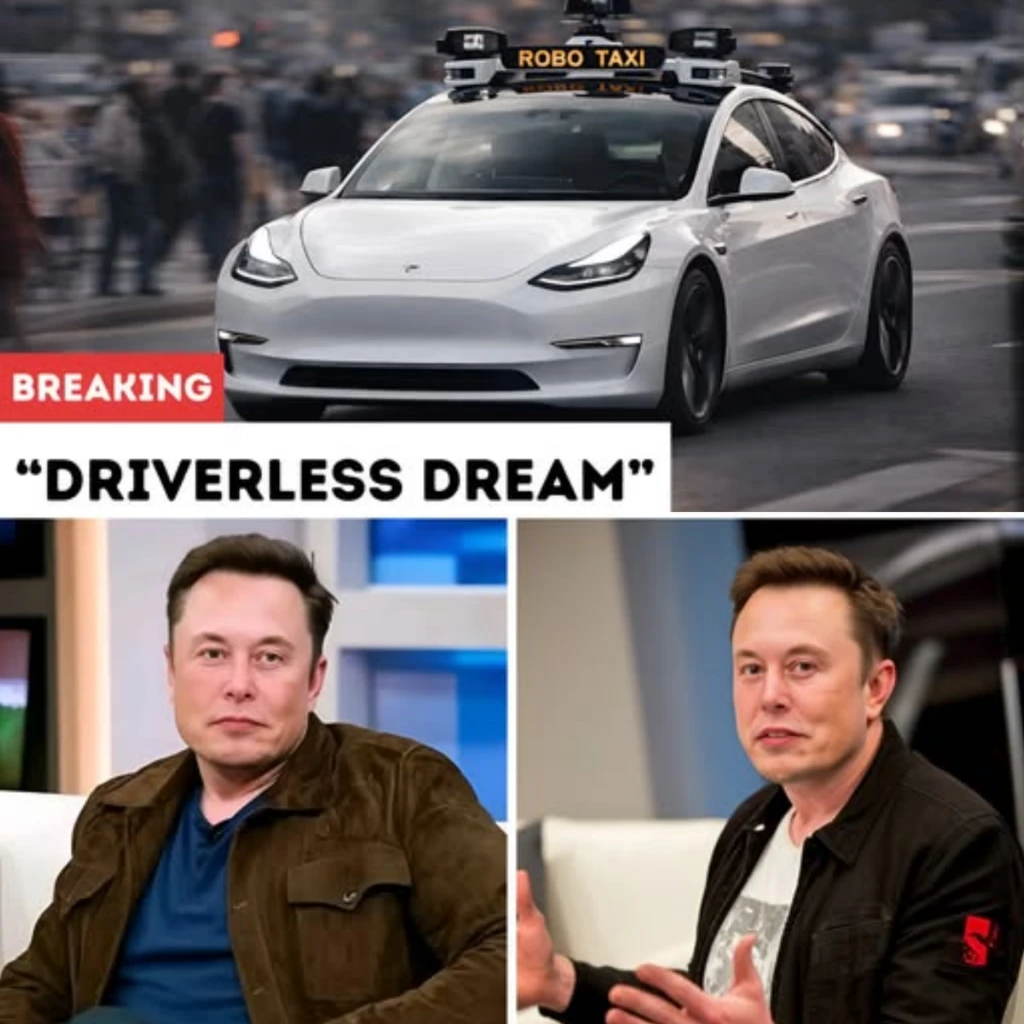
Elon Musk’s Driverless Dream: Tesla’s Robotaxi Moves From Promise to Public Roads
For years, fully autonomous driving has lived in the realm of “almost there.”
Now, Tesla, Inc. says it’s testing unsupervised Robotaxi vehicles on public roads in Texas — no safety driver, no hands on the wheel, no human in the front seat ready to intervene.
If accurate, that marks one of the boldest real-world autonomy moves yet.
And investors noticed. Tesla’s stock jumped following the announcement, reflecting renewed confidence in Elon Musk’s long-standing vision of a driverless future.
But beyond markets and momentum lies a deeper question:
Is society ready for cars that drive themselves — completely?
🚦 A Breakthrough — Or a High-Stakes Gamble?
Tesla’s Robotaxi strategy differs sharply from competitors.
While companies like Waymo have deployed autonomous ride-hailing in limited areas, they rely on:
Lidar sensors
High-definition mapping
Geofenced operational zones
Extensive hardware redundancy
Tesla takes another path:
Camera-based vision systems
Neural networks trained on billions of miles of driving data
Minimal reliance on lidar
Scalability over city-by-city mapping
Musk has argued that if humans drive using vision, AI can too.
If that philosophy proves correct, Tesla’s system could scale globally faster and at lower cost than competitors.
If it fails, the consequences will be public — and immediate.
💰 The Economic Disruption at Stake
Musk has repeatedly framed Robotaxi not as a feature, but as a new economic model.
In theory:
A Tesla could operate autonomously while its owner sleeps.
Vehicles become revenue-generating assets instead of depreciating ones.
Ride-hailing giants like Uber and Lyft face direct competition.
If scaled successfully, Robotaxi could:
✔ Reduce transportation costs
✔ Shift urban planning priorities
✔ Decrease private car ownership
✔ Reshape multi-billion-dollar mobility markets
That’s why Wall Street is watching closely.
This isn’t just about technology.
It’s about transforming transportation economics.
⚠️ Safety: The Question That Won’t Go Away
Tesla’s Full Self-Driving (FSD) system has faced scrutiny in the past over driver misuse and accident investigations.
Unsupervised public-road testing raises critical questions:
How does the system handle rare, unpredictable events?
Who carries liability in a fatal crash?
Should public streets serve as live testing environments?
Even if autonomous systems become statistically safer than human drivers, public perception will matter.
One high-profile incident could reshape regulatory policy overnight.
🧠 Tesla vs. Waymo: Two Visions of Autonomy
The divide isn’t just technical — it’s philosophical.
Waymo’s approach:
Conservative expansion
Heavy sensor stacks
Safety-first rollout
Tesla’s approach:
Rapid iteration
Vision-only AI
Broad deployment strategy
Neither path guarantees success.
The real question may be:
Which system will people trust with their lives?
🏛 Regulation and Public Trust
Autonomous vehicles challenge decades-old legal frameworks.
Current traffic laws assume a human driver. Insurance systems, liability standards, and enforcement models are built around that assumption.
Regulators now face a dilemma:
Move too slowly — risk stifling innovation.
Move too quickly — risk public safety backlash.
History shows disruptive technologies often face resistance not because they fail, but because they advance faster than society adapts.
🔮 The Road Ahead
Tesla’s Robotaxi tests in Texas could become:
A historic milestone in automation
Or a cautionary case study
If successful, fully autonomous fleets could reshape global mobility.
If not, the industry may face tighter restrictions and slower progress.
For now, Tesla is doing what it has always done:
Moving fast.
Testing publicly.
Forcing the world to react.
The future of driving may not depend on steering wheels.
It may depend on trust.
And trust — unlike software — cannot be patched overnight.