A mail-order bride arrived to find her husband dead and his farm in ashes—Then eight orphaned children looked up from a root cellar and changed everything
By the time Catherine Walsh saw the smoke, she already knew something was wrong.
It was not the kind of smoke that rises from a warm chimney at the end of a long day. It did not curl softly into the evening sky or carry the smell of supper, coffee, or split pine. This smoke was thin, gray, and bitter, dragging itself over the Nebraska prairie like the last breath of something that had fought hard before it disappeared.
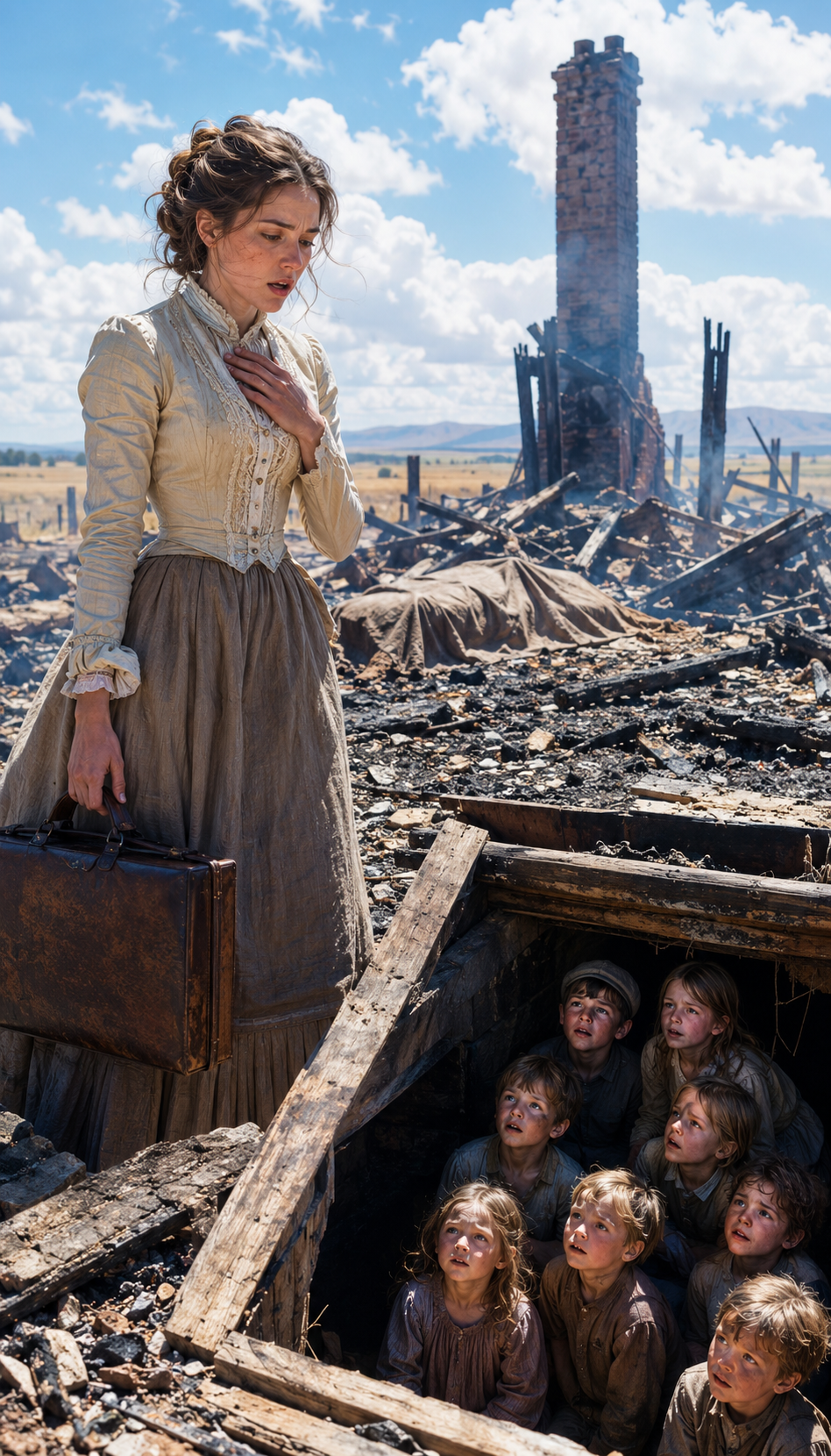
She sat in the back of Tom Parker’s wagon with her gloved hands folded tightly in her lap, staring ahead as the black shape of the homestead came into view.
For six months, that place had existed in her imagination as a promise.
Samuel Morrison had described it in letters written with careful ink and steady patience. A cabin with a stone hearth. A barn still unfinished but strong enough to hold through winter. A root cellar tucked into the slope behind the workshop. A line of cottonwoods bending near a creek. A rocking chair he had made with his own hands because he believed a woman coming so far deserved at least one comfortable place to rest.
Catherine had read those letters so many times in Philadelphia that the paper had softened at the folds.
She had pictured herself stepping down from a wagon in a clean dress, nervous but dignified. She had pictured Samuel standing near the gate, hat in hand, trying not to seem too eager. She had imagined awkward first words, a quiet meal, a marriage born not from a grand romance but from two lonely people deciding, with clear eyes, that loneliness did not have to win.
But there was no gate now.
There was no Samuel.
There was only ash.
The wagon rolled to a stop, and for a moment nobody spoke. Tom Parker climbed down first. His wife, Janet, stayed seated beside Catherine, her face pale beneath the brim of her bonnet. Even the horses seemed uneasy, shifting their weight as if the land itself had become strange.
Catherine stepped down slowly.
The prairie wind pressed against her skirt. It carried the smell of burned wood, wet earth, and something colder than autumn. The cabin was gone except for a foundation of blackened stones and a chimney that stood alone like a warning. The barn had collapsed inward, its beams twisted and charred. Tools lay scattered in the dirt. A metal kettle had melted out of shape near the old hearth. Half a book, its pages curled and black at the edges, fluttered in the wind as if still trying to be read.
Then she saw it.
The rocking chair.
Or what was left of it.
One arm remained, burned but recognizable. Samuel had written three paragraphs about that chair. He had joked that it leaned slightly to the left, but that he would fix it before she arrived. He had said he hoped one day she would sit in it beside the fire while the snow gathered outside and the world finally felt less hard.
Catherine walked toward it without breathing.
She touched the burned wood with two fingers.
And something inside her went quiet.
Not broken. Not yet.
Just quiet.
Because grief sometimes arrives too quickly for tears. Sometimes the heart refuses to understand the thing the eyes have already accepted.
Tom moved through the remains of the barn with a careful, heavy step. Janet stood close to Catherine, close enough to offer comfort but wise enough not to speak too soon.
“This wasn’t lightning,” Tom said at last.
His voice sounded older than it had that morning.
Catherine turned toward him.
He looked across the ruins, his jaw tight. “Whoever came through here knew what they were doing. Livestock’s gone. Good tools are gone. Anything they couldn’t carry, they ruined.”
Janet’s hand rose to her mouth.
Catherine looked around again, this time not as a bride, not as a woman searching for the home she had been promised, but as someone trying to understand the shape of the disaster in front of her.
There were marks in the mud near the barn. More than one horse. Deep ruts from a wagon. Splintered wood where the door had been forced. Blackened timber. Signs of a struggle. A deliberate destruction so thorough it felt personal.
“Where is he?” Catherine asked.
Nobody answered.
The wind moved through the ruins.
Samuel Morrison, the man she had traveled twelve hundred miles to marry, was nowhere to be found.
He was not waiting with an apology. He had not changed his mind. He had not abandoned her. Whatever had happened here had swallowed him whole and left only smoke behind.
Catherine had been afraid of many things on the journey west. She had been afraid Samuel might be cruel. Afraid he might be older than he claimed. Afraid the prairie might swallow her spirit. Afraid she might regret leaving Philadelphia, even though Philadelphia had given her little more than debt, grief, and locked doors.
But she had not prepared herself for this.
She had not prepared to arrive at the edge of her new life and find it burned to the ground.
Janet finally spoke, softly. “Catherine…”
The kindness in her voice nearly undid her.
Catherine straightened.
“What happened here?”
Tom removed his hat and wiped at his brow, though the air was cold. “There’s been trouble in the territory. Bands of men moving between isolated claims. They steal livestock, supplies, sometimes burn what they leave behind. Territorial authorities are stretched thin. Folks out here are far apart. Too far apart.”
“And Samuel?”
Tom looked away.
That was answer enough.
Catherine stared at the empty chimney.
For a moment, she saw her whole life as a road that had simply ended.
Her parents had died two years earlier in a tenement fire back east, leaving her with nothing but unpaid debts and a name that carried more exhaustion than hope. At twenty-six, she had been treated like a woman already past the proper doorway of life. Too old to be innocent. Too poor to be desirable. Too proud to beg. The boarding house where she lived had become more dangerous by the month, and every morning she woke with the same question pressing against her ribs.
How long can I survive like this?
Samuel Morrison’s advertisement had not felt romantic.
It had felt like a door.
A rancher in the Nebraska Territory seeking a wife of good character, strong constitution, and willingness to share the responsibilities of frontier life. Not an ornament. Not a servant. A partner.
That word had stayed with her.
Partner.
So she wrote back.
Then he wrote again.
And again.
Six months of letters became six months of imagining a different future. She had sold what little she owned, endured the long journey west, and held onto his final letter the entire way, folded inside her Bible.
Now the man who had written it was gone.
The house was gone.
The dream was gone.
Janet seemed to read the thought crossing Catherine’s face.
“You can stay with us for a little while,” she said carefully. “Tom and I will do what we can. But with five children of our own…”
“I understand,” Catherine said.
And she did.
Kindness had limits when winter was coming.
Tom and Janet Parker were good people, but good people could still have empty cupboards. A family on the prairie could not feed every tragedy that knocked on its door. Catherine had forty-seven dollars left. No husband. No legal home. No family nearby. No clear path forward.
For the first time since leaving Philadelphia, she wondered whether she had been foolish to believe the world might still make room for her.
Then something shifted in the wind.
A sound.
Small.
Barely there.
Catherine turned her head.
“What was that?”
Tom looked up. “What?”
She raised a hand for silence.
There it came again.
Not from the cabin ruins.
Not from the barn.
From behind what had once been Samuel’s workshop.
A faint scrape. Then a hush. Then something like a breath being held by more than one person.
Catherine moved before anyone stopped her.
The ground near the workshop was cluttered with fallen timber and burned boards. Behind the debris, half-hidden by prairie grass and dirt, was the door Samuel had mentioned in one of his letters.
The root cellar.
Unlike the rest of the homestead, it had survived.
The heavy wooden door was partly open, no more than a few inches. Fresh scratches marked the soil near the entrance. Someone had been there recently. Someone had gone inside.
Tom came up behind her. “Careful.”
Catherine’s heart began to pound in a way that had nothing to do with fear for herself.
She pulled the door open.
Darkness breathed out from below.
The cellar smelled of earth, apples, damp wood, and old smoke. Shelves lined the walls. Barrels stood in shadow. For a few seconds, Catherine could see nothing.
Then she heard it.
A child crying.
Not loudly. Not the open cry of a child who expects to be comforted.
This was a small, broken sound. A sound made by someone who had learned crying could be dangerous.
Catherine’s throat tightened.
“Hello?” she called gently. “We’re not here to hurt you.”
Silence.
Tom took a step down.
A whisper came from the dark.
“Please don’t come closer.”
Catherine froze.
The voice was young.
Too young.
She lowered herself to the cellar steps, keeping her hands visible.
“My name is Catherine Walsh,” she said, as calmly as she could. “This is Mr. Parker and Mrs. Parker. We came looking for Samuel Morrison. We found the house burned. We heard you. You’re safe now.”
No answer.
Then another sound.
A shuffling. A sniffle. A tiny hiccup.
Janet whispered, “Oh Lord.”
Tom climbed down first, slowly, speaking the way one speaks to frightened animals and wounded hearts.
“It’s all right,” he said. “Nobody’s going to touch you. Come toward the light if you can.”
The first child emerged with a stick in his hand.
He was a boy of about fourteen, though his eyes made him look much older. His clothes were torn and dirty. His face was gaunt. His hair stuck to his forehead. He held the stick like a weapon, but Catherine could see his hands shaking.
Behind him came seven more children.
Seven.
Catherine counted without meaning to.
A girl around twelve with her arm around a younger boy. Another girl around eleven carrying a small bundle. A boy of nine whose face was smudged with soot. A seven-year-old girl with wide eyes and chapped lips. Twin boys no older than five, both clinging to each other’s sleeves. And last, a little girl of about three, clutching a corn husk doll so tightly her knuckles had gone white.
Eight children stood in the dying light of Samuel Morrison’s burned homestead.
Eight children who looked at the adults as if adults were no longer things to trust.
The oldest boy lifted his chin.
“We didn’t take anything,” he said.
His voice cracked on the last word.
Catherine felt something inside her fracture.
“I know,” she said.
His eyes narrowed. “You don’t know that.”
“No,” she admitted. “But I believe it.”
The boy seemed confused by that.
Catherine knelt, slowly, so she was not towering over them.
“What’s your name?”
He hesitated.
The little girl with the doll whimpered and pressed herself against his leg.
The boy’s face changed instantly. Not soft, exactly. But protective.
“Marcus,” he said. “I’m Marcus.”
Catherine nodded. “Marcus. Are these your brothers and sisters?”
He swallowed.
“Yes.”
“What are their names?”
He looked at the children as if counting them was the only thing keeping him from falling apart.
“Lucy,” he said, nodding toward the twelve-year-old girl. “Rebecca. Michael. Sarah. Jacob and Joshua. And Emma.”
Emma hid her face in Lucy’s skirt.
“How long have you been down there?” Janet asked softly.
Marcus blinked, trying to measure time from inside terror. “Three nights. Maybe four.”
Catherine closed her eyes for one second.
Three or four nights underground.
Hungry.
Afraid.
Listening for the return of the men who had destroyed everything.
Tom’s face had hardened, but he kept his voice gentle. “Where are your folks, son?”
The question passed through the group like cold water.
Lucy looked down.
Rebecca hugged the bundle in her arms.
Marcus stared at the burned cabin and said, without expression, “Gone.”
No child should be able to say that word so flatly.
No child should have to.
Catherine did not ask him to explain more. She did not need details. The truth stood in front of her in eight thin bodies, eight sets of hollow eyes, eight children who had survived by hiding in a stranger’s cellar because the world above them had become too dangerous.
Janet began crying silently.
Tom turned away, jaw clenched.
Catherine stayed on her knees.
She looked at Marcus, then Lucy, then Rebecca, then little Emma’s doll.
And in that moment, something impossible happened.
Her future, which had seemed to end in ash, moved.
Not backward.
Forward.
Not the way she had imagined.
Not in a white dress beside Samuel Morrison.
Not with a simple marriage and a ready-made home.
But there, in the smoke and ruin, Catherine Walsh understood with a clarity that almost frightened her:
She had not come all this way for nothing.
She had come for them.
“You’re coming with me,” she said.
Marcus stiffened. “Where?”
“With us. To town tonight. You’ll eat. You’ll sleep somewhere warm. After that, we’ll decide what comes next.”
He looked suspicious. “Folks always say that before they split children up.”
Catherine heard Janet draw in a breath.
Marcus had said it like he already knew too much about the way the world worked.
“No,” Catherine said. “I’m not splitting you up.”
“You can’t keep us,” he said.
“Maybe not by ordinary sense,” Catherine replied. “But ordinary sense has not done much for any of us today.”
For the first time, Lucy looked directly at her.
“You don’t even know us.”
Catherine’s eyes stung.
“No,” she said. “But I know what it is to stand in the world with nowhere to go.”
That was the first honest bridge between them.
Small.
Fragile.
But real.
They rode back to Kearney that evening in near silence.
The wagon was crowded. Janet wrapped the younger children in blankets. Tom drove with both hands tight on the reins. Catherine sat near the back with Emma asleep against her side and Sarah leaning against her knee despite trying not to.
Marcus did not sleep.
He sat at the edge of the wagon, eyes on the road behind them, guarding everyone with a boy’s body and a man’s burden.
Catherine watched him in the fading light.
She wondered what kind of world forced a fourteen-year-old to become a wall.
At the hotel, the owner hesitated when he saw the children. Eight hungry, dirty children did not look like paying guests. They looked like trouble, and trouble cost money.
Catherine paid for one small room with coins she could not afford to spend.
The children ate bread, stew, and apples in silence. Not because they were calm. Because hunger had trained them to focus. Emma fell asleep halfway through chewing. Jacob and Joshua curled together on the floor with their boots still on. Lucy refused the bed until the younger ones had blankets. Rebecca hid part of her bread in her pocket, and when Catherine noticed, she pretended not to.
Marcus stayed by the door.
“Marcus,” Catherine said quietly. “You can rest.”
He shook his head.
“They might come.”
“Not here.”
“You don’t know that.”
He was right.
She did not.
So she did not insult him with false comfort.
Instead, she pulled a chair near the door and sat down beside him.
“All right,” she said. “Then we’ll keep watch together.”
He looked at her, surprised.
“You don’t have to.”
“I know.”
The night stretched long.
Children slept in uneven breaths. Somewhere downstairs, men laughed in the saloon, the sound strangely cruel because life had continued so easily for everyone else. Janet had gone home to her own family after promising to return in the morning. Tom had ridden to speak with the sheriff.
Catherine sat beside Marcus until his head finally dipped forward.
Even then, he fought sleep.
“You said you wouldn’t split us up,” he murmured.
“I meant it.”
“People mean things until they get hard.”
Catherine looked at him.
That sentence told her more about his life than any confession could.
“You’re right,” she said. “So don’t trust my words yet. Watch what I do.”
His eyes closed before he could answer.
Catherine stayed awake until dawn.
By morning, reality arrived with the cold precision of a ledger.
She had forty-two dollars left after the hotel room and food.
Eight children needed clothing, shoes, food, blankets, care, and legal protection.
She had no husband.
No house.
No employment.
No family.
The Parkers could help briefly, but they could not absorb nine extra souls. The sheriff could take a statement, but he could not rebuild lives. The church ladies could donate quilts, but quilts were not a future.
Everyone in town seemed to have an opinion.
Some kind.
Some practical.
Some disguised cruelty as concern.
“You’re a brave woman,” one merchant said, “but bravery doesn’t feed children.”
A widow at the church told her, “The little ones might be placed with families. The older ones could hire out.”
Marcus heard that.
Catherine saw his face close like a door.
Hire out.
A polite phrase that meant sending children into other people’s homes to work for room and board, with no guarantee of kindness.
Lucy held Emma tighter.
That afternoon, Catherine went alone to the territorial land office.
The clerk behind the desk looked up when she entered, then looked back down as if she had wandered into the wrong room.
“I need to file a claim,” she said.
He raised his eyebrows.
“A claim?”
“Yes.”
“For land?”
“That is generally what one files a land claim for.”
His mouth tightened. “Name?”
“Catherine Walsh.”
“Married?”
“No.”
“Widowed?”
“No.”
“Then what business—”
“The Homestead Act allows single women to file,” Catherine said, placing both hands on the desk. “I have read the requirements. I am of age. I intend to improve the land and reside upon it.”
The clerk studied her as if searching for the crack in her nerve.
“What parcel?”
She told him.
His expression changed. “Morrison’s place?”
“Yes.”
“That land has seen trouble.”
“I am aware.”
“The cabin’s burned.”
“I am aware.”
“There are men who may still have interest in that area.”
“Then I will have to become very uninteresting to them.”
He stared at her.
She did not look away.
At last, he pulled the papers from a drawer.
Signing her name felt like stepping onto thin ice.
Catherine Walsh.
Ink on paper.
A name where Samuel’s future had ended and something else was beginning.
When she returned to the hotel, Marcus was waiting outside the room.
“You went somewhere.”
“I filed a land claim.”
“For what?”
“For Samuel’s place.”
His face hardened. “Why?”
“Because we need land.”
“We need not to go back there.”
The hallway seemed to narrow around them.
Catherine lowered her voice. “Marcus, I know you’re afraid.”
His eyes flashed. “I’m not afraid.”
“You are. And you have every right to be. Fear kept you alive. But it cannot be the only thing that decides your life now.”
He looked away.
“That place is bad.”
“No,” Catherine said. “What happened there was bad. The land did not do it. The cabin did not do it. The creek did not do it. The root cellar saved you.”
He said nothing.
She continued, more gently. “If we stay in town, they will separate you. Not because they are all cruel, but because eight children are too many for one household and too inconvenient for everyone else. If we go back, we have a chance to remain together.”
“With what?” he demanded. “You got money hiding somewhere?”
“No.”
“Tools?”
“Very few.”
“Animals?”
“No.”
“Seed?”
“Not yet.”
“Then you’re talking about dying slower.”
The words struck hard because they were not childish.
They were reasonable.
Catherine took the blow and stood inside it.
“Then help me make a better plan.”
Marcus blinked.
She stepped closer. “You know this prairie. You know what grows, what can be trapped, where the creek runs deepest, what wood burns longest. Lucy can cook. Rebecca knows plants. Michael can help with water and kindling. The twins can gather. Sarah can learn. I can sew, keep accounts, read contracts, write letters, barter, and work until my hands forget they were ever soft. Alone, none of us has enough. Together, we may.”
His expression shifted, just slightly.
Not agreement.
But thought.
That was enough.
Over the next week, Catherine learned that survival was not one grand decision but a hundred humiliating conversations.
She asked for credit.
She asked for scraps.
She asked for broken tools, bent nails, torn coats, old flour sacks, cracked dishes, and anything else the respectable people of Kearney were willing to part with once they understood the items were too poor to be sold.
Some gave with genuine compassion.
Some gave because Janet Parker had a way of making refusal feel shameful.
Some gave because Catherine stood in front of them with a dignity so calm it made mockery difficult.
Tom Parker helped her secure basic tools: an axe with a worn handle, a saw missing teeth, a shovel, a hammer, two lanterns, a small stove, and enough nails to make a beginning but not enough to make anything easy.
Janet brought blankets and a cast-iron pot.
The church women donated clothing, though not without commentary.
Dr. William Hayes, the only physician in town, arrived at the hotel on the third day and asked to see Catherine privately.
He was a lean man with tired eyes and a doctor’s habit of looking closely without seeming to stare.
“I hear you intend to take the children back to Morrison’s claim,” he said.
“I do.”
“Most would call that impossible.”
“Most are not responsible for eight children.”
That almost made him smile.
“I’ve been wanting a way station northeast of town,” he said. “Settlers out that way are too far from help. Riders get hurt. Women go into labor. Children take fever. Travelers get stranded. If you can provide emergency shelter and basic care, I can supply you with bandages, simple medicines, instructions, and a small monthly payment.”
Catherine stared at him.
It was not salvation.
But it was a rope.
“You would trust me with that?”
“I trust desperate people when their desperation has direction,” he said. “And from what I hear, yours does.”
She accepted before pride could interfere.
The morning they left Kearney, the sky was sharp and blue, the kind of autumn brightness that makes everything look cleaner than it is.
Their belongings fit in one wagon.
Eight children. One woman. A handful of tools. Blankets. Food enough for a little while. Papers proving Catherine’s claim. A doctor’s box. A Bible. Samuel’s letters. A small pouch of coins.
That was all.
As the wagon rolled out, Catherine felt the eyes of the town on her back.
Some people pitied her.
Some admired her.
Some were waiting for failure.
She decided not to spend energy on any of them.
The prairie opened wide ahead.
Beside her, Marcus kept his gaze forward.
Lucy held Emma.
Rebecca watched the grass as if already searching for useful things.
Michael sat with the twins, whispering something that made Joshua almost smile.
Sarah leaned against Catherine’s side without realizing she had done it.
When the burned homestead came into view again, every child went silent.
The ruins looked worse in daylight.
More final.
For a few moments, nobody moved.
Then Catherine climbed down.
She did not make a speech. She did not tell them to be brave. She knew by then that children who had survived what they had survived did not need lectures about courage.
She walked to the root cellar door, opened it, and looked down into the dark.
“This saved you,” she said. “Tonight, it shelters us. Tomorrow, we start building.”
Marcus stood behind her.
“And if the men come back?”
Catherine looked across the land Samuel had once believed could become a home.
“Then they will find more than ashes this time.”
The first weeks were brutal.
Not dramatic.
Brutal in the plain, grinding way that real hardship is brutal.
Hands blistered. Shoulders ached. Food disappeared too quickly. The children woke from nightmares. Emma cried for a mother whose name Catherine did not yet know how to say without breaking the room. The twins clung to Marcus so tightly he could barely work. Lucy moved through tasks with the stiff efficiency of a girl determined not to need comfort. Rebecca collected roots and berries with a seriousness that made her seem like a small scholar of survival. Michael tried to be useful everywhere and often ended up exhausted before noon.
Catherine made mistakes.
So many mistakes.
She split wood badly. She burned biscuits. She misjudged the weather. She cut her palm trying to repair a latch. She cried once behind the remains of the barn where nobody could see her, then wiped her face and returned because crying did not stack firewood.
But she learned.
She learned how to listen when Marcus said a cloud bank meant trouble.
She learned which boards could be salvaged and which would collapse under weight.
She learned that Lucy hummed when she was afraid.
She learned that Sarah loved stories but pretended not to.
She learned that Emma would only sleep if someone rubbed slow circles between her shoulders.
She learned that grief in children does not come in one shape.
Marcus became harder before he became softer.
He challenged Catherine constantly, not because he wanted her to fail, but because part of him needed to know whether she would leave when the work became unbearable.
“You’re holding the axe wrong.”
“Then show me.”
“That won’t hold in wind.”
“Then teach me how to brace it.”
“You shouldn’t promise the little ones things.”
“I promise what I intend to keep.”
“Intending don’t matter.”
“It matters to me.”
He would glare.
She would continue working.
Day by day, the argument between them changed. It stopped being about whether she should lead and became about how they would survive.
The root cellar became their first home.
They cleaned it, reinforced the door, added straw ticks along the walls, hung blankets for privacy, and made shelves for supplies. It was cramped, damp, and too dark, but it was theirs. Catherine called it temporary. The younger children called it the burrow. Marcus called it a hole until one cold night when the wind screamed over the prairie and the cellar held warm enough to keep Emma from shivering. After that, he stopped insulting it.
The cabin began as a line of stones.
Then a frame.
Then a wall.
Then another.
Tom Parker came when he could. Two neighboring homesteaders arrived once with a team and helped raise beams, though they made it clear they could spare no more time. Dr. Hayes visited with supplies and lessons, teaching Catherine how to clean wounds, reduce fevers, recognize danger signs, and keep records of every traveler she helped.
“You write everything down,” he told her. “Names, dates, symptoms, supplies used, payment if any. A woman alone with children must keep records better than any man keeps a rifle.”
Catherine understood.
Paper could become protection.
So every night, by lantern light, she wrote.
Food inventory.
Weather.
Work completed.
Debts owed.
Medical supplies used.
Names of visitors.
And, in a separate notebook, every detail the children remembered about the men who had attacked their family and Samuel’s place.
She did not press them. She never dragged memories from them like roots from hard soil. But when they volunteered something, she wrote it down.
A gray horse with one white ear.
A man with a scar across his thumb.
A laugh that sounded like coughing.
A wagon wheel with a broken spoke bound in iron.
A brand mark that looked altered.
A smell of expensive tobacco.
Individually, they were fragments.
Together, they began to look like a map.
The first snow came early.
Not heavy, but enough to warn them.
Catherine stood outside the half-built cabin and watched white settle over black earth. For a moment, despair reached for her again. Winter did not care about determination. Winter did not admire noble intentions. Winter simply arrived and asked whether you had prepared.
They had not prepared enough.
That was the truth.
But they had prepared more than anyone expected.
The root cellar held potatoes, beans, cornmeal, dried apples, and what Rebecca had gathered. Marcus and Michael had set traps. Lucy had sewn old flour sacks into curtain panels and patched every garment twice over. Catherine had bartered mending work for salt, candles, and coffee. Dr. Hayes’ monthly fee had purchased a milk goat so stubborn the twins named her Queen Victoria.
On the first truly cold night, all nine of them crowded underground while wind moved over the cellar door like a living thing.
Emma woke crying.
Not loudly.
Just enough.
Lucy reached for her, but Catherine was already there.
The little girl pressed her face into Catherine’s shoulder. “I want Mama.”
The room went still.
No one spoke.
There were sentences Catherine could have said. Gentle ones. Useless ones. She chose the truth.
“I know,” she whispered. “I wish I could bring her here.”
Emma cried harder.
Catherine held her.
Then Sarah crawled over and leaned against Catherine’s other side.
Then Jacob.
Then Joshua.
Then Michael.
Lucy turned away, wiping her face quickly, but Rebecca took her hand.
Marcus sat in the shadows, jaw tight.
Catherine looked at him over Emma’s head.
For once, he did not look angry.
He looked fourteen.
The next morning, he called her Miss Catherine for the last time.
After that, he called her Catherine.
It sounded like trust, though neither of them said so.
The way station’s first real test came in December.
A rider arrived near dusk, half-frozen and shaking, leading a horse with an injured leg. His name was Elias Grant, a freight driver separated from his wagon after a storm. He had ridden toward the Morrison claim because he remembered smoke there once, and smoke meant people.
Catherine brought him inside.
Lucy heated broth.
Marcus took the horse.
Rebecca helped Catherine prepare bandages.
The younger children watched from the corner, wide-eyed but quiet.
Elias looked around the root cellar and the unfinished cabin beyond it, taking in the odd household: one unmarried woman, eight children, a goat, a doctor’s box, and enough determination to make the air feel warmer.
“You folks running a hospital out of a hole in the ground?” he asked weakly.
“Only until the walls are finished,” Catherine said.
He laughed, then winced.
They kept him alive through the night.
By morning, the storm had passed. Elias paid with two silver dollars, a sack of oats, and a promise to tell others that the Walsh Station was real.
Catherine did not correct the name.
Walsh Station.
It sounded impossible.
Then it sounded useful.
By January, travelers knew to look for the lantern near the creek.
By February, settlers began stopping even when they were not desperate. A woman brought eggs in exchange for thread. A blacksmith passing through repaired Catherine’s stove plate for a meal and news. A circuit preacher stayed one night and left behind a hymnal. A trapper brought hides and taught Marcus a better snare.
The cabin walls rose slowly.
So did their reputation.
But reputation has a way of drawing not only friends.
One evening in late February, Marcus came back from checking traps with his face pale.
“Riders,” he said. “Three miles west. Moving slow.”
Catherine felt every child in the room hear him.
“How many?”
“Four. Maybe five.”
Travelers came from the south road, not the west grass.
The west meant open country.
The west meant men who did not want to be seen until they were close.
Catherine did not panic.
Panic wastes time.
“Lucy, take the little ones to the cellar. Rebecca, bring the doctor’s box and records. Michael, water inside. Marcus, with me.”
He looked at her. “You should hide too.”
“I will not teach them this home is something we abandon at every shadow.”
“This isn’t a shadow.”
“No,” she said. “That is why we prepare.”
They put out the main lantern and left one low light near the cabin frame. Tom Parker had helped rig a bell line along the lower approach, made from scrap metal and wire. Marcus checked it. Catherine placed the records box beneath a loose floorboard. Then she stood in the open with her shawl around her shoulders and her heart beating hard enough to hurt.
The riders appeared at the edge of the property just as dusk folded the prairie into blue.
There were four.
They did not ride like lost men.
They rode like men deciding what a place was worth.
The one in front had a coat too fine for the trail and a hat pulled low. Catherine could not see his face clearly, but she smelled tobacco when the wind shifted.
Not cheap tobacco.
Expensive.
Behind her, Marcus went very still.
Catherine understood.
This was a fragment from the notebook.
The man smiled.
Even in low light, Catherine disliked the smile.
“Evening,” he called. “Didn’t know anyone was living here.”
Catherine stepped forward. “Now you do.”
His eyes moved over the half-built cabin, the cellar door, the stacked wood, the goat pen, the laundry frozen stiff on a line.
“Widow?”
“No.”
“Man of the place around?”
“No.”
His smile widened.
Marcus’s hand tightened around the axe handle at his side.
Catherine spoke before the boy could. “This is a registered claim and a medical way station under Dr. Hayes of Kearney. If you need shelter, state your name and business. If not, ride on.”
The man looked amused.
“Quite a speech.”
“Quite a cold evening to waste.”
One of the riders behind him laughed.
The leader leaned slightly in the saddle. “A place like this can be dangerous without protection.”
“We are protected.”
“By who?”
Catherine let the silence stretch.
Then she said, “By records.”
His expression changed.
Only for a second.
But she saw it.
Men like him were not afraid of women. Not usually. Not out here. They were not afraid of children or burned houses or winter.
But records were different.
Records could travel into town. Records could sit on a sheriff’s desk. Records could carry names farther than bullets. Records could become testimony.
Catherine continued, calm as a blade. “Every traveler who stops here is written down. Every rider seen. Every brand. Every direction. Dr. Hayes collects my reports monthly. Sheriff Wilkes has been informed of prior trouble on this claim. So if you are here honestly, give your names and warm yourselves. If you are not, I suggest you consider how many people will know you came.”
The man’s horse shifted beneath him.
Marcus stared at the rider’s hand.
At his thumb.
Catherine saw it too.
A pale scar across the base.
Another fragment.
The man tipped his hat.
“No need for unpleasantness.”
“I agree.”
“We were only passing.”
“Then pass.”
For one long moment, nothing moved.
Then the rider turned his horse.
The others followed.
Only when they disappeared into the dark did Catherine realize her knees were shaking.
Marcus did not speak until the bell line stopped trembling in the wind.
“That was him,” he said.
“One of them?”
He nodded.
“The tobacco. The thumb. I remember.”
Catherine turned toward the cellar.
Eight lives depended on what she did next.
Not revenge.
Justice.
There is a difference.
Revenge rushes.
Justice records.
That night, Catherine wrote everything.
Time.
Number of riders.
Descriptions.
Direction.
Words exchanged.
The scar.
The tobacco.
The horse.
Marcus sat beside her, adding details when she asked. His voice remained steady until he mentioned the laugh from one of the men behind the leader. Then it broke.
Catherine put down the pen.
“We can stop.”
He shook his head.
“No. Write it.”
So she did.
In March, the thaw began.
Mud swallowed the yard. The creek rose. The cabin roof leaked in two places, which meant they had a roof to complain about. Catherine considered that progress.
Walsh Station became known across that corner of the territory not as a comfortable stop, but as a reliable one. Travelers might sleep on a hard floor and eat thin stew, but they would be treated fairly. No one left hungry if Catherine could help it. No child was turned away. No woman traveling alone was made to feel unsafe.
The children changed too.
Not all at once.
Healing is rarely cinematic when you are inside it.
Emma began speaking more. She named the goat queen of everything and insisted her doll needed breakfast. The twins stopped flinching whenever the cellar door opened. Sarah learned to read from Samuel’s old books, the surviving pages patched and stitched together like the family itself. Michael became proud of his ability to carry water without spilling. Rebecca kept a notebook of plants and remedies, written in careful letters Catherine taught her by lantern light.
Lucy was harder.
Lucy did everything well and asked for nothing. She cooked before being told. She mended until her fingers cramped. She braided Emma’s hair and checked the twins’ socks and moved through the household like a second mother, which was exactly why Catherine worried.
One evening, Catherine found her outside near the creek, scrubbing a pot long after it was clean.
“You can stop,” Catherine said.
Lucy kept scrubbing.
“It’s already clean.”
“I know.”
“Then why continue?”
Lucy’s shoulders rose, then fell.
“If I stop, I think.”
Catherine sat beside her on a flat stone.
The creek moved dark and silver under the moon.
For a while, they listened to water.
Then Lucy said, “She used to sing when she washed.”
“Your mother?”
Lucy nodded.
“I hated it sometimes,” she whispered. “The same song over and over. I used to wish she’d stop.”
Catherine said nothing.
Lucy’s hands tightened around the pot.
“Now I can’t remember the whole tune.”
That was the sentence that broke her.
Not the loss itself. The fear of losing the shape of what had been loved.
Catherine reached for her, slowly enough that Lucy could refuse.
Lucy did not refuse.
She cried without sound at first. Then with sound. Then with all the force she had been using for months to remain useful.
Catherine held her beside the creek until the moon rose higher.
The next morning, Lucy slept late.
Nobody commented.
Marcus made breakfast badly.
Everyone ate it anyway.
Spring brought grass, repairs, and trouble.
Sheriff Wilkes arrived one afternoon with two men Catherine did not know. One was the land clerk. The other wore a wool coat too clean for the road and introduced himself as Mr. Ansel Whitcomb, a supply agent with business interests across the territory.
Catherine disliked him immediately.
Not because he was openly rude.
Because he was smooth.
Smooth men were often more dangerous than rough ones. Rough men showed the blade. Smooth men smiled while measuring where it should go.
Whitcomb removed his hat. “Miss Walsh, I’ve heard much about your admirable efforts.”
“Have you?”
“Indeed. A woman taking in orphaned children. Establishing a station. Quite stirring.”
The sheriff looked uncomfortable.
Catherine noticed.
“What brings you here?”
Whitcomb glanced at the land clerk. “A question of ownership.”
Catherine felt Marcus appear behind her, silent.
The children had learned to listen from corners.
The clerk cleared his throat. “There may be prior obligations attached to this property. Mr. Morrison owed debts.”
“Samuel Morrison wrote to me for six months,” Catherine said. “He mentioned no debts that endangered his claim.”
Whitcomb smiled sadly. “Men do not always disclose financial embarrassment to prospective brides.”
The insult was wrapped in velvet.
Catherine did not touch it.
“What debt?”
Whitcomb produced papers.
Catherine took them.
At first glance, they looked official. Samuel’s name appeared. A sum large enough to crush any hope she had. Collateral language. Livestock. Tools. Improvements. Claim interest if abandoned.
But Catherine had kept Samuel’s letters.
She knew his handwriting.
And the signature on the paper was wrong.
Not dramatically wrong. Not enough for a careless person to notice. But Samuel formed his capital M with a distinct downward stroke. This paper did not.
Catherine looked up.
“When was this signed?”
Whitcomb answered smoothly. “Late summer.”
“Samuel wrote to me two days after this date,” Catherine said. “He mentioned purchasing hinges for the barn and a milk cow. Strange behavior for a man who had just borrowed against everything he owned.”
“Debtors often maintain appearances.”
Catherine folded the paper once.
“I will have Dr. Hayes and Sheriff Wilkes compare this signature to Samuel’s letters.”
Whitcomb’s eyes cooled.
The sheriff shifted his weight.
“That would be prudent,” he said.
Whitcomb gave him a sharp look.
Catherine saw then what the man had expected. A frightened woman. A woman grateful to be spoken to at all. A woman overwhelmed by children and mud and debt. A woman who would see a legal paper and surrender.
He had not expected a former Philadelphia woman who had survived landlords, debt collectors, church committees, railroad agents, and grief.
He had not expected records.
“I also have written descriptions,” Catherine said, “of riders who approached this claim in February. One carried expensive tobacco. One had a scar on his thumb. One rode a gray horse with one white ear. Would those descriptions interest you, Mr. Whitcomb?”
His smile vanished.
Only for a heartbeat.
But enough.
“I meet many men in my business.”
“I imagine you do.”
The sheriff looked from Catherine to Whitcomb.
Something changed in his face.
Suspicion, perhaps.
Or shame.
After they left, Marcus followed Catherine into the cabin.
“That paper was fake?”
“I believe so.”
“He’s with them.”
“I believe that too.”
“Then why didn’t the sheriff take him?”
“Because belief is not proof.”
Marcus slammed his fist against the wall hard enough to rattle a pan.
Catherine caught his wrist.
Not harshly.
Firmly.
“I know.”
“You don’t!”
His voice cracked.
“They get to ride away. They get to smile. They get papers and coats and everyone listens because they look clean. My parents—”
He stopped.
The room went silent.
Catherine’s hand remained on his wrist.
Marcus looked horrified by his own words, as if saying parents aloud had opened a door he had nailed shut.
Catherine let go of his wrist and stepped closer.
“They do not get to win simply because justice is slow,” she said.
His eyes filled, and he turned his face away.
She did not force comfort on him.
She simply stood there until he stopped shaking.
That night, the household began its most important work.
Not building.
Not planting.
Not mending.
Preparing the case.
Samuel’s letters were laid out on the table beside Whitcomb’s paper. Catherine compared handwriting by lantern light. Rebecca, precise and observant, noticed the ink differed. Lucy remembered her father once warning that stolen livestock often passed through “respectable” supply men before disappearing into distant markets. Marcus drew the altered brand mark he had seen. Michael remembered the wagon wheel bound in iron.
Dr. Hayes, when shown the papers, became very still.
“I treated Samuel Morrison in August,” he said. “He came to town for supplies and paid in cash. He was not a man borrowing heavily.”
“Can you write that?”
“I can.”
Tom Parker examined the wagon description and said he had seen one matching it behind Whitcomb’s warehouse weeks before the attack.
“Can you write that?”
He could.
Janet Parker collected statements from women who had heard things men assumed women would not understand. A laundress had washed a shirt with a torn cuff and expensive tobacco smell. A stable boy had seen a gray horse with one white ear tied behind the supply office. A freight hand had heard Whitcomb complain about homesteaders who refused to sell.
Piece by piece, the map became a road.
Still, the danger grew.
A fence post was cut.
A stack of hay was scattered.
One morning, Catherine found a dead lantern placed on the cabin threshold.
A warning.
She picked it up, carried it inside, and set it on the table.
The children stared.
“What does it mean?” Sarah whispered.
Catherine looked at the blackened glass.
“It means someone is afraid of light.”
Then she cleaned the lantern and hung it higher than before.
By May, the cabin was finished enough to hold a table, stove, shelves, and nine beds built narrow and close. It was not beautiful in the way Samuel had imagined. The floor sloped slightly. Smoke sometimes backed down the chimney. The door stuck in damp weather. But when rain came, they stayed dry. When wind came, the walls held. When travelers arrived, they saw not a ruin but a place.
A home.
The first night they all slept above ground, Emma asked if the bad men could still find them.
Catherine tucked the blanket under her chin.
“They may know where we are,” she said. “But they do not know who we have become.”
Emma considered that.
“Are we scary?”
Catherine smiled.
“To the right people, I hope so.”
Summer came golden and relentless.
The garden struggled, then surprised them. Beans climbed poles. Corn pushed through stubborn soil. Rebecca’s herbs grew near the cabin door. Queen Victoria the goat remained tyrannical but useful. Marcus traded labor for a young mule no one else wanted because it bit. The mule bit Marcus once, then apparently respected him.
They named him General Sherman.
Walsh Station became a place people spoke of with a peculiar mixture of admiration and disbelief.
“Woman out there raising eight children.”
“Runs a station too.”
“Stood down riders.”
“Filed papers against Whitcomb.”
“Children work like a proper crew.”
“Cabin’s rough, but there’s always a lantern.”
The last part mattered most.
There was always a lantern.
Catherine made sure of it.
No one approaching in honest need would ever wonder whether help existed there.
But Whitcomb did not disappear.
Men like him rarely vanish when exposed. They become more careful.
His mistake came in August.
A covered wagon arrived at Walsh Station near midnight. Inside was a young mother with a feverish child and a husband nearly frantic from two days on bad roads. Catherine and Rebecca worked through the night under Dr. Hayes’ instructions. The child improved by dawn.
The father, a quiet man named Nathan Bell, noticed Marcus staring at one of his wagon wheels.
“Something wrong with it?” Nathan asked.
Marcus crouched.
The wheel had an old break repaired with an iron brace.
His face went white.
Catherine saw.
Nathan raised both hands. “I bought this wagon used in Kearney. Three weeks ago. From Whitcomb’s yard.”
Catherine asked, carefully, “May we inspect it?”
By then, Nathan owed her his child’s comfort and perhaps more. He agreed.
Under the wagon bed, half-covered by mud, Marcus found a carved mark.
Not a brand.
A child’s mark.
Two small letters cut into the wood: L and M.
Lucy made a sound behind them.
Catherine turned.
Lucy was staring at the mark as if the world had tilted.
“My father carved that,” she whispered. “For me and Marcus. He said when the wagon got old, we’d still know it was ours.”
The wagon had belonged to the children’s family.
The same wagon that should have burned or vanished after the attack had passed through Whitcomb’s business and been sold like any ordinary item.
This was no longer a story built only on memory.
This was physical proof.
Catherine sent for Sheriff Wilkes.
This time, he came quickly.
By evening, the wagon sat in front of the station, and half a dozen men from nearby claims stood around it, silent and grim. Nathan Bell gave a statement. Lucy identified the carving. Marcus identified the wheel repair. Tom Parker identified the wagon as matching the one he had seen behind Whitcomb’s warehouse. Dr. Hayes documented everything in his clean medical hand because he understood, better than most, that neat writing could make truth harder to dismiss.
Sheriff Wilkes removed his hat.
“I should have looked harder sooner,” he said.
Catherine did not absolve him.
Not because she was cruel.
Because some guilt should be carried long enough to become useful.
“Look harder now,” she said.
He did.
Whitcomb was arrested two days later, not in a dramatic shootout, not in the grand style dime novels prefer, but in the back office of his supply warehouse, surrounded by ledgers he had assumed no one would ever read closely.
Men like Whitcomb trusted distance. They trusted fear. They trusted the silence of the poor, the scattered, the grieving, and the dead.
He had not counted on Catherine Walsh teaching eight children that memory mattered.
He had not counted on a scarred boy watching everything.
He had not counted on a twelve-year-old girl remembering two carved letters beneath a wagon bed.
He had not counted on women talking.
He had not counted on a lantern in the dark becoming a place where stories gathered and turned into evidence.
The trial was held in Kearney when the heat still lay heavy over the streets.
Catherine did not want to bring the children.
But Marcus insisted.
Lucy too.
“They did it to us,” Marcus said. “We should be there when people finally say it out loud.”
Catherine understood.
The courtroom was crowded. Some came for justice. Some came for spectacle. Some came because they had done business with Whitcomb and wanted to know how close evil had stood to respectability.
Whitcomb looked smaller without his smooth confidence.
His lawyer spoke of confusion, false accusations, unreliable children, frontier hysteria, and a woman overwhelmed by responsibility.
Catherine sat still through all of it.
She had learned something on the prairie.
Storms spend themselves faster when you stop arguing with the wind.
Then the evidence came.
The forged loan document.
Samuel’s letters.
The altered brands.
The wagon.
The carved initials.
The statements.
The descriptions.
The tobacco.
The gray horse.
The scar.
One of Whitcomb’s hired men, facing charges of his own, finally chose to speak. Not nobly. Not because conscience had bloomed in him overnight. Because men like that often mistake betrayal for survival.
He confirmed enough.
Not everything.
Enough.
Enough to show that Samuel Morrison had refused to cooperate with Whitcomb’s scheme. Enough to show that isolated families had been targeted for profit. Enough to show that the destruction of the Morrison place had not been random, and the children’s family had been caught in the same cruel machinery.
Catherine kept her eyes on her hands while the testimony unfolded.
She did not let the younger children hear the worst of it. Janet Parker kept them outside with lemonade and shade. But Marcus and Lucy stayed.
Marcus’s face did not change.
Lucy held Catherine’s hand under the bench.
When the verdict came, the courtroom did not erupt.
Real justice often sounds quieter than people expect.
A few gasps.
A chair scraping.
A woman crying softly.
Sheriff Wilkes lowering his head.
Whitcomb staring straight ahead as if the world had personally offended him by noticing what he was.
Marcus exhaled.
That was all.
Just one breath.
But Catherine heard months of weight leave with it.
Outside, the town seemed too bright.
People approached them awkwardly. Some offered apologies. Some offered praise. Some tried to make themselves part of the story now that the story had turned honorable.
Catherine accepted what was useful and ignored what was not.
Dr. Hayes stood beside her on the courthouse steps.
“You did something rare,” he said.
“What?”
“You made people look.”
Catherine watched Marcus kneel to speak with Emma, who had run up holding a cup of lemonade with both hands.
“No,” she said. “They made me look. I only refused to look away.”
By autumn, the claim looked nothing like the ruin Catherine had first seen.
The cabin stood square against the wind. The barn had begun again, smaller but stronger. A garden lay behind a fence. The root cellar was full. The way station had a sign now, painted by Michael in letters slightly uneven but proud:
WALSH STATION
Catherine had protested the name once.
The children overruled her.
“It’s what everyone calls it,” Sarah said.
“It’s ours,” Rebecca added.
Marcus said nothing, but he was the one who hung the sign.
The first anniversary of their arrival came with a cold sky and a prairie wind that smelled like snow.
Catherine woke before dawn and stepped outside.
The land was quiet.
No smoke.
No screams.
No riders in the dark.
Only the cabin behind her, warm with sleeping children, and the lantern beside the door, still burning.
She walked to the place where Samuel’s first cabin had stood. The blackened stones had been moved into the new hearth. It seemed right. Nothing wasted. Not even ruin.
In her pocket was Samuel’s final letter.
She had carried it for more than a year.
For a long time, she had thought of him as the man she never got to marry. A promise interrupted. A life stolen before it could begin.
But now, standing in the gray morning, she understood him differently.
Samuel Morrison had not given her the future he described.
He had given her a road to the place where she was needed.
That did not make the loss fair.
It did not make tragedy gentle.
But it gave the grief somewhere to stand.
The cabin door opened behind her.
Marcus stepped out, pulling on his coat.
“Couldn’t sleep?” he asked.
“No.”
He came to stand beside her.
He was taller than when she first found him, though still too thin in the wrists. His face had changed. Not softened entirely, but steadied. He no longer looked like a boy holding a collapsing world with both hands.
He looked like someone who had set part of the weight down.
“You thinking about him?” Marcus asked.
“Samuel?”
“Yeah.”
Catherine nodded.
Marcus looked across the land.
“I used to think if he hadn’t had that cellar, we’d be gone too.”
“So did I.”
“And if you hadn’t come…”
She turned to him.
He stopped, uncomfortable with the size of the sentence.
Catherine saved him from finishing it.
“If you hadn’t survived,” she said, “I would have gone back east believing my life had ended.”
He looked at her.
“You really would’ve left?”
“I don’t know. Maybe. I had no plan.”
“That’s strange.”
“What is?”
“You always seem like you have a plan.”
Catherine laughed softly.
“Marcus, most of adulthood is pretending you have a plan while carrying a hammer and hoping the wall stays up.”
He almost smiled.
For Marcus, that was sunlight.
After a while, he said, “Emma asked if she can call you Mama.”
Catherine’s breath caught.
The prairie blurred.
Marcus kept his eyes forward, pretending the question was casual though it clearly was not.
“What did you tell her?” Catherine asked.
“I told her to ask you.”
“And what do you think?”
He swallowed.
“I think she already does. Just not out loud.”
Catherine pressed her gloved hand against her mouth.
The word was too large. Too sacred. Too complicated.
She had not given birth to these children. She had not known their first steps, first words, first fevers. She could not replace the mother whose song Lucy still tried to remember. She would never ask to.
But love is not always born at the beginning.
Sometimes love arrives late.
Sometimes it climbs out of a cellar, hungry and terrified, and dares you to become worthy of it.
When Emma finally asked that evening, she did so while Catherine was kneading bread.
The little girl stood beside the table, doll tucked under one arm.
“Catherine?”
“Yes, sweetheart?”
Emma twisted her fingers in her apron.
“If I call you Mama, will my real Mama be sad?”
Every sound in the cabin stopped.
Lucy turned from the stove.
Rebecca looked down at her mending.
Marcus froze by the door.
Catherine wiped flour from her hands and knelt.
“No,” she said, voice trembling. “I think your first mama loved you so much that she would want you to have arms around you. As many as this world can give.”
Emma studied her face.
“Can I have two?”
Catherine’s eyes filled.
“Yes.”
Emma nodded, satisfied.
Then she wrapped her arms around Catherine’s neck and whispered, “Mama.”
Catherine held her carefully at first.
Then tightly.
Around them, the household remained silent, not because there was nothing to say, but because some moments are too delicate for words.
Later that night, after the bread was baked and the children slept, Catherine sat at the table with the account book open before her.
She wrote the date.
Then she paused.
For months, her records had been practical. Weather. food. repairs. debts. visitors. incidents.
But that night, she turned to a clean page and wrote something else.
Today Emma called me Mama.
She stared at the sentence.
Then added:
I was afraid my heart would not know what to do with such a gift. But it did.
Years later, people would tell the story of Walsh Station in many different ways.
Some said Catherine Walsh was the bravest woman in the Nebraska Territory.
Some said she was foolish and simply survived long enough for foolishness to look like courage.
Some said the children saved her.
Some said she saved them.
The truth was less tidy and more beautiful.
They saved one another.
Catherine gave them shelter, food, law, patience, and a name no one could take from them.
They gave her purpose, laughter, terror, noise, laundry, broken sleep, impossible responsibility, and a love so fierce it burned away the last of the life she thought she had lost.
Marcus eventually became the kind of man people trusted with hard things. Not because he was fearless, but because he knew fear and did not worship it. Lucy became known for her cooking, her sharp mind, and the way she could quiet a crying child with one half-remembered song. Rebecca studied with Dr. Hayes and learned medicine from the ground up, first herbs, then bandages, then books. Michael could fix nearly anything with wire and patience. Sarah read every surviving page in the house and then every book travelers left behind. Jacob and Joshua grew into mischief, muscle, and loyalty. Emma, who once climbed out of a dark cellar with a doll in her arms, grew up believing every home should keep a lantern lit for strangers.
And Catherine?
Catherine never did become the wife Samuel Morrison expected.
She became something else.
A claimant.
A station keeper.
A mother by choice.
A woman who arrived too late for one life and just in time for another.
The prairie did not become gentle. Winters still came hard. Crops still failed some years. Travelers still arrived with trouble at their backs. Money was never abundant. The roof still leaked in storms no matter how often Marcus swore he had fixed it.
But the house held.
That was the miracle.
Not that nothing bad ever happened again.
Only children believe safety means the absence of danger.
Adults learn, if they are honest, that safety is sometimes a locked door, a warm stove, a written record, a neighbor willing to ride through snow, and one person standing in front of a frightened child saying, with no proof except love:
You are not alone anymore.
On the day Catherine received the final certificate proving her claim, five years after she first signed her name at the land office, the entire household gathered outside Walsh Station.
The paper was official. Dry. Plain. Almost ugly in its lack of poetry.
But Catherine held it as if it were a crown.
Marcus, now nearly a man, stood beside her.
“You did it,” he said.
Catherine looked at the cabin, the barn, the garden, the sign, the lantern, the children lined in various stages of pride and embarrassment.
“No,” she said. “We did.”
Tom and Janet Parker came for supper that evening. Dr. Hayes brought coffee, sugar, and a book for Rebecca. Sheriff Wilkes, older and humbler, arrived with two sacks of flour and stood awkwardly near the door until Catherine invited him in.
They ate outside because the cabin could not hold everyone comfortably. The sun lowered over the prairie. The children laughed. Queen Victoria tried to steal bread. General Sherman brayed at exactly the wrong moment and made even Marcus grin.
After supper, Janet found Catherine standing near the creek.
“You ever think about what your life might’ve been if Samuel had been waiting that day?” Janet asked.
Catherine watched the lantern glow in the distance.
“Yes.”
“And?”
Catherine considered the question.
She owed the truth to the dead and to herself.
“I think I might have been content,” she said. “Maybe even happy. Samuel seemed like a good man.”
Janet nodded.
“But this,” Catherine continued, looking back at the noisy, imperfect, impossible family gathered around the fire, “this made me larger than happiness.”
Janet’s eyes softened.
“That sounds heavy.”
“It is.”
“Worth it?”
Catherine smiled.
Every tired bone in her body knew the answer.
“Yes.”
That night, after everyone left and the children went to bed, Catherine stepped outside alone.
The prairie stretched wide and dark.
Above her, the stars looked close enough to gather in her hands.
She thought of Philadelphia, of smoke and loss, of the boarding house, of the advertisement she almost did not answer. She thought of Samuel writing letters by lamplight, never knowing the woman who read them would one day build a family from the ashes of his land. She thought of eight children climbing out of darkness, blinking against the sun.
She thought of the first time she had touched the burned rocking chair and believed the story was over.
How little she had known.
The story had not ended there.
It had begun there.
Because sometimes life does not open the door you prayed for.
Sometimes it burns that door to the ground.
Sometimes it leaves you standing in the smoke with empty hands, a shattered plan, and no map forward.
Then, from somewhere beneath the ruin, you hear the smallest sound.
A cry.
A whisper.
A life still waiting.
And if you are brave enough, or desperate enough, or broken enough to answer, you may discover that the thing you thought was the end was only the first line of a much greater story.
Catherine Walsh came west to become a wife.
Instead, she became the reason eight children lived long enough to laugh again.
And every night after that, no matter how cold the wind became, no matter how dark the prairie stretched, no matter how many strangers rode past looking for shelter, Walsh Station kept one promise burning in the window.
A lantern.
A light.
A warning to cruel men.
A welcome to the lost.
And proof that even on land once reduced to ash, a family could still rise.